

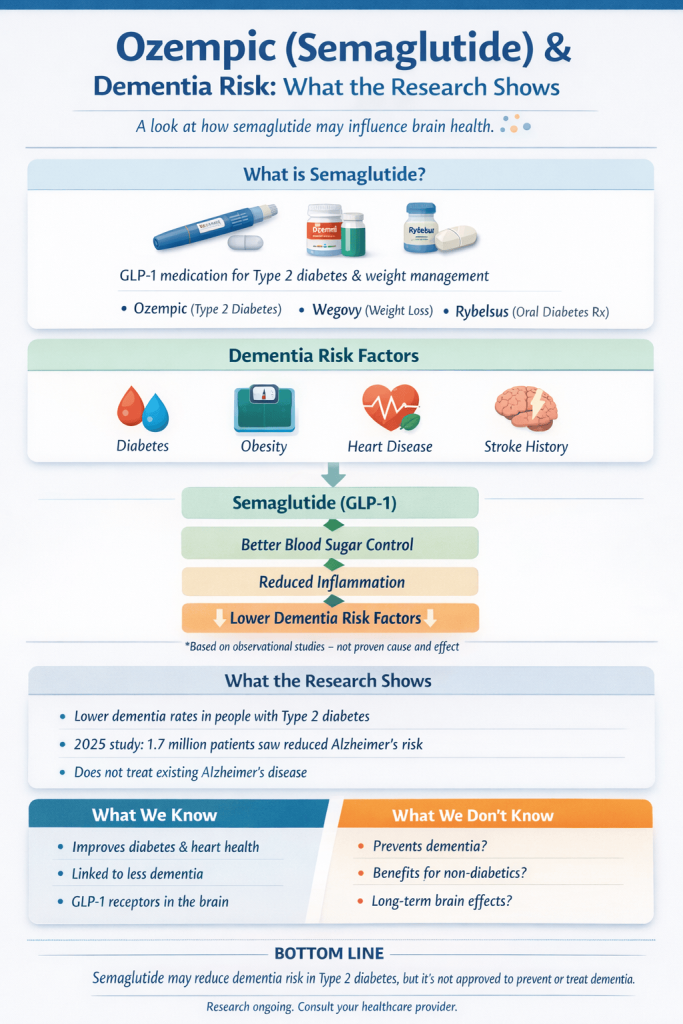
Semaglutide, the active ingredient in Ozempic, may be associated with a lower risk of dementia in people with Type 2 diabetes, according to large observational studies. Researchers believe this may be due to improved blood sugar control, reduced inflammation, and better cardiovascular health. However, current evidence does not prove cause and effect, and semaglutide is not approved to prevent or treat dementia.
What Is Ozempic (Semaglutide)?
Semaglutide is a medication that belongs to a class called GLP-1 receptor agonists (glucagon-like peptide-1). These drugs mimic a naturally occurring hormone that helps regulate blood sugar, appetite, and insulin release.
Semaglutide is available under several brand names: each approved for different uses:
- Ozempic (injectable)
FDA-approved for treating Type 2 diabetes in adults. It is also approved to lower the risk of heart attack, stroke, and cardiovascular death in people with Type 2 diabetes and heart disease, and to reduce kidney-related complications in those with chronic kidney disease. - Wegovy (injectable and oral)
FDA-approved for chronic weight management in people age 12 and older with obesity or overweight. Wegovy is also approved to reduce cardiovascular risk in certain adults and to treat metabolic dysfunction–associated steatohepatitis (MASH). - Rybelsus (oral)
FDA-approved for treating Type 2 diabetes in adults.
As experts continue to study semaglutide, it’s becoming clear that its effects may extend beyond blood sugar and weight — potentially influencing brain health as well.
Why Is Dementia Risk Higher in Certain People?
Dementia is not a single disease but a group of conditions that affect:
- Memory
- Thinking and reasoning
- Communication
- Ability to perform daily self-care
People are at higher risk for dementia if they have certain medical conditions, including:
- Type 2 diabetes
- Obesity
- Heart disease
- A history of strokes or mini-strokes
Because semaglutide directly improves several of these conditions, researchers are investigating whether it could also reduce dementia risk.
Types of Dementia Linked to Diabetes
Two forms of dementia are especially common among people with diabetes.
Alzheimer’s dementia develops when abnormal proteins — amyloid plaques and tau tangles — accumulate in the brain. These disrupt communication between nerve cells and eventually lead to cell death.
Vascular dementia is caused by damage to blood vessels supplying the brain, often due to atherosclerotic cardiovascular disease. It is common after strokes and is strongly associated with diabetes and heart disease.
Understanding these mechanisms helps explain why treatments that improve metabolic and cardiovascular health may influence dementia risk.
Can Semaglutide Lower the Risk of Dementia? What the Research Shows
It’s still too early to say definitively, but recent research is encouraging.
Large observational studies have found that people with Type 2 diabetes who take semaglutide — and other GLP-1 medications — appear to have lower rates of Alzheimer’s dementia, vascular dementia, and stroke compared to those using other diabetes treatments.
However, most of these studies are retrospective, meaning they analyze existing data rather than testing treatments in real time. While useful, these studies cannot prove cause and effect.
What Did the 2025 Semaglutide Dementia Study Find?
To get closer to cause-and-effect answers, researchers conducted a target-trial emulation in 2025. This approach uses real-world electronic health records to simulate what a randomized clinical trial might show.
In this study, researchers analyzed health records from more than 1.7 million people with Type 2 diabetes in the United States. They found that individuals taking semaglutide had a significantly lower risk of developing Alzheimer’s disease compared to those using other diabetes medications.
Important Limitations to Keep in Mind
While promising, this research comes with important caveats:
- It still does not prove that semaglutide directly prevents dementia
- The findings apply only to people with Type 2 diabetes
- The exact mechanism of brain protection remains unclear
For now, these results should be viewed as encouraging but not conclusive.
Does Age Affect Dementia Risk With Semaglutide?
Most studies have focused on middle-aged and older adults with Type 2 diabetes, typically those over age 50. There is currently no clear evidence that semaglutide reduces dementia risk in younger adults or in people without diabetes.
Researchers continue to explore whether earlier metabolic control may provide long-term brain protection, but age-specific recommendations are not yet available.
Can Semaglutide Treat Alzheimer’s or Other Dementias?
So far, evidence suggests no.
Two large randomized controlled trials — EVOKE and EVOKE+ — studied whether oral semaglutide could slow the progression of early Alzheimer’s disease. These trials involved thousands of participants across 38 countries.
According to study organizers, semaglutide did not slow Alzheimer’s progression more than placebo, and the planned extension of the trials was cancelled.
This indicates that semaglutide may be more relevant for risk reduction, not treatment.
How Might Semaglutide Affect Brain Health?
Researchers have proposed two main theories.
Reducing Dementia Risk Factors
Semaglutide improves key risk factors linked to dementia, including:
- Blood sugar control
- Insulin resistance
- Obesity
- Cardiovascular health
Interestingly, some studies found reduced dementia risk even in people without obesity, suggesting that semaglutide’s effects may extend beyond weight loss alone.
Potential Neuroprotection
GLP-1 receptors are present in the brain, and GLP-1 acts as a neurotransmitter. Animal studies suggest GLP-1 medications may reduce brain inflammation, improve neuronal signaling, and protect nerve cells. Whether these effects fully translate to humans is still under investigation.
How to Lower Your Risk of Dementia
While medications may play a role in the future, lifestyle choices remain one of the most powerful tools for protecting brain health.
Some risk factors cannot be changed, such as age and genetics. Others may be difficult to avoid, including brain injury or environmental factors.
However, research shows that addressing modifiable risks can significantly reduce dementia risk, including:
- Managing high blood pressure
- Limiting alcohol use
- Quitting smoking
- Staying physically active
- Maintaining social connections
- Managing diabetes effectively
If you’re concerned about dementia risk, a healthcare professional can help assess your individual situation and guide next steps.
How Care and Support Matter as Risk Increases
For individuals with diabetes or early cognitive changes, supportive care plays a critical role. Assistance with medication management, healthy routines, physical activity, and social engagement can help protect quality of life and independence.
As cognitive health changes, in-home care and companion support may become essential for safety, dignity, and daily well-being.
The Bottom Line
Large new studies suggest that people with Type 2 diabetes who take semaglutide may be less likely to develop dementia — but current evidence does not prove cause and effect. Semaglutide is not approved for preventing or treating dementia, and recent trials show it does not slow Alzheimer’s progression. Still, its benefits for metabolic, cardiovascular, and kidney health make it an important medication — and a promising area of ongoing research. As science continues to explore the connection between metabolism and brain health, semaglutide offers a glimpse into how future treatments may one day support both body and mind.

