
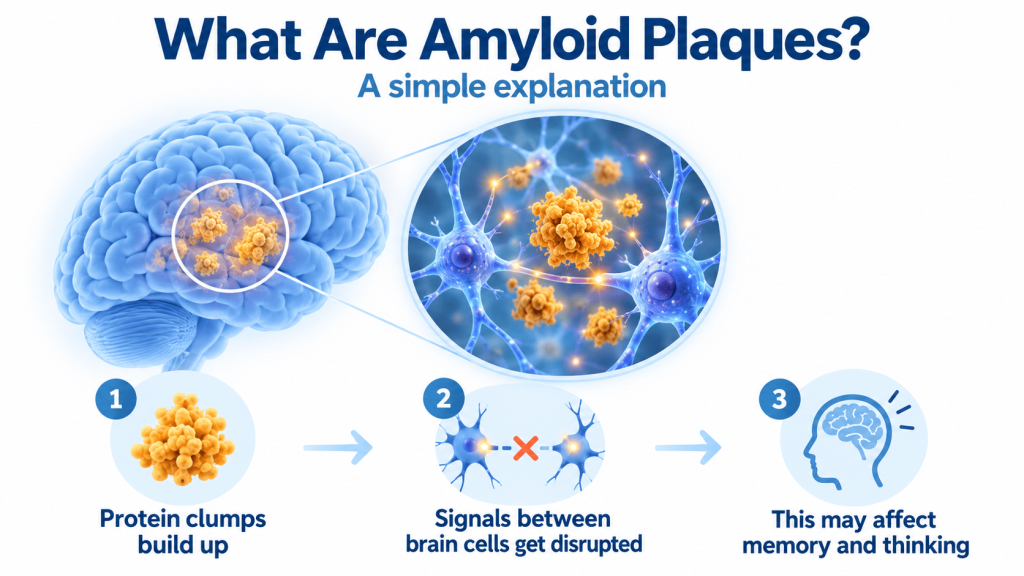
When families first hear the phrase “amyloid plaques,” the terminology is quite complex. Simply put, an amyloid plaque is an unusual accumulation of beta-amyloid protein that is deposited between brain cells. It is considered one of the biological features of Alzheimer’s disease.
They are significant, but not all there is to it.
Alzheimer’s disease is also characterized by the presence of unusual tau proteins, inflammation, impaired communication between brain cells, and ultimately the death of brain cells. The National Institute on Aging states that beta-amyloid and tau may interact with other processes when Alzheimer’s disease develops.
This knowledge is crucial for caregivers of people with memory loss because it will allow them to understand why the doctors are doing what they do.
Exactly What Are Amyloid Plaques?
Beta-amyloid is a protein fragment that is created from a larger protein called amyloid precursor protein or APP.
In the brain, there are multiple forms of beta-amyloid protein. The beta-amyloid 42 form is particularly prone to clumping. If there is an abnormal amount of these proteins present in the brain between neurons, then they can create plaques which may be disruptive to brain cell activity.
This does not mean that all memory problems are due to amyloid. It means that amyloid is one of the key biological indicators of Alzheimer’s disease.
How Do Amyloid Plaques Affect the Brain?
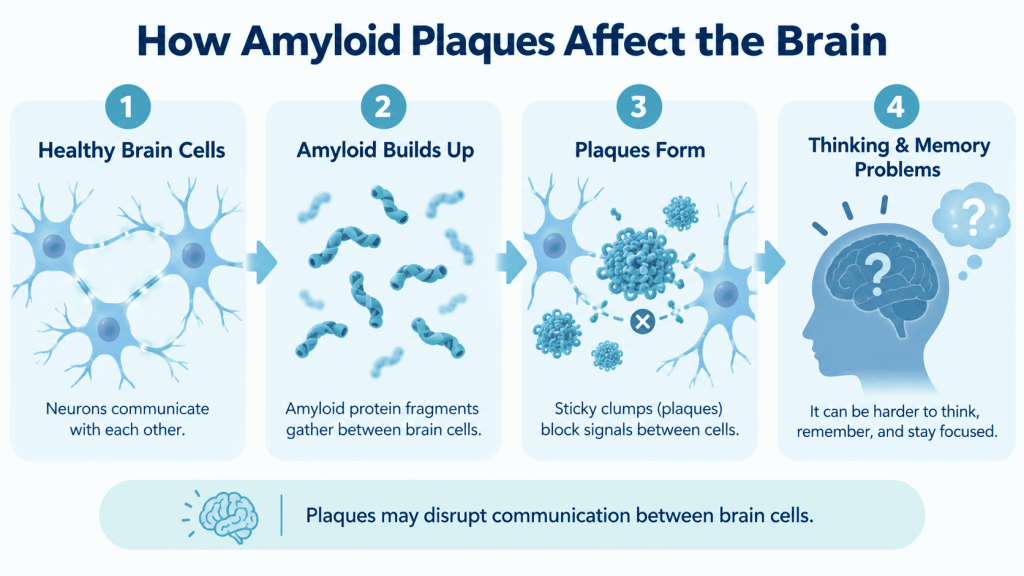
To put it simply, the brain consists of billions of nerve cells exchanging signals with each other all the time.
Amyloid plaques develop between such cells, while tau tangles form in the brain cells themselves. With time, such developments might affect the brain’s ability to exchange information and deliver substances. Eventually, connections between neurons will be destroyed and some parts of the brain might start shrinking.
A Simple Way to Understand the Alzheimer’s Care Picture
| Brain Change | Where It Happens | Why It Matters |
|---|---|---|
| Amyloid plaques | Between brain cells | Abnormal beta-amyloid clumps can interfere with normal cell function. |
| Tau tangles | Inside brain cells | Abnormal tau can disrupt the cell’s internal transport system. |
| Loss of connections | Between neurons | Brain cells become less able to communicate effectively. |
| Inflammation | Around damaged brain tissue | Chronic immune activity may contribute to further brain cell injury. |
| Brain atrophy | Across affected brain regions | Brain tissue can shrink as neurons become damaged and die. |
Why is the Amyloid Plaque so Important in Alzheimer’s Disease?
This substance has been extensively researched since it has the ability to accumulate in the brain even years before any signs of dementia are observed.
Moreover, this substance can be measured even before death by using various imaging techniques. PET imaging and new biomarkers help to detect changes associated with Alzheimer’s disease much faster.
Furthermore, the importance of this substance was reinforced due to the recent medications targeting it.
Can Doctors See Amyloid Plaques?
Yes, in certain cases.
An amyloid PET scan is one such tool which enables physicians to see the amyloid plaques in the brain. According to Alzheimer’s Association, amyloid PET is useful in certain clinical conditions where a possible diagnosis of Alzheimer’s disease is unclear and has a potential impact on the treatment decisions being made.
It is critical to mention that a PET scan alone cannot provide sufficient information.
A doctor may consider various factors including cognition testing, symptoms, medical history, blood or cerebrospinal fluid biomarkers, medication, among others.
Does the Presence of Amyloid Automatically Mean that One Is Suffering from Dementia?
No. This is a crucial point.
One may have amyloid even when no problems in terms of memory or cognition arise. This is the first reason why amyloid testing is regarded as being a part of an overall evaluation rather than a test itself.
According to the new 2025 recommendations by the Alzheimer’s Association, the use of PET scans of amyloid and tau is supposed to be complementary to the full clinical examination.
Can Amyloid Plaques Be Removed?
They can be, and this is perhaps the most groundbreaking development in Alzheimer’s treatment in recent history.
Two anti-amyloid drugs – lecanemab and donanemab – have been fully approved by the FDA in cases of certain people with early Alzheimer’s disease. They are supposed to diminish amyloid plaques and decrease cognitive decline in patients in some cases.
One of these drugs is Kisunla, or donanemab-azbt.
It is approved for Alzheimer’s disease, and according to the FDA, it should be used on people with mild cognitive impairment or mild dementia, who were involved in clinical trials.
What Changes Might Families Notice at Home?
Early Alzheimer’s can look different from one person to another, but common changes may include:
- Repeating the same questions
- Forgetting recent conversations
- Missing appointments
- Struggling with bills or medications
- Becoming confused by familiar routines
- Getting lost in places that were once familiar
- Needing more help with meals, dressing, or personal care
As the disease progresses, the amount of support needed often increases.
The goal should not be to correct every mistake. It should be to preserve dignity, reduce unnecessary stress, and support as much independence as is safely possible.
How Assisting Hands Can Help With Alzheimer’s and Dementia Care
For most people, the medical diagnosis is just the start of a bigger problem. The daily routine is when the challenges truly arise.
At Assisting Hands Home Care, we provide non-medical assistance for Alzheimer’s and dementia to ensure that elderly patients live in their own homes while providing additional assistance to their family members.
The type of care provided includes help with bathing and dressing, preparing meals, taking medicine, companion services, transportation, light housekeeping, running errands, and keeping a regular schedule.
In the case of a memory-impaired person, it is very important to provide the consistency of care. In particular, consistency of carers, routines and conversations may help to avoid confusion.
Home care cannot eliminate amyloid plaques but can definitely help in practical issues related to having Alzheimer’s.

