571-506-4264
main-ah-logo-horz-w_gradbox
 
  • About Us
    • Meet the Team
    • Industry Statistics
    • Our Caregivers
    • Hospital Readmission Penalties
    • How to Pay for Home Care
  • Careers
  • Home Care services
    • Alzheimer’s and Dementia Care
    • Personal Care & Companionship
    • Senior In Home Care
    • After Surgery Care Care
    • Stroke Recovery Home Care
    • Orthopedic Home Care
    • Parkinson’s Home Care
    • Respite Care Services
    • Transitional Care
    • Veterans Aid and Attendance
    • Hiring an Agency vs. Direct Caregiver
    • Full List of Services
  • Service Area
    • Gainesville, VA
    • Chantilly, VA
    • Centreville, VA
    • Haymarket, VA
  • Blog
  • Ask a Question

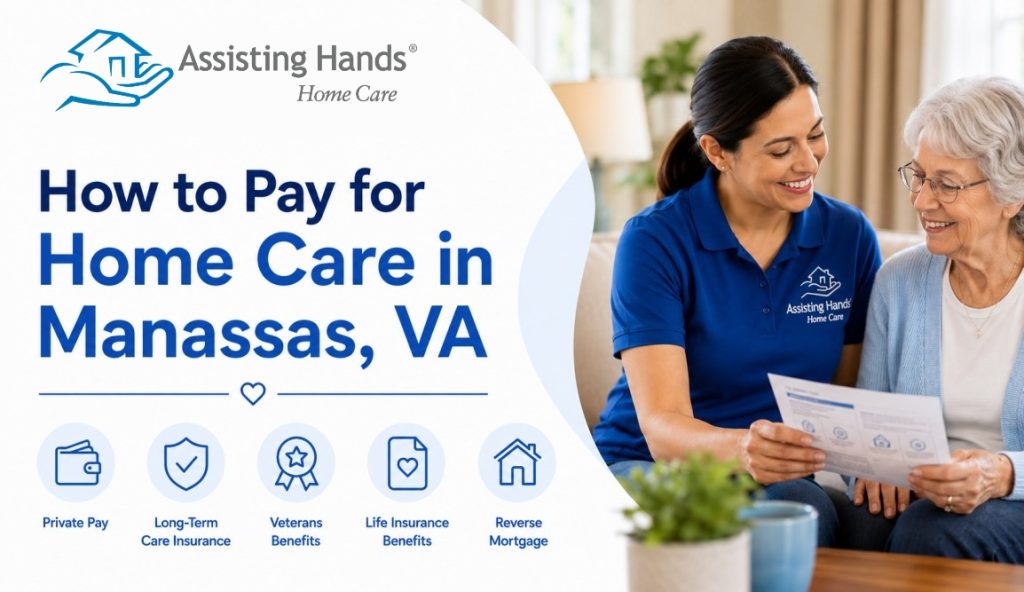
How to Pay for Home Care in Manassas, VA

How to pay for Care

When an aging parent, spouse, or adult family member begins needing assistance at home, one of the first questions families ask is, “How are we going to pay for care?”

The cost of in-home care can feel overwhelming, especially when a loved one’s needs change unexpectedly after a fall, hospitalization, surgery, illness, or new diagnosis. However, families may have more payment options than they initially realize.

The costs of home care could be covered by personal savings and income, long-term care insurance, veteran benefits, certain Medicaid plans in Virginia, life insurance proceeds, home equity, or any combination thereof.

Understanding these options can help your family create a plan that supports your loved one’s safety, independence, and quality of life at home.

What Is Nonmedical Home Care, and What Services Does It Include?

Non-medical home care helps seniors and adults with disabilities, chronic conditions, mobility limitations, or other daily challenges remain safely and comfortably at home.

Depending on the individual’s needs, a caregiver may assist with:

  • Bathing, grooming, and dressing
  • Toileting and incontinence care
  • Walking and mobility
  • Transfers and positioning
  • Fall prevention
  • Meal preparation
  • Medication reminders
  • Light housekeeping
  • Laundry and changing linens
  • Transportation and errands
  • Personal care and companionship
  • Respite for family caregivers
  • Alzheimer’s and dementia care
  • Overnight supervision
  • Assistance following a hospital or rehabilitation stay

Non-medical home care differs from home health care. Home health care is a form of medical care provided to the patient in his own home through the licensed nurses and therapists according to a medically-approved program. Non-medical care assistants mainly help in personal care, supervision, household work, and companionship.

Home Care Payment Options at a Glance

Payment Option How It May Help Important Consideration
Private Pay Uses personal savings, retirement income, Social Security, pensions, investments, or family contributions. Offers flexibility, but families should consider how long their financial resources may last.
Long-Term Care Insurance May help pay for qualifying in-home care services when policy requirements are met. Coverage, waiting periods, benefit limits, and approved-provider requirements vary by policy.
Veterans Benefits Eligible veterans and surviving spouses may qualify for benefits, including VA Aid and Attendance, to help offset care expenses. Applicants must meet military service, financial, medical, and pension eligibility requirements.
Life Insurance Benefits Certain policies may provide funds through riders, accelerated benefits, policy loans, surrender, or other options. Accessing funds may reduce the death benefit or result in fees, interest, taxes, or other financial consequences.
Reverse Mortgage Eligible homeowners age 62 or older may access part of their home equity while continuing to live in the home. A reverse mortgage is a loan and may reduce the home equity left for a spouse, family members, or heirs.
Combined Funding Families may combine savings, retirement income, insurance, veterans benefits, home equity, and family contributions. Each funding source should be reviewed for possible effects on taxes, benefits, and long-term finances.

Can Families Use Private Pay for Home Care?

Absolutely, Families can use personal savings, retirement income, Social Security benefits, pensions, investments, or any other personal funds for paying for home care services.

Private pay gives families the flexibility to choose their preferred home care agency, schedule, and level of support without waiting for insurance or government approval. Many families start with a few hours of care a week and build up the schedule based on need.

Few private-pay resources include:

  • Personal savings
  • Retirement income
  • Social Security or pension income
  • Investment income
  • Contributions from family members

Does Long-Term Care Insurance Pay for Home Care in Manassas?

Yes, many long-term care insurance plans provide financial support for qualifying in-home care. This is subject to the specifics of each policy in terms of its limitations and terms.

The payment usually starts when a person requires assistance in performing some ADLs, such as bathing, getting dressed, eating, using the toilet, transferring, and continence care. Some plans also provide coverage of care due to Alzheimer’s disease or any other qualifying cognitive impairment.

Prior to the start of the care, it is necessary to clarify the waiting period, the sum of the benefit, and other necessary criteria.

Can Veterans Benefits Help Pay for Home Care?

Yes. Qualified veterans and their surviving spouses can be eligible for benefits that will help lower the costs of home care.

The VA Aid and Attendance can provide an additional payment to those qualified applicants who need assistance with their everyday activities or fulfill some other criteria of the program. The eligibility can depend on military service, discharge, income, assets, medical needs, and the number of daily care.

The families can contact the Department of Veterans Affairs, Veterans Service Officer, or an authorized representative of the VA to check their eligibility.

How Can Life Insurance Help Pay for Home Care?

Certain life insurance policies may allow the policyholder to access or convert benefits to help pay for home care.

Options may include a long-term care rider, chronic illness rider, accelerated death benefit, policy loan, policy surrender, or life settlement. The available options will vary from one type of insurance policy to another.

Accessing this money will have some implications for future death benefits or fees, interest, taxes, or public benefits. It is advisable that families consult with the insurance company and a professional.

Is a Reverse Mortgage an Option for Paying for Home Care?

Reverse mortgages could be an alternative for some homeowners above 62 years who would like to tap into their home equity to cover their care cost but wish to stay in the house.

The money could be offered by way of monthly payments, line of credit, lump sum payments, or any combination of the three forms.

The homeowner must continue paying property taxes, homeowners insurance, and maintenance costs. Families should consult a HUD- certified housing counselor because the loan could impact the spouse and heir.

Why Do Families Combine Multiple Payment Sources?

This is because a single source might be insufficient to meet the whole expense.

A good example would be where a family utilizes retirement income for the daily needs, insurance for the eligible service, veterans’ aid to minimize out-of-pocket expenses, and finally, savings and family funding to settle the remainder.

This will ensure that the funds stretch further to ease the burden on one individual.

Questions Families Ask About Paying for Home Care


How Much Does Home Care Cost in Manassas, VA?

The cost of home care in Manassas varies based on how often care is needed, the type of support provided, and the length of each visit. A senior who needs a few hours of companionship each week will usually have a different cost than someone who requires daily personal care, overnight supervision, or 24-hour assistance.

Several factors can affect the total cost, including:

  • Number of care hours per week
  • Personal care or mobility needs
  • Dementia or memory care support
  • Evening, weekend, or overnight visits
  • Short-term or ongoing care
  • Minimum visit requirements

Because every person’s needs are different, the best way to estimate the cost is through a home care consultation. Assisting Hands Home Care Manassas can review your loved one’s routine, safety concerns, and level of assistance to recommend an appropriate care schedule.

Is Home Care Covered by Health Insurance?

Traditional health insurance usually does not cover ongoing nonmedical home care. It is more likely to cover medically necessary services provided by nurses, therapists, or other licensed professionals.

Some private insurance and Medicare Advantage plans may provide limited in-home support benefits. Families should confirm the covered services, approved providers, authorization requirements, and out-of-pocket costs directly with the plan.

Does Medicare Pay for an In-Home Caregiver?

Medicare does not cover ongoing nonmedical personal care, companionship, housekeeping, or 24-hour service when this is all that is required.

It may cover limited home health aide services when the person also qualifies for skilled nursing or therapy. Medicare-covered home health care is different from ongoing nonmedical home care.

How Does Virginia Medicaid Help With Home Care?

Virginia Medicaid may cover certain home and community-based services for people who meet financial, medical, and functional criteria for eligibility.

Eligibility will depend on which particular program or waiver applies, an authorized care plan and approved hours, as well as participation of the selected provider in Medicaid.

It is recommended that families verify their eligibility and provider participation prior to beginning any home care services.

Is Sharing Home Care Costs With Family an Option?

Yes. Adult children, siblings, and other relatives may divide home care expenses or contribute in different ways.

A written family plan can explain:

  • How much each person will contribute
  • Who will manage payments
  • Who will communicate with the agency
  • How future care increases will be handled

A clear agreement can prevent confusion and reduce the burden on one family member.

What Should Be Included in a Home Care Budget?

A home care budget should include the expected care schedule, hourly rate, additional fees, available benefits, family contributions, and an allowance for future changes.

The budget should account for:

  • Hours and visits per week
  • Weekend or holiday rates
  • Insurance or benefit payments
  • Family contributions
  • Emergency expenses
  • Possible increases in care needs

Families may reduce costs by scheduling care during the times when their loved one needs the most support.

Does Insurance or a Government Program Pay for Home Care?

Coverage Type Does It Pay for Home Care? What Families Should Know
Traditional Health Insurance Usually not for ongoing nonmedical home care. Coverage is more likely for medically necessary services provided by nurses, therapists, or other licensed healthcare professionals.
Medicare Generally not when personal care is the only service needed. Medicare may cover limited home health aide services when the person also qualifies for skilled nursing or therapy.
Medicare Advantage Some plans may offer limited in-home support benefits. Benefits vary by plan and may include limits on visits, approved providers, prior authorization, or copayments.
Virginia Medicaid May cover approved home and community-based services. The person must meet financial, medical, and functional eligibility requirements, and the provider must participate in the applicable program.
Long-Term Care Insurance May pay for qualifying in-home care services. Coverage depends on the policy, benefit triggers, waiting period, limits, and approved-provider requirements.
Veterans Benefits May help eligible veterans and surviving spouses pay for care. Programs such as VA Aid and Attendance have service, financial, medical, and pension eligibility requirements.

Where Can Families Get Help With Home Care in Manassas?

A local home care professional can help families understand their loved one’s needs, available schedules, estimated costs, and accepted payment methods.

Please feel free to contact Assisting Hands Home care Manassas to get assistance for your loved one who is an elderly person or an adult with disability or illness. Call us today at (571) 506-4264 to speak with our local home care team.

Disclaimer: This article is for educational purposes only and is not financial, legal, tax, insurance, or benefits advice. Eligibility and coverage vary, so families should confirm details with the appropriate agency or qualified professional.

Call Us

For New Clients: (571) 506-4264
For Jobs: (703) 462-8480

Services

  • Alzheimer’s and Dementia Care
  • Companion Care
  • Home Health Care
  • Fall Prevention
  • Elderly Care
  • Orthopedic Care
  • Stroke Recovery Care
  • Transitional Care
  • Full List of Services

Service Area

  • Manassas, VA
  • Centreville, VA
  • Gainesville, VA
  • Haymarket, VA
chat-icon

Read Our Newsletter

Read More
Facebook
apache_pb

Download Our Brochure

Download
Home Care

assisting hands

Assisting Hands Home Care provides elder care services and senior in home care services for families across the country.

  • Call us: (571) 506-4264
  • For jobs: (703) 462-8480
  • [email protected]
  • 9029 Center St. Ste. #201 Manassas, VA 20110

COMPANY

  • Home
  • Services
  • About Us
  • Contact Us

Services

  • Aging In Place
  • Alzheimer’s and Dementia Care in Manassas, VA
  • Companion Care in Manassas, VA
  • Full List of Services

legal

  • Hospital Readmission Penalties
  • Privacy Policy
  • Terms & Conditions
  • Accessibility Statement

© Assisting Hands® Home Care, LLC. All rights reserved.