

At Assisting Hands, Aging in Place is what we are all about. We understand and respect older adults’ desire to age in their home (aka “Age In Place”) and diligently work to make it happen – safely.
Take the 2024 “Community Preference Survey from AARP, which states that a whopping 75% of older adults overwhelmingly want to stay in their homes, while some doubt their ability to make it happen.
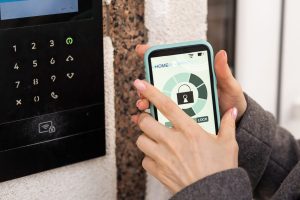 In this blog, we’ll explore how our technology, whether regular technology or “AgeTech”, can improve our chances to stay home longer, safer and with improved well-being….and watch for our next blog on how AI is revolutionizing aging in place soon.
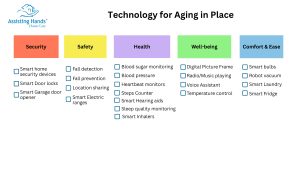
The truth is that technology comes in a myriad of ways and covers various aspects of living as well as aging in place. We’ve developed a framework that places each technology in one of five categories.
- Security: technology that helps us stay secure in our homes, protected from outside dangers.
- Safety: technology that allows us to stay safe within the confines of our homes.
- Health: technology that tracks biomarkers or health factors
- Well-being: technology that enhances our well-being
- Comfort & ease: technology that makes our lives easier
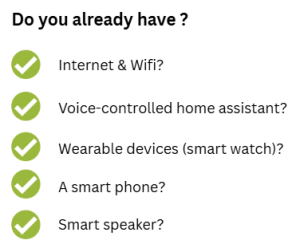
First things first. Please note that often technology will come with basic requirements, such as internet & wifi in the home. Others will be using voice-activated devices (home assistants), yet others will be wearable or come in the form of an app in your (smart) phone or a smart speaker. The Internet and a wifi connection will be the foundation on which you can build and use the technology we will be discussing.
Technology that enhances security and protects us from outside dangers.
✅ Smart home security devices. These record people are coming and ringing your bell. Paired with an application on your phone, you can also interact with the person. But you’ll know who rang your bell at 2 AM.
✅ Smart door locks. Can’t find your keys? Switch to a code-based lock for your main door. Enter the four digits to lock and unlock your door. And if you have a smartphone, check that your door is locked and keep it that way.
✅ Smart garage door openers. Imagine opening and closing your garage door from an app? Yes.
Technology that keeps you safe in your home.
✅ Fall detection. This is the Holy Grail for older adults: There are a lot of devices that help detect falls. Some can even help prevent falls in the first place. Stay tuned for a blog on this soon.
✅ Location sharing. Parents have enjoyed knowing where their children are. Linked to the fall detection, it is also nice to know where your mom is inside her home (and whether she is she laying besides the bed rather than on the bed)
✅ Smart electric ranges. This can ensure that you do not leave your range on for hours by mistake.
Technology that keeps track of your health.
✅ Blood sugar. Continuous glucose monitoring (CGM) is user-friendly and helps you track your blood sugar at all times on your phone.
✅ Blood pressure. Some watches can check your blood pressure and send you hypertension notifications.
✅ Heartbeat monitoring. Wearables on your wrist can track your pulse. You can check your heart rate at rest or any time during the day.
✅ Step counting. We know that staying healthy is linked to moving. Counting steps can be done from your watch.
✅ Sleep quality. How many hours did you sleep last night? Did you get your deep, REM, and light sleep? Wearables can help you track this easily.
✅ Smart hearing aids. Can automatically reduce background noise or stream audio from your phone.
✅ Smart inhalers can help people with asthma or COPD by tracking medication usage and sending reminders.
Technology that enhances our well-being.
We love these, as some have nothing to do with AgeTech; they are used by millions of people already. Think of them for your grandma, too!
✅Digital picture frame. Who does not love these rotating family and trip pictures? Art lovers can go big and choose a large frame that will display and rotate famous paintings from museums around the world.
✅ Radio/music playing. We used to have radios. Now, we simply ask our voice assistant to play our preferred radio station. Paired with a music-streaming app, you can play oldies to your heart’s content.
✅ Have your voice assistant help you! Ask your home assistant to answer basic questions. Check the weather (and anything else). Who was the president in 1958? (it was Eisenhower). Set a timer or an alarm? etc…
✅ Temperature control. Devices that keep your house at the temperature of your choice are particularly useful for older adults.
Technology that brings us comfort makes our lives easier.
 There are so many of these!
✅ Smart bulbs. Control brightness, set schedules, and change colors to fit the mood.
✅ Robot vacuum. They can be annoying, but they can also get the job done. You’ll have to empty them every so often, but they should find their way back to their base and recharge on their own.
✅ Smart laundry. It can dispense laundry detergent, monitor the cycle remotely, and integrate with an app on your phone.
✅ Smart fridge. Come with internal cameras, which help you track food inventory. Ridiculous(ly fun).
Where is AI in all this?
AI is smartly behind a lot of these technologies. But there is more to cover. Follow one of our next blogs on AI.
Are you overwhelmed? Pick and choose according to your needs.
Our advice is to review this list, starting with the categories that we showed, and decide which technology you will really benefit from.
Frequently Asked Questions about Tech for Aging in Place.
What does aging in place mean? / Do most older adults prefer to age in place?
Aging in place means aging in the comfort of your home, i.e., Growing Older at Home. The alternatives are moving to facility-based care, such as independent living, assisted living, a memory care facility, etc.
The vast majority of seniors – 75% in fact – indicate their preference for aging in their homes, as indicated in the AARP 2024 “Community Preference Survey.
As one ages, it is important to consider how we can safely stay in our homes to make this vision a reality.
The issues to consider for growing older in your community are how to stay safe, independent, and handle the activities of daily living. The National Institute on Aging, from the National Institute of Health, offers a simple but great resource.
At Assisting Hands, we are committed to helping seniors to ensure that this wish becomes a daily reality.
What are the five pillars of aging in place?
In order to successfully age in place, a number of elements will have to be put in place. The National Council on Aging has created a framework that considers 5 critical elements to aging. These are housing, health & wellness, finances, transportation, and social interaction.

These same 5 pillars are relevant not only to aging in general, but also to Aging In Place specifically.
Housing: Remaining safe and independent in your house.
Health and Wellness: Putting in place habits, lifestyle, and preventative measures to age well and independently?
Finances: Plan your finances (expenses, investment choices, use of long-term care insurance, VA benefits, etc.) around your financial needs
Transportation. Manage mobility within your home and outside it
Social Interaction: Make the difference between loneliness and solitude, and keep loneliness at bay
All of these aspects have been carefully studied, and resources are available. We recommend checking out the National Council on Aging for resources.
The use of family and professional caregivers is a great way to manage a number of these pillars, especially the health and wellness, transportation, and social interaction pillars.
What are the downsides of aging in place?
One of the most often overlooked areas of aging in place is the additional support that will be needed by the aging person, and its corresponding costs, also called long-term care costs. This includes costs in the following areas:
- Enhancing your home to make it more accessible and safe.
- Having an emergency system in place should you need immediate assistance
- Getting assistance with personal care and activities of daily living (ADLs)
- Ensuring your mobility, both within and outside the home
This is what Long-Term Care is: services and support designed to meet one’s personal and health care needs over an extended period of time.
 While aging in place provides the comfort of one’s home, it could also be isolating for seniors. Social interaction is one of the 5 critical elements to aging, so ensuring that you stay connected as you age at home is crucial.
Does Medicare cover aging in place?
By and large, Medicare does not cover long-term personal care for aging seniors, whether in their home or an assisted living facility.
Medicare will cover the costs of medical assistance (home health), following a medical event (stroke, heart attack, fall, etc.), with physical (PT), occupational (OT), and speech therapies (ST) for a few weeks. Medicare will also cover some of the costs of durable medical equipment (DME), for medically necessary equipment like walkers, canes, wheelchairs, and hospital beds.
Medicare will not cover the costs of personal care (non-medical, home care), and Medicare will not cover the costs of structural home modifications like grab bars or wheelchair ramps.
Start Finding Support With Aging in Place in Murray, UT.
Technology is a powerful tool — but it works best when paired with the right human support. At Assisting Hands, we help families in Murray and across the greater Salt Lake area combine smart home solutions with compassionate, professional in-home care so that aging in place doesn’t just sound good on paper — it actually works in real life. Whether you’re just starting to explore your options or you’re ready to put a plan in place, we’re here to help. Start receiving the support you deserve by following these simple steps:
- Reach out for a free consultation.
- Meet with a member of our caring team
- Learn how our senior home care services can help you and your loved ones stay safe!
Other Services Offered with Assisting Hands Home Care.
Assisting Hands Home Care in Greater Murray offers many forms of support for seniors. We are happy to provide a full range of professional, compassionate in-home care services designed to help seniors live with greater comfort, safety, and peace of mind.
We offer support in the form of long-term care insurance advocacy, Alzheimer’s and Dementia Care, Parkinson’s Home Care, Stroke Recovery Home Care, and Orthopedic Home Care Services. We also provide Personal Care & Grooming, Meal Preparation, Light Housekeeping, and Grocery Shopping & Errands to support the day-to-day needs of seniors aging in place.
For families navigating life transitions, our Transitional Care, Hospice Support Services, and Coordination of Care services can also provide support. We also proudly serve Veterans through our Veterans Aid & Assistance program, and offer Companionship and Fall Prevention services. Whatever your family’s needs look like, Assisting Hands is here to help. Explore our full list of services or contact us today for more helpful information!

