
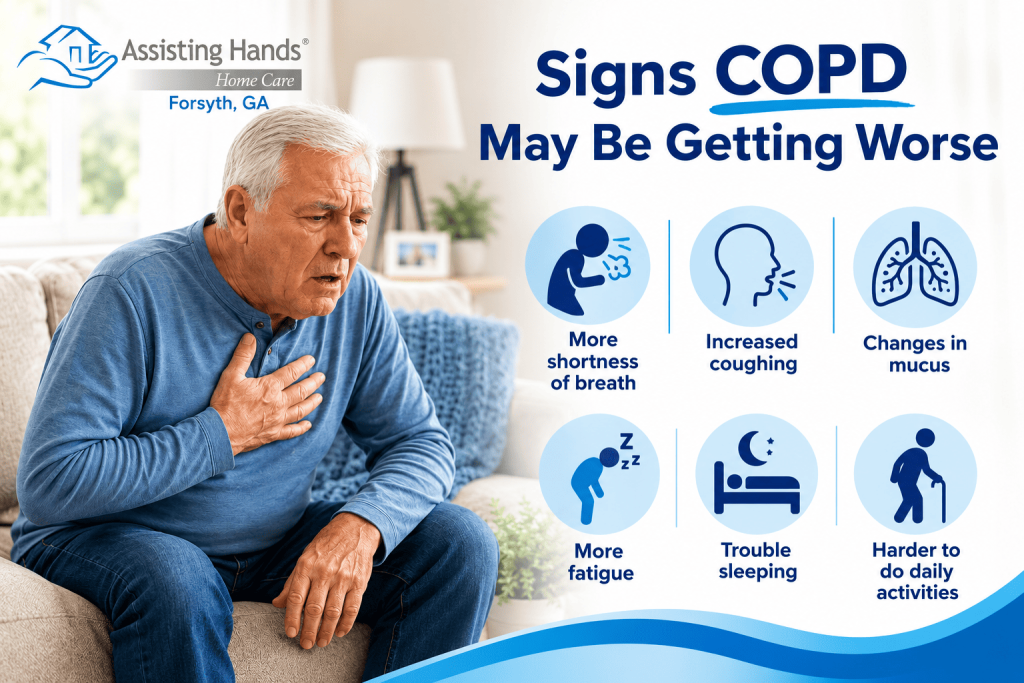
For a senior living with chronic obstructive pulmonary disease (COPD), not every difficult breathing day means the condition is getting worse. Symptoms can change with activity, weather, respiratory infections, poor air quality, or exposure to smoke and other irritants.
What families should pay attention to is a noticeable change from their loved one’s normal pattern.
Maybe your mother normally walks from the bedroom to the kitchen without stopping, but suddenly she needs to sit down halfway. Maybe your father has always had a cough, but now he is coughing more frequently, producing more mucus, and sleeping poorly.
These changes matter because they may signal a COPD flare-up, also called an exacerbation, or another health problem that deserves medical attention.
For families throughout Forsyth County and surrounding North Georgia communities, understanding the early warning signs can make it easier to know when to contact a healthcare provider—and when additional help at home may be useful.
Assisting Hands Home Care – Forsyth provides non-medical in-home support for seniors living with COPD and other chronic conditions. While caregivers do not diagnose or treat COPD, they can help with the everyday activities that may become more difficult when breathing and energy levels decline.
What Are the Signs COPD May Be Getting Worse?
Common signs that COPD symptoms may be worsening include more shortness of breath than usual, increased coughing or wheezing, changes in mucus, greater fatigue, difficulty sleeping, reduced appetite, and trouble completing normal daily activities.
The most important comparison is not with another person who has COPD. It is with your loved one’s usual baseline.
If symptoms suddenly become severe, breathing is difficult even at rest, or the person develops confusion, chest pain, or blue or gray lips or fingertips, seek emergency medical care.
Understanding Your Loved One’s COPD Baseline
COPD is a chronic lung disease that includes conditions such as emphysema and chronic bronchitis. It can cause ongoing shortness of breath, coughing, mucus production, wheezing, and reduced stamina.
Because many of these symptoms may already be present every day, families sometimes have difficulty knowing when something is actually wrong.
That is why establishing a baseline is useful.
Think about what a normal week looks like for your loved one.
How far can they usually walk before needing a break? Can they shower and dress independently? How much do they normally cough? What does their typical mucus look like? Are they normally able to prepare meals? How much activity can they tolerate?
A change from those familiar patterns may be more meaningful than any individual symptom.
1. Shortness of Breath Is Worse Than Usual
Increasing breathlessness is one of the most important changes to watch for.
Someone who usually becomes winded after walking outside may suddenly become short of breath simply walking to the bathroom. A person who normally dresses without difficulty may begin stopping several times to rest.
You might notice your loved one:
- Taking longer to walk across the home
- Pausing frequently during conversations
- Becoming breathless while dressing or bathing
- Avoiding activities they normally enjoy
- Sitting down more often because movement feels exhausting
The question to ask is:
“Is this harder for them than it normally is?”
If the answer is yes, especially if the change happens over a short period, contact their healthcare provider according to their COPD care plan.
2. Their Cough Has Changed
Many people with COPD have a chronic cough. That makes it easy to overlook changes.
Instead of asking whether your loved one is coughing, notice whether the cough is different.
For example, it may become more frequent, stronger, more persistent, or disruptive at night.
A cough that suddenly interferes with eating, sleeping, conversation, or normal activity should not simply be dismissed as “part of COPD.”
A changing cough may occur during a COPD exacerbation or respiratory illness and should be discussed with the person’s healthcare provider.
3. Mucus Has Increased or Changed
Mucus, sometimes called sputum or phlegm, can provide another clue that COPD symptoms are changing.
Families should notice whether there is:
- More mucus than usual
- A change in color
- A change in thickness
- Greater difficulty coughing mucus up
A change in mucus does not automatically tell you what is causing the problem. Respiratory infections are one possible trigger, but a healthcare professional should determine whether evaluation or treatment is necessary.
Families should not start leftover antibiotics or change medications without medical guidance.
4. Wheezing or Chest Tightness Is Increasing
Wheezing can sound like a whistle or other unusual noise during breathing.
Some people with COPD experience wheezing regularly. Others only notice it during periods when symptoms become worse.
Pay attention if wheezing becomes noticeably louder or more frequent, or if your loved one begins complaining that their chest feels tighter than usual.
Increasing wheezing combined with worsening breathlessness, coughing, or fatigue should be discussed with the healthcare provider.
5. Everyday Tasks Are Taking Much More Energy
Sometimes the first sign of worsening COPD has little to do with what you can hear. Instead, you notice that normal activities are becoming harder.
Your loved one may stop halfway through a shower because they are exhausted. They may avoid cooking because standing at the stove feels like too much work. Getting dressed might take twice as long as it used to.
Watch for difficulty with:
- Bathing and grooming
- Dressing
- Preparing meals
- Walking around the home
- Doing laundry
- Light housekeeping
- Getting to appointments
- Shopping
- Climbing stairs
This is especially important for seniors living alone. When breathing problems begin interfering with activities of daily living, the person may need both a medical reassessment and additional support at home.
6. Fatigue Is Becoming More Noticeable
COPD can make ordinary activities require more energy. A senior who is working harder to breathe may begin feeling unusually tired even when they have not been very active.
Families may notice that their loved one:
- Sleeps more during the day
- Stops participating in hobbies
- Spends more time sitting
- Needs longer rest periods
- Seems weaker than usual
- Has less interest in social activities
Fatigue has many possible causes, so it should not automatically be blamed on COPD. A new or significant change should be shared with the healthcare provider.
7. Sleep Problems Are Getting Worse
Breathing problems do not always stop at bedtime.
Some seniors with COPD may experience more coughing, breathlessness, or discomfort at night. Poor sleep can then contribute to daytime fatigue, weakness, and difficulty concentrating.
Pay attention if your loved one begins:
- Waking repeatedly because of coughing
- Becoming short of breath when lying down
- Sleeping in a chair because it feels easier
- Appearing unusually restless overnight
- Sleeping much more during the daytime
A new pattern of nighttime breathing difficulty deserves medical attention.
8. They Are Using Rescue Medication More Often
Some people with COPD have a prescribed rescue inhaler or another medication they use when symptoms increase. If your loved one begins reaching for their rescue medication much more frequently than they normally do, that may indicate their COPD is not as well controlled as usual.
Follow the instructions provided by their healthcare professional or COPD action plan.
A non-medical caregiver can remind a client to take medications according to the established routine, but caregivers should not change medication doses, inhaler schedules, or oxygen settings.
9. Eating Has Become More Difficult
Eating can take more effort than families realize. When someone is already struggling to breathe, preparing food, sitting through a meal, chewing, and eating may feel exhausting.
You may begin noticing:
- Smaller portions
- Skipped meals
- Reduced interest in food
- Difficulty preparing meals
- Shortness of breath during meals
- Unexplained weight loss
- Not drinking enough fluids
Poor nutrition can also contribute to weakness, creating a cycle where the senior becomes less able to manage daily activities.
10. Your Loved One Is Becoming Less Independent
COPD often affects more than breathing. It can gradually change how much a senior is able to do safely and comfortably on their own. A senior who once managed independently may begin needing help with showering, dressing, meals, errands, transportation, or household tasks.
Families sometimes compensate without realizing how much has changed. A daughter starts bringing dinner every night. A spouse begins doing all the household chores. A son starts driving over every morning to make sure medications and breakfast are handled.
Those adjustments are important clues. If family members are doing significantly more than they were several months ago, it may be time to reassess the amount of support your loved one needs.
What Is a COPD Flare-Up?
A COPD flare-up, also called an exacerbation, occurs when respiratory symptoms become noticeably worse than the person’s usual condition.
A flare-up may involve more shortness of breath, coughing, mucus, or wheezing. Some people also experience fatigue, sleep problems, or difficulty completing normal activities. Respiratory infections are a common trigger, but smoke, pollution, weather conditions, and other respiratory irritants may also contribute.
Not every exacerbation means COPD has permanently progressed. However, a meaningful worsening of symptoms should be taken seriously.
When Is COPD an Emergency?
Some breathing problems require immediate medical attention. Call 911 or seek emergency care if a person is experiencing severe or rapidly worsening shortness of breath, especially if they cannot catch their breath while resting.
Other concerning symptoms may include:
- Chest pain
- New confusion
- Extreme difficulty staying awake
- Blue or gray lips, fingertips, or nails
- Coughing up blood
- Severe breathing difficulty that is not improving
Do not wait for a routine appointment when symptoms appear life-threatening.
Should You Monitor Oxygen Levels at Home?
Some people with COPD are instructed by their physician to monitor oxygen saturation with a pulse oximeter. If your loved one has been given an individualized oxygen target, follow the instructions provided by their healthcare team.
Families should be cautious about comparing readings with numbers they find online. A person’s appropriate oxygen range may depend on their medical condition and treatment plan. Never adjust prescribed supplemental oxygen without instructions from a qualified healthcare professional.
Also remember that a device reading does not replace observation. Someone who is severely short of breath, confused, or turning blue needs immediate medical evaluation regardless of what a home monitor displays.
How Can Families Help Prevent COPD Flare-Ups at Home?
Not every flare-up can be prevented, but families can help reduce avoidable triggers and support the medical plan already established by the person’s healthcare providers.
Keep the home free from cigarette smoke whenever possible. Strong fragrances, cleaning fumes, dust, and other irritants may also bother some people with COPD. Encourage your loved one to follow their prescribed medication routine, attend medical appointments, and follow their physician’s recommendations regarding vaccinations, exercise, nutrition, or pulmonary rehabilitation.
Families can also make everyday routines less physically demanding by keeping frequently used items nearby, preparing meals ahead of time, creating clear walking paths, and allowing additional time for bathing and dressing.
The goal is not to prevent activity. Maintaining appropriate activity can be important. Instead, the home environment should make necessary daily tasks easier to manage.
What Is Energy Conservation for Seniors With COPD?
For someone with COPD, ordinary activities may consume significantly more energy than they once did.
Energy conservation simply means organizing daily life so the person does not use all of their energy on basic tasks.
For example, instead of standing throughout a morning grooming routine, a senior may sit while getting dressed or brushing their hair.
Meals can be prepared ahead so the person does not need to stand at the counter for long periods.
Laundry, housekeeping, grocery shopping, and other physically demanding activities can be handled by family members or caregivers.
It is a practical approach: save energy for the things the senior actually wants and needs to do.
How Can In-Home Care Help a Senior With COPD?
COPD is a medical condition, and treatment belongs in the hands of physicians and other qualified healthcare professionals.
But much of life with COPD happens outside the doctor’s office.
It happens when a senior is trying to shower without becoming exhausted. When preparing lunch feels overwhelming. When there are stairs between the bedroom and laundry room. When a spouse is doing more and more each week to keep everything running.
That is where non-medical home care can be helpful.
Assisting Hands Home Care – Forsyth can provide support with everyday activities that may become more difficult as COPD affects stamina and independence.
Depending on the individual care plan, caregivers may help with personal care, meal preparation, light housekeeping, laundry, transportation, errands, medication reminders, mobility, companionship, and daily routines.
This support does not treat COPD. Instead, it can help reduce the physical burden of everyday tasks and make living at home more manageable.
Supporting a Loved One With COPD in Forsyth County, GA
For many seniors with COPD, the goal is straightforward: remain at home, maintain as much independence as possible, and continue enjoying familiar routines.
As COPD changes, the amount of help required at home may change too.
Assisting Hands Home Care – Forsyth provides non-medical in-home care for seniors who need additional help with everyday activities. We support families in Cumming, Alpharetta, Johns Creek, Roswell, Dunwoody, Sandy Springs, Milton, Sugar Hill, Suwanee, and surrounding communities.
Our caregivers can work alongside the care plan established by your loved one’s medical providers while helping with the everyday tasks that make staying at home possible.
If you have noticed that COPD is making daily activities harder for your parent, spouse, or loved one, it may be time to talk about what additional support at home could look like.
Contact Assisting Hands Home Care – Forsyth 770-626-5150 to discuss your loved one’s needs and learn how personalized in-home care can support their daily routine.

