
Several years ago, maybe decades ago, you purchased a long-term care insurance (LTCi) policy. Every month, you see a premium being deducted from your bank account. Now what?
You wonder. What should I do with it? What type of expenses will this LTCi policy cover? How much benefit am I entitled to? When is the right time to activate my policy, or should I wait? And will long-term care insurance help me stay in my home and age in place?
These are great questions that many policyholders like you ask themselves. Let’s cover the basics here.
First, having a long-term care insurance (LTCi) policy is a great thing as you age and start needing help, especially if you want to stay home as you age.
Read on for a brief overview and answers to basic questions you may have.
What type of expenses will this LTCi policy cover? Short answer: long-term care services

Long-term care insurance (LTCi) is designed to cover long-term care services, including help with activities of daily living, home care, respite care or adult day care. This care may be given in your own home, or outside your home, such as at an adult day care, an assisted living facility, a nursing home or a hospice facility.
Statistically, about 70% of people who reach age 65 are expected to need some form of long- term care as described above at least once in their lifetime.
Keep in mind that these long-term care expenses are not reimbursed by Medicare, Medicare supplement insurance (Medigap), or regular health plans, so planning to pay for these, either out of pocket or with an LTCi, is a good idea.
What kind of coverage can I expect from my Long-term care insurance (LTCi) policy?
What? The expenses covered are spelled out in your policy; they will range from personal care services to homemaker services to home improvements to your home; we’ll have to check.
Where? They will generally cover care in your own home, or an assisted living facility, a nursing home, or a hospice facility.
Who? You may have taken a shared policy that covers you and your spouse.
When is the right time to activate my policy, or should I wait? Let’s assess your health
There are many variations of policies, so we do not want to generalize without looking at your specific policy.
Let’s start with your health: LCTi policies are triggered by functional or cognitive impairment.
Ask yourself these questions:
- Do you have trouble dressing, bathing, toileting, mobility, eating, or continence?
- Do you have trouble driving?
- Have you been diagnosed with dementia?
Be honest in assessing your health. If you have said yes to a few of these questions above, it is the right time to look into your policy.
How much benefit am I entitled to?
Again, your LTCi policy will have all the details. There will be a “maximum benefit limit”, aka a “maximum lifetime benefit,” over your lifetime. But your policy will also have a daily (or weekly or monthly) limit, or a one-time limit from the installation of a home alert system or a ramp.
Your policy could also include an inflation rider, which would mean that the amount listed in the original policy would have to be increased by the rate of inflation for today’s limits.
Is waiting to activate your LTCi a good idea?
If you are in perfect health, probably! But if you are noticing you need assistance with the activities of daily living (dressing, bathing, toileting, mobility, eating, continence), a review of your LTCi policy is definitely in order.
Is now too late to activate my policy?
No. You might as well get the financial benefits that you have paid premiums for for so many years. Getting some of the benefits is better than not getting any at all because you waited too long. An interesting statistic is that 50% of policyholders will die before ever using any benefits. We want you to be in the other 50%, the policyholders who activate their policies well before they die and take advantage of their benefits.
Will I be able to use my benefits before I pass away is actually a better question to ask…
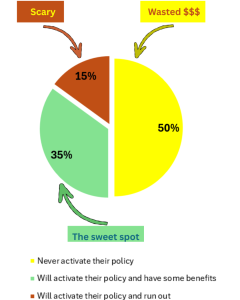 The sad thing is that a lot of policies will go completely unused: 50% of policyholders will die before ever using any benefits. Among the 50% of policies that are activated, 70% of the people die before the policy runs out of money. So the statistics indicate that in the majority of cases, people are not getting the full benefit of their LTCi.
Not benefiting from your policy at all will evidently need to be balanced with the imperative not to run out of money. A careful review of your policy, along with an assessment of your current and future needs, can mitigate that risk while leveraging the benefit that your policy can bring you.
Staying in my home, aging in place, is my top priority. Can I have in-home care covered by long-term care insurance?
Very likely yes. Long-term care insurance covers home care in a very large number of policies. Which means that you can use your long-term care insurance (LTCi) to stay in your home in Dedham, MA.
Start Understanding Long-Term Care Insurance in Murray, UT
You’ve planned ahead. You paid your premiums. You made sure you would have support when the time came. Now it’s time to actually use what you’ve built.
At Assisting Hands, we specialize in helping policyholders in Murray, Cottonwood Heights, Holladay, and Millcreek navigate their long-term care insurance and access the in-home care they are entitled to. We understand the paperwork, the timelines, and the process — so you don’t have to figure it out alone. You can start working with our caring team by following these simple steps:
- Contact us for a free consultation
- Meet with a member of our team
- Start making the most of your policy!
Other Services Offered with Assisting Hands Home Care
At Assisting Hands Home Care in Greater Murray, we offer other forms of support in addition to long-term care insurance advocacy. Our team provides a full range of compassionate, professional in-home care services designed to help seniors and their families live with greater comfort, safety, and peace of mind.
In addition to LTCi advocacy, we offer Alzheimer’s and Dementia Care, Parkinson’s Home Care, Stroke Recovery Home Care, and Orthopedic Home Care Services. We also provide Personal Care & Grooming, Meal Preparation, Light Housekeeping, and Grocery Shopping & Errands to support the day-to-day needs of seniors aging in place.
For families navigating life transitions, our Transitional Care, Hospice Support Services, and Coordination of Care services offer support. We also proudly serve Veterans through our Veterans Aid & Assistance program, and offer Companionship and Fall Prevention services. Whatever your family’s needs look like, Assisting Hands is here to help. Explore our full list of services or contact us today for more helpful information!

