
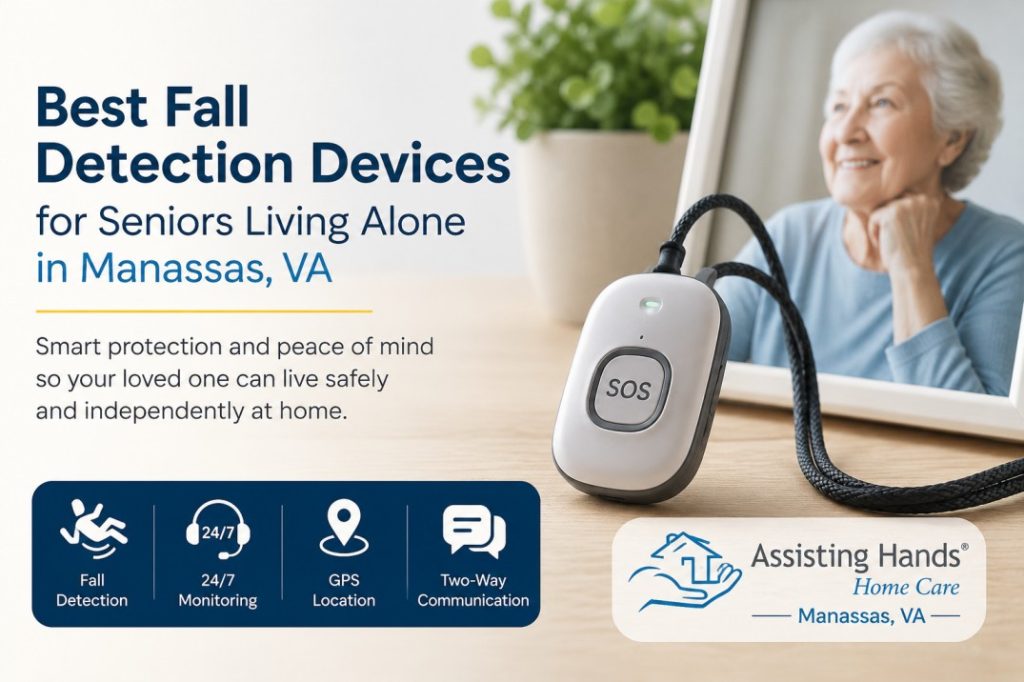
You are not worried because something went wrong. You are worried because nothing has gone wrong yet — and you know that could change on any ordinary Tuesday.
Your parents lives alone in Manassas. They is doing well. They gets around. They would never ask for help unless they absolutely had to. And that is exactly what keeps you up at night.
At Assisting Hands — Manassas, we work with families across Prince William County, Centreville, Gainesville, and Haymarket who are navigating exactly this situation every day. One of the most common questions we hear from adult children is: “Should we get Dad a fall detection device?”
The honest answer is yes — with important caveats about what these devices can and cannot do. This guide covers everything a Manassas family needs to know before making that decision.
Why Fall Detection Matters Specifically for Seniors Living Alone
Falls are not rare events. According to the CDC, more than 36 million older adults fall in the United States every year — with 8 million resulting in injuries serious enough to require medical attention.
But the statistic that matters most for families in Manassas is different. Research consistently shows that seniors living alone face significantly higher fall risk than those living with others — and the consequences of a fall without anyone nearby are dramatically more serious.
The danger is not always the fall itself. It is the time between the fall and when help arrives. A senior who falls in the kitchen at 9pm and is not found until the next morning has spent 12 hours on the floor. That period — called a long lie — is associated with dehydration, pressure injuries, hypothermia in cooler months, and profound psychological trauma that often accelerates decline even when the physical injuries are minor.
A new study of 2,695 adults found that even though 44 percent of seniors report having fallen, medical alert device usage remains stubbornly flat at 9%. The gap between how common falls are and how few seniors have any protection in place is striking — and it means most families are waiting until after something happens to act. Mesothelioma Guide
A fall detection device does not prevent falls. What it does is close the gap between when a fall happens and when help arrives. For a senior living alone in Manassas — that gap is everything.
How Fall Detection Technology Actually Works
Understanding the technology helps families evaluate devices more accurately than relying on marketing language alone.
Modern fall detection devices use a combination of sensors built into the wearable — most commonly accelerometers and gyroscopes. By 2026, the technology objective has evolved into a three-layer approach — pre-fall risk prediction, real-time automatic fall detection and alerting, and post-fall physiological monitoring to assess injury severity and guide response.
In practical terms — the device is continuously reading movement patterns. When it detects the specific signature of a fall — a sudden downward acceleration followed by an extended period of stillness — it triggers an automatic alert to a 24/7 monitoring center. A trained operator attempts to communicate with the wearer through the device. If there is no response or the wearer confirms an emergency, the operator dispatches emergency services and contacts designated caregivers.
The critical feature here is that this process happens automatically — without the senior needing to press a button. Fall detection technology ensures that help is automatically summoned even if the wearer is unconscious, disoriented, or unable to press a button after a fall — all situations that occur in a significant proportion of senior falls.
The 3 Types of Fall Detection Devices — And Which Is Right for Your Loved One
Not all fall detection devices work the same way or suit the same lifestyle. Here are the three main categories — with honest guidance on who each one is right for:
Type 1 — In-Home Medical Alert Pendant With Fall Detection
Best for: Seniors who spend most of their time at home — the most common scenario for seniors living alone in Manassas and Prince William County.
How it works: A base unit is placed in the home — typically plugged into an outlet in a central location. The senior wears a lightweight pendant around their neck or a wristband. When the pendant detects a fall — or the button is pressed — the base unit connects to a 24/7 professional monitoring center via cellular or landline connection.
What to look for specifically:
- Range of at least 1,000 feet from the base unit — This matters for Northern Virginia homes. A pendant that only works within 300 feet of the base may not cover the backyard, the garage, or the front porch. Falls happen outdoors too — especially while checking the mail, gardening, or walking to the car.
- Fully waterproof pendant — designed for shower use — The bathroom is the highest-injury-risk room in the home. A pendant that is water-resistant but not shower-safe is useless for the moment when it is needed most. Confirm the device is rated for full shower immersion — not just splash resistance.
- Two-way audio through the pendant itself — When a fall is detected, the monitoring center needs to communicate with your loved one. If the base unit is in the kitchen and your loved one fell in the bedroom — communication through the base is useless. The pendant itself should have a built-in speaker and microphone.
- 24/7 professional monitoring center — US-based — The response to a fall alert should come from a trained emergency monitoring professional — not a family notification app that sends a text message and waits for someone to respond.
Type 2 — Mobile Medical Alert Device With GPS and Fall Detection
Best for: Seniors who are still active and go out regularly — to medical appointments in Woodbridge, grocery shopping at Giant or Harris Teeter in Manassas, church, senior center programs, or walks in the neighborhood.
How it works: A compact wearable device — pendant style or a dedicated mobile unit — connects via cellular network rather than a home base. Fall detection and two-way communication work anywhere the device has cellular coverage — which in the Manassas and Northern Virginia area is virtually everywhere.
Key advantage for Manassas seniors: GPS location tracking means that if your loved one falls during a walk in Centreville or outside a medical office in Gainesville — emergency services can find them precisely without needing to know the address.
What to look for specifically:
- Multi-day battery life — A device that requires daily charging creates a dangerous gap every night and every time charging is forgotten. For seniors who may not remember to charge consistently — or who have caregivers who build the charging routine into their visits — multi-day battery life dramatically reduces the “not worn when needed” risk.
- Lightweight and wearable design — The best device is the one that actually gets worn. Heavy, bulky, or visually obvious devices are removed and left on the dresser. The device needs to be comfortable enough that your loved one wears it without thinking about it.
- Cellular independence — The device should not require the senior’s home WiFi or a specific mobile phone to function. It should operate on its own cellular connection.
Type 3 — Smartwatch With Fall Detection
Best for: Tech-comfortable seniors who are already wearing a smartwatch — or younger family members who want a less medically obvious device for a senior who resists traditional medical alert systems.
How it works: Consumer smartwatches like Apple Watch Series include built-in fall detection. When a hard fall is detected and the wearer does not respond to the alert — the watch can automatically call emergency services.
Honest limitations families should understand:
A consumer smartwatch is not professionally monitored — this is not the same response path as a medical alert company’s 24/7 monitoring center. When an Apple Watch calls 911 — it connects directly to emergency services without a trained monitoring professional assessing the situation first. There is no caregiver notification, no intermediate assessment, and no follow-up if the call disconnects. Medicaid Planning Assistance
Charging burden is a genuine safety risk. A dead battery is one of the fastest ways protection disappears — especially for seniors who may forget to charge consistently or who have irregular routines. Medicaid Planning Assistance
Smartwatches are best suited for lower-risk, tech-comfortable seniors who will wear them consistently and charge them reliably. For higher fall-risk seniors living alone in Manassas — a professionally monitored medical alert pendant is a more complete protection.
Type 4 — Ambient Room Sensors Without Wearables
Best for: Seniors who flatly refuse to wear any device — pendant, wristband, or watch.
How it works: Passive sensors installed in the home — typically radar-based or infrared — monitor movement patterns in each room. When unusual stillness is detected for an extended period, an alert is triggered. No wearing required.
Limitations: Room sensors only work inside the home. They provide no protection outdoors, no GPS, and no direct communication. They are the right option only when wearable resistance is absolute — not a first choice for fall protection.
What to Look for When Choosing — A Practical Checklist for Manassas Families
Before speaking to any provider — work through these questions specific to your loved one’s situation:
Where does your loved one spend time?
Mostly at home → in-home pendant with 1,000+ foot range
Regularly goes out alone → mobile GPS device
Both → consider a mobile device that also covers the home
Is the bathroom covered?
Confirm the pendant or device is rated for shower immersion — not just splash resistance. If the answer is uncertain — ask directly before purchasing.
How reliable is charging?
Will someone remind your loved one to charge the device every day? If not — a multi-day battery device is not optional. It is necessary. The most common feedback from medical alert users was a request for longer battery life to enable overnight wear.
Will they actually wear it?
Users consistently reported wanting smaller or more discreet designs with flexible wear options such as wrist, pendant, or clip. If your loved one is resistant to wearing a pendant — a wristband or watch-style device may have better compliance. A device left on the nightstand provides no protection.
Does it require a landline?
Most Manassas-area seniors no longer have a landline. Confirm that the device operates on cellular — not landline — before purchasing.
Is there a contract?
Most quality medical alert providers do not require long-term contracts. Avoid any provider that does — your loved one’s needs will change and you should be able to change providers without penalty.
What is the real monthly cost?
Most quality systems run roughly $25 to $45 a month, with fall detection adding about $10. Watch for activation fees, equipment fees, and feature add-ons that are not included in the advertised price. Ask for the all-in monthly cost including fall detection before committing
Does Medicare Cover Fall Detection Devices in Virginia?
Original Medicare does not cover fall detection devices because medical alert systems are generally not considered durable medical equipment. Some Medicare Advantage plans may offer discounts or limited benefits for select medical alert systems, but coverage varies by plan.
Contact your loved one’s Medicare Advantage plan directly to ask whether their specific plan includes any medical alert or fall detection benefit.
For veterans in Manassas and Prince William County:
The VA Aid and Attendance benefit provides wartime veterans with up to $1,903 per month in tax-free payments that can be used for home safety equipment and in-home care support. Contact the Prince William County Area Agency on Aging at (703) 792-6400 for local Veterans benefit guidance.
Local Resources for Seniors and Families in Manassas and Prince William County
| Resource | What They Provide | Contact |
|---|---|---|
| Assisting Hands – Manassas | In-home fall prevention care and daily caregiver support | (571) 506-4264 |
| Prince William County Area Agency on Aging | Senior services, case management, benefit navigation | (703) 792-6400 |
| Novant Health UVA Prince William Medical Center | Local emergency care and post-fall follow-up | (703) 369-8000 |
| Virginia Aging and Disability Services | Statewide aging resources and home care programs | vda.virginia.gov |
| Prince William County Senior Centers | Balance programs, social activities, wellness programs | (703) 792-4848 |
Is Your Loved One Living Alone in Manassas or Prince William County?
A fall detection device is a valuable tool. But it is not a complete safety plan. Assisting Hands — Manassas provides trained caregivers who are present during the highest-risk moments of the day — providing the fall prevention that a device alone cannot offer.

