

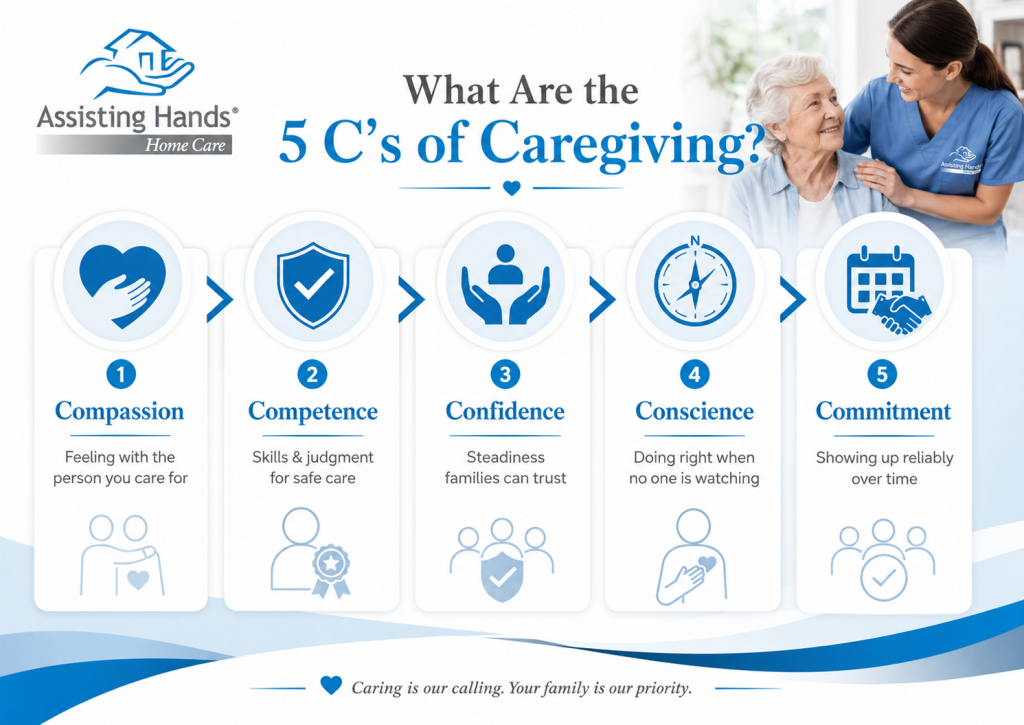
The 5 C’s of caregiving are compassion, competence, confidence, conscience, and commitment. Together they describe the character and habits of a quality caregiver, and they give families a simple, reliable way to judge whether someone can be trusted with a loved one’s care. The framework comes from Canadian nursing theorist Sister Simone Roach, who introduced it in 1987.
When a family starts looking for in-home care, the hard part is rarely finding a caregiver. It is knowing whether the caregiver in front of you is the right one. Credentials and hourly rates only tell you so much. What you really want to know is how someone will treat your mom or dad when you are not in the room. The 5 C’s give you a way to answer that question before you hire.
The 5 C’s of Caregiving at a Glance
| The C | What it really means |
|---|---|
| Compassion | Feeling with the person, not just doing tasks for them |
| Competence | The skills and judgment to keep someone safe |
| Confidence | Staying calm and decisive so everyone else can relax |
| Conscience | Doing right when no one is checking |
| Commitment | Showing up, the same face, over the long haul |
What Are the 5 C’s of Caregiving?
Roach first wrote about the five in her 1987 book Caring: The Human Mode of Being. Her point was pretty simple: good care depends on the kind of person doing the caring, not just their training. She added a sixth C, comportment, in 1992, but the original five are what stuck, and they are what most people still use today.
The framework started in nursing, but it carries over to home care almost word for word, because it describes who a caregiver is rather than a checklist of chores. It also hands everyone the same vocabulary. Two of the C’s are about the heart of the work (compassion and conscience), two are about the hands (competence and confidence), and the last one, commitment, is about sticking around. When a caregiver has all five, families finally stop bracing themselves.
1. Compassion: Feeling With the Person You Care For
Compassion is the ability to feel with someone and respond with real kindness. In plain terms, it is the gap between a caregiver who gets the tasks done and one who actually notices the person they are doing them for.
In home care, compassion is usually quiet. It is the caregiver who has a cup of coffee with a client before starting the chores, who hears the same story for the third time without rushing it, who reads a rough morning and eases up on the schedule instead of plowing through. It lives in the small stuff too: warming a blanket, remembering a late husband’s name, catching that someone feels embarrassed about needing help in the shower and making it feel like nothing at all.
Compassion also does something families do not always think to look for. It pushes back against loneliness, which is a real health risk for older adults living at home. Around 24 percent of adults 65 and older in the U.S. are socially isolated, and roughly 43 percent of adults over 60 say they feel lonely, according to the National Academies of Sciences and the National Institute on Aging. And this is not a soft problem. Social isolation has been tied to about a 50 percent higher risk of dementia, as stated by the Alzheimer’s Association. A caregiver who provides genuine companion care is not just keeping someone safe. They are keeping someone company.
2. Competence: The Skills and Judgement to Do the Job Safely
Competence is having the skills, the know-how, and the judgment to do the job right, plus the humility to keep learning. It matters every bit as much as the warmer C’s, because kindness without skill can put a client in real danger.
Day to day, competence is the practical stuff. A competent caregiver can move someone from the bed to a wheelchair without hurting the client or their own back. They keep medication reminders straight and on time. They can put together a meal that works for a low-sodium or diabetic diet, catch the early signs of a UTI or dehydration before it turns into an ER trip, and tell the difference between an off day and a change worth calling the family or doctor about.
None of that happens by accident. At Assisting Hands Home Care, our caregivers are licensed, bonded, insured, and background-checked, and they keep training after they are hired so they are ready for whatever your loved one actually needs, including conditions like dementia.
3. Confidence: The Steadiness That Lets Families Exhale
Confidence is a caregiver’s ability to act calmly and decisively, and to build trust in the people around them. It is not about being loud or taking over. It is the steadiness that lets a family exhale.
This C is easy to underrate until you watch it work. When a caregiver is confident, an anxious client settles because they can tell they are in capable hands. Adult children who have been worrying from another state start sleeping better because the person on-site handles problems without panic. If a fall happens or a medication question comes up, a confident caregiver responds clearly instead of freezing.
Confidence grows out of competence, which is why the two travel together. A caregiver who knows what they are doing tends to carry themselves in a way that reassures everyone in the house.
4. Conscience: Doing Right When No One Is Watching
Conscience is the moral compass that guides a caregiver to do the right thing, especially when no one is watching. Home care happens in private, often one-on-one, so this C is the one families worry about most and can observe least.
In a home, conscience shows up as dignity, privacy, and honesty. A caregiver with conscience protects a client’s modesty during bathing and toileting and treats those moments as ordinary rather than something to feel ashamed about. They respect the home and the belongings in it. They tell the truth about how a shift went, including the parts that did not go well, and they log care accurately even when a shortcut would be easier. They do not exploit a client’s confusion or loneliness, and they never treat someone’s memory loss as a reason to cut corners.
You cannot supervise conscience directly. What you can do is hire through an agency that screens for it, backs it with accountability, and stands behind the people it sends into your home.
5. Commitment: Showing Up Reliably Over Time
Commitment is the steady, reliable dedication to a client over time. Care is not a one-day event. It is a relationship, and relationships depend on showing up.
For families, commitment translates into consistency. It means the same caregiver returning shift after shift instead of a rotating cast of strangers, which matters enormously for someone with memory loss who finds new faces stressful. It means a caregiver who arrives on time, follows the care plan, and communicates changes rather than disappearing. Continuity like this lets a caregiver notice small declines early, because they know what normal looks like for that person.
Commitment has a second side that families do not always see. It depends on caregivers who are supported enough to avoid burnout. A caregiver stretched too thin cannot stay reliable. Good agencies protect commitment by managing schedules realistically and offering respite care so that family caregivers get a break too, before exhaustion sets in.
5 C’s vs 6 C’s of Caring: What Is the Difference?
Families often ask about a 6 C’s framework, and there are actually two different answers. Sister Simone Roach herself added a sixth C, comportment (professionalism in dress, language, and conduct), to her original five in 1992. Separately, the United Kingdom’s National Health Service launched its own 6 C’s of nursing in 2012: care, compassion, competence, communication, courage, and commitment. The two lists overlap but are not the same. For families choosing in-home care in the United States, Roach’s original five C’s remain the most practical checklist, because they describe qualities you can actually watch for in a caregiver.
How to Use the 5 C’s When Choosing an In-Home Caregiver
The 5 C’s are more useful as a hiring tool than as a definition. Treat them as an evaluation checklist. When you meet a caregiver or agency, you are trying to confirm all five, and each one has signs you can look and listen for.
For compassion, watch how they talk about past clients. Do they describe people or just duties? For competence, ask about training and specific situations. For confidence, notice whether they answer your hard questions calmly or get flustered. For conscience, ask how they handle privacy and mistakes, and check that the agency runs background checks and supervision. For commitment, ask directly about scheduling and caregiver consistency, because that is where good intentions meet reality.
An agency should welcome these questions. If a home care provider gets defensive when you ask how they vet and support their caregivers, that answers a question all by itself.
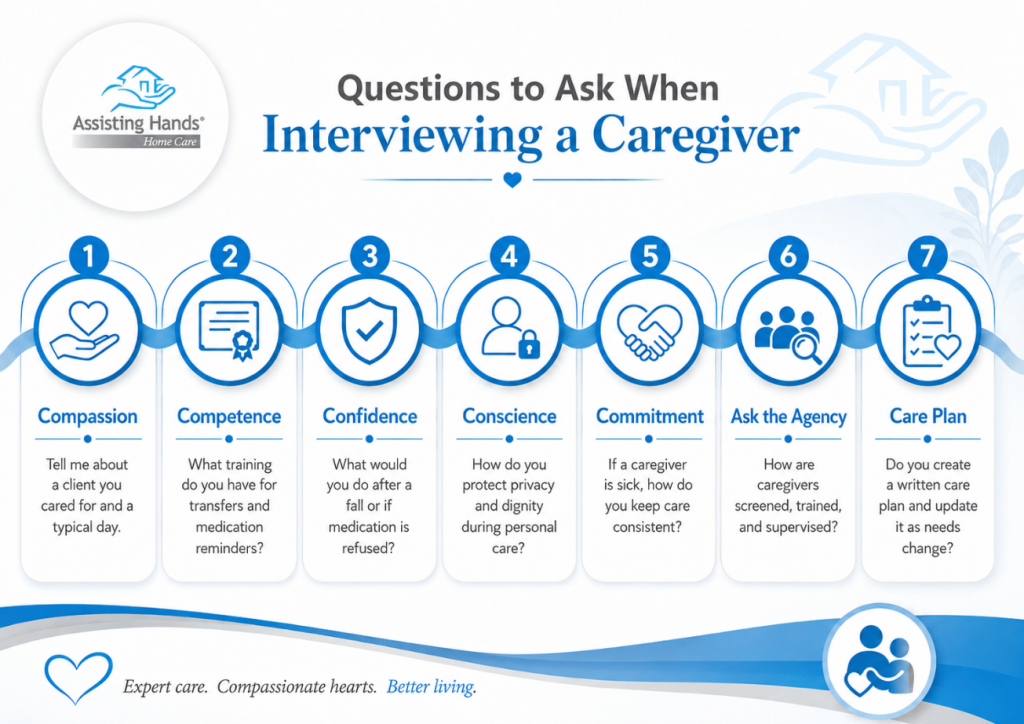
Questions to Ask When Interviewing a Caregiver
Use these to pressure-test all five C’s in a single conversation:
- Can you tell me about a client you cared for and what a typical day looked like? (Compassion)
- What training have you completed, and how do you handle a safe transfer or medication reminders? (Competence)
- What would you do if my parent has a fall or refuses to take their medication? (Confidence)
- How do you protect a client’s privacy and dignity during personal care? (Conscience)
- What happens if my regular caregiver is sick, and how do you keep the same caregiver on my case? (Commitment)
- How does your agency screen, train, and supervise caregivers? (Ask the agency directly)
- Do you create a written care plan, and how is it updated as needs change?
If you are hiring through an agency rather than an individual, aim most of these at the agency. A strong provider has clear answers about screening, training, backup coverage, and how they match a caregiver to your family.
Which of the 5 C’s of Caregiving Is Most Important?
No single C outranks the others, because they depend on each other. Competence without compassion feels cold, and compassion without competence is not safe. Confidence grows from competence, and commitment is what keeps all of it going over time. If a caregiver is strong in four C’s but weak in one, you will eventually notice the gap.
If families press for a starting point, conscience and commitment are the two that are hardest to fake and hardest to observe from the outside, so they are worth screening for most carefully. But the honest answer is that quality care needs all five working together.
Choosing Quality Care in Hollywood, FL
The 5 C’s give families a way to name what good care feels like: a caregiver who is kind, skilled, steady, honest, and reliable. Caregiving does not require perfection. It requires intention, and the five C’s are a way to check for it before you hire.
At Assisting Hands Home Care, we build our care around these qualities. Our caregivers are trained, screened, and supported so they can show up with compassion and competence day after day, and we start every client with a complimentary in-home consultation to build a care plan that fits your loved one.
If you are ready to find a caregiver in Hollywood, FL or the surrounding areas of Broward County who checks all five boxes, give us a call at (954) 859-2271 to learn more about our senior home care services or to schedule your free consultation.
Frequently Asked Questions About the 5 C’s of Caregiving
What are the 5 C’s of caregiving?
The 5 C’s of caregiving are compassion, competence, confidence, conscience, and commitment. Together they describe the qualities of a trustworthy caregiver: someone who is kind, skilled, steady, honest, and reliable.
Who created the 5 C’s of caregiving?
The 5 C’s were developed by Sister Simone Roach, a Canadian nursing theorist, who introduced them in her 1987 book Caring: The Human Mode of Being. She later added a sixth C, comportment, in 1992.
What is the difference between the 5 C’s and the 6 C’s of caring?
There are two versions of a 6 C’s framework. Roach added comportment to her original five in 1992. Separately, the UK’s National Health Service introduced its own 6 C’s in 2012: care, compassion, competence, communication, courage, and commitment. Roach’s original five remain the most common framework for describing quality caregiving in home care.
Which of the 5 C’s is most important?
No single C outranks the others, because they depend on each other. Competence without compassion feels cold, and compassion without competence is not safe. If families want a starting point, conscience and commitment are the hardest to fake and the hardest to observe, so they are worth screening for most carefully.
Why do the 5 C’s matter specifically in home care?
Home care happens in private, often one-on-one, so a family cannot supervise it directly. The 5 C’s give families a clear way to judge a caregiver’s character and habits before they hire, and a shared vocabulary for talking with an agency about what quality care should look like.

