

If you are seeing a parent or loved one lose interest in food — you are not alone. And you are right to pay attention. Loss of appetite in seniors is one of the most common concerns families raise. But it is also one of the most frequently disdained — because many people assume it is just part of getting old.
It is not that simple. And the outcomes of not eating enough are serious.
Let us talk about what is really happening — and what you can actually do about it.
Is Appetite Loss Normal in Seniors?
This is the first question most extended family ask. And the answer is more nuanced than a simple yes or no.
To some extent — yes. Some reduction in appetite is a natural part of aging. As the body ages, metabolism slows, muscle mass decreases, and caloric needs gradually reduce. A senior who was once hungry three times a day may naturally feel satisfied with less food as they get older.
But here is what most families do not hear often enough.
According to Hope Barkoukis, chair of the department of nutrition at Case Western Reserve University, loss of appetite is not a normal part of healthy aging. While some mild reduction is expected — significant appetite loss that leads to weight loss and nutritional decline is a medical concern that deserves attention.
There is a critical difference between eating a little less as you age — and losing interest in food entirely. The first is biology. The second is a warning sign.
Families often make the mistake of accepting poor appetite because they do not want to make a fuss. But consistently not eating enough is one of the most significant predictors of physical and cognitive decline in older adults. It deserves attention — not acceptance.
At What Age Does Appetite Loss Begin in Seniors?
This surprises most families — because the changes often start earlier than expected.
Most research suggests appetite begins to decline gradually from around age 60 to 65. The changes are subtle at first. A smaller portion here. Skipping breakfast there. Not finishing a plate they once cleaned easily.
However the most significant and noticeable changes typically happen after age assistinghands.com/70/senior-care/articles/appetite-and-weight-loss-in-the-elderly-causes-and-treatment”>U.S. News and World Report, the aging process causes several physiological changes that lead to decreased appetite — and these changes become more pronounced as adults move into their 70s and 80s.
By age 80 and beyond — appetite loss is more common than not. The combination of hormonal changes, slower digestion, reduced activity, and often multiple medications creates a perfect storm that makes eating feel like an effort rather than a pleasure.
It is not a sudden switch. It is a gradual process that families often notice slowly — until one day they realize their loved one has barely eaten in a week and they are not sure when it started.
That gradual onset is exactly why families need to pay attention early — before appetite loss becomes a nutritional crisis.
How Many Seniors Experience Appetite Loss?
More than most families realize — and far more than ever get help for it.
Research finds that one in four seniors suffers from appetite loss. That is approximately 25% of all older adults — a significant portion of the senior population dealing with a condition that profoundly affects their health and quality of life.
According to DailyCaring, the clinical name for this condition is the anorexia of aging — a complex issue driven by a combination of physiological and lifestyle changes. It is not a choice. It is not stubbornness. It is biology — layered on top of emotions, medications, and circumstances.
And yet — many seniors never mention it to their doctor. Why? Because they assume nothing can be done. Because they do not want to worry their family. Because they genuinely believe it is just part of getting older.
It does not have to be. Most causes of appetite loss in seniors are addressable — when someone takes the time to find them.
Normal Appetite Changes vs. Warning Signs in Seniors
| Normal Aging Appetite Changes | Warning Signs That Need Attention |
|---|---|
| Eating slightly smaller portions | Rapid or noticeable weight loss |
| Occasionally skipping meals | Rarely eating full meals for days |
| Feeling full slightly faster | Loss of interest in food completely |
| Mild appetite reduction with age | Weakness, fatigue, or dizziness |
| Occasional taste changes | Signs of dehydration or confusion |
What Is the Anorexia of Aging?
You may not have heard this term before. But understanding it helps families move from confusion to action.
The anorexia of aging refers to the gradual, age-related decline in appetite and food intake that affects a significant portion of older adults. Unlike eating disorders in younger people — the anorexia of aging is driven primarily by physiological changes in the body, compounded by social, emotional, and medical factors.
According to Hebrew Senior Life, physical changes in the body, shifts in mental health, and certain medications all contribute to the anorexia of aging. It is rarely just one thing. It is almost always several things working together.
Understanding what is driving it in your particular loved one is the first step toward fixing it.
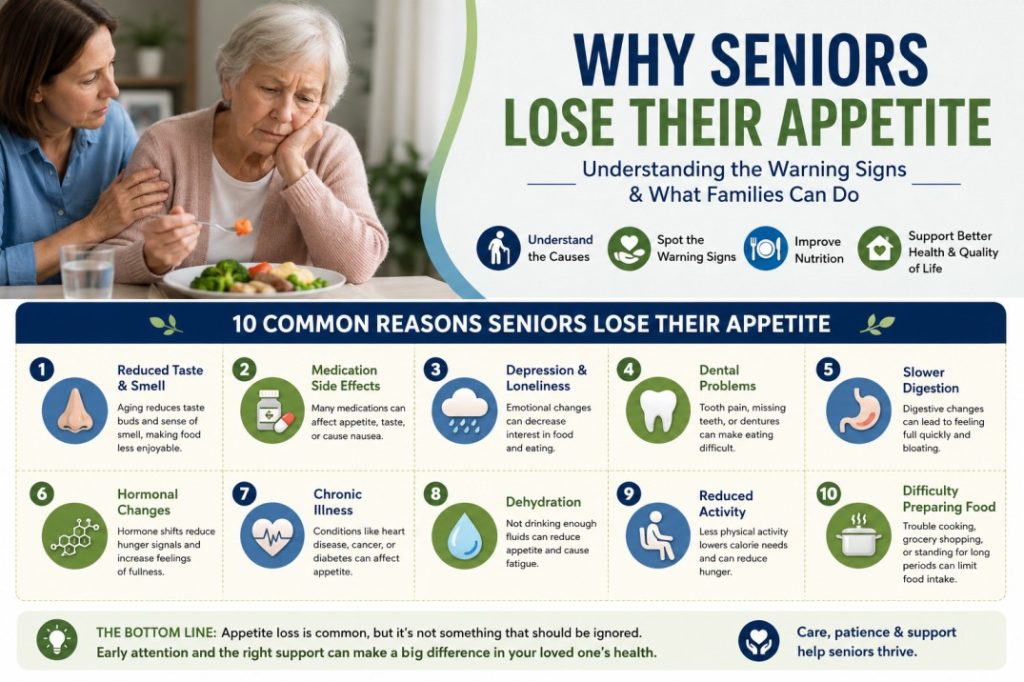
10 Reasons Why Seniors Lose Their Appetite
Here are the most common causes — and what each one actually means for your loved one:
1. Food Does Not Taste or Smell the Same Anymore
This one surprises most families.
According to DailyCaring, seniors typically have only about half as many taste buds as they had in their youth. The senses of taste and smell can diminish significantly with age — making previously favorite foods taste bland, flat, or completely different.
When food stops tasting good — eating stops feeling worthwhile. It is that simple. And it is one of the most overlooked causes of appetite loss in seniors.
2. Hormonal Changes Reduce Hunger Signals
The body’s internal hunger signals change with age.
Levels of ghrelin — the hunger-stimulating hormone decline with age. At the same time cholecystokinin — the hormone that signals fullness remains elevated or even increases. The result is a senior who feels full after just a few bites — and rarely feels genuinely hungry even when they have not eaten for hours.
3. Slower Digestion
The digestive system slows down considerably with age.
When food takes longer to move through the digestive tract — seniors feel full for longer periods after meals. This means they may genuinely not feel hungry at mealtimes — even when their body desperately needs nutrition.
4. Medications — One of the Biggest Culprits
This is the cause families miss most often.
According to the National Council on Aging, nearly 93% of adults aged 65 and older have at least one chronic condition — and about 79% have two or more. Managing multiple conditions means managing multiple medications. And many common medications directly affect appetite.
Common medication side effects that reduce appetite include:
- Nausea and stomach upset — makes eating feel unpleasant
- Dry mouth — makes chewing and swallowing uncomfortable
- Changes to or loss of taste — food stops tasting appealing
- Constipation — causes a persistent feeling of fullness
- Fatigue — makes the effort of eating feel too great
If your loved one’s appetite changed around the same time a medication was added or adjusted — that connection is worth raising with their doctor immediately.
5. Depression and Grief
Food and emotion are deeply connected. And seniors face more emotional losses than most families realize.
According to Care.com, loneliness, social isolation, and depression are among the most significant drivers of appetite loss in older adults. A senior who has lost a spouse, close friends, or their sense of purpose often loses interest in eating too — because meals feel lonely rather than pleasurable.
Eating alone every day is not just sad. It is a real, well-documented cause of reduced food intake.
6. Dental Problems and Difficulty Chewing
Eating should not hurt. But for many seniors — it does.
Dental problems — including missing teeth, ill-fitting dentures, painful gums, and tooth decay — make eating physically uncomfortable or even painful. When chewing hurts — seniors simply eat less. And many never mention it because they feel embarrassed or assume nothing can be done.
7. Chronic Illness and Health Conditions
Many health conditions directly suppress appetite.
According to U.S. News and World Report, conditions commonly associated with appetite loss in seniors include cancer, chronic kidney disease, heart failure, thyroid disorders, gastrointestinal conditions, and infections. In many cases — treating or better managing the underlying condition significantly improves appetite.
If appetite loss came on suddenly or is accompanied by other symptoms — this is the first place to look.
8. Dehydration
This connection surprises most families — but it is very real.
Seniors can become dehydrated without noticing it — because the sense of thirst diminishes with age. And dehydration directly suppresses appetite. A senior who is not drinking enough water throughout the day will feel less hungry at mealtimes — creating a harmful cycle of poor hydration and poor nutrition.
9. Reduced Physical Activity
Movement drives hunger. When a senior becomes more sedentary — appetite naturally decreases.
According to Healthline, light physical activity such as low-impact exercise and short walks can meaningfully improve appetite in older adults — by increasing energy expenditure and stimulating hunger hormones. A senior who sits most of the day may genuinely not feel hungry — not because of illness but because their body has not used enough energy to need refueling.
10. Loss of Independence in the Kitchen
For many seniors — especially those with arthritis, limited mobility, or cognitive decline — cooking has simply become too hard.
Standing at the stove for 30 minutes is exhausting. Chopping vegetables with arthritic hands is painful. And navigating a grocery store alone is overwhelming. When eating requires more effort than it feels worth it, seniors find reasons to skip meals. Not because they are not hungry — but since the barrier to getting food is too high.
Why Poor Appetite in Seniors Is Serious — Not Just Inconvenient
This is the part families need to understand clearly.
The anorexia of aging increases the overall risk of sickness and mortality. That is a clinical way of saying — consistently not eating enough shortens life.
More specifically — poor nutrition in seniors leads to:
- Malnutrition — which accelerates physical and cognitive decline
- Muscle loss (sarcopenia) — leading to weakness, poor balance, and increased fall risk
- Weakened immune system — more frequent illness and slower recovery
- Bone loss — increasing the risk of fractures from falls
- Poor wound healing — a particular concern after surgery
- Depression and cognitive decline — nutrition directly affects brain health
- Dehydration — appetite and hydration are closely connected
For a senior living at home — these are not abstract risks. They are the difference between independence and crisis.
Can Medications Cause Appetite Loss in Seniors?
Yes — significantly. And it is one of the most commonly missed causes of poor appetite in older adults.
Here is a number that stops most families in their tracks.
According to research published in the journal Nursing Older People and cited by Caring for the Ages — up to 250 commonly used medications can impact appetite in older adults. Two hundred and fifty. And most seniors are taking several of them simultaneously.
The problem is not just individual medications. It is the combination. When a senior takes multiple prescriptions — and the vast majority of older adults do — interactions between drugs can create side effects that no single medication would cause on its own. The National Council on Aging notes that nearly 93% of adults aged 65 and older have at least one chronic condition — and about 79% have two or more. That means most seniors are managing multiple conditions with multiple medications — every single day.
Can Medications Cause Appetite Loss in Seniors?
Yes — significantly. And it is one of the most commonly missed causes of poor appetite in older adults.
Here is a number that stops most families in their tracks.
According to research published in the journal Nursing Older People and cited by Caring for the Ages — up to 250 commonly used medications can impact appetite in older adults. Two hundred and fifty. And most seniors are taking several of them simultaneously.
The problem is not just individual medications. It is the combination. When a senior takes multiple prescriptions — and the vast majority of older adults do — interactions between drugs can create side effects that no single medication would cause on its own. The National Council on Aging notes that nearly 93% of adults aged 65 and older have at least one chronic condition — and about 79% have two or more. That means most seniors are managing multiple conditions with multiple medications — every single day.
Which Medications Most Commonly Cause Appetite Loss in Seniors?
According to the University of Arkansas Medical Sciences Geriatric Education Center and research published in the National Library of Medicine, medications well-known to reduce appetite in older adults include:
- Amiodarone — heart rhythm medication
- SSRIs and SNRIs — antidepressants including fluoxetine and sertraline
- Opioid pain medications — causing constipation and nausea
- Antibiotics — particularly quinolones and metronidazole
- ACE inhibitors — blood pressure medications
- Digoxin — heart medication
- Levodopa — Parkinson’s medication
- Cholinesterase inhibitors — dementia medications including donepezil
- Anticonvulsants — seizure medications
- Antipsychotics and benzodiazepines — cause sedation at mealtimes
This is not a completed list. According to Caring for the Ages, the list of medications that can contribute to appetite loss runs to over 250 commonly used drugs. Which is why a comprehensive medication review — not guesswork — is always the right approach.
What Families Should Do
If your loved one’s appetite changed around the same time a medication was added or adjusted — that connection is worth raising with their doctor directly. Do not assume it is coincidence.
According to the University of Arkansas Medical Sciences Geriatric Education Center, stopping appetite-reducing medications — or reducing them to their lowest effective dose — may aid in restoring appetite. A focused attempt to reduce overall pill burden or spread out medication administration throughout the day can also help.
This single step — a thorough medication review — sometimes produces dramatic improvements in appetite that families had been struggling to achieve for months. And it costs nothing to ask.
How Can a Caregiver Help With Senior Appetite Loss?
At Assisting Hands Forsyth, GA, our caregivers do far more than just prepare a meal and leave. They sit with your loved one. They learn their favorite dishes. They make mealtimes feel like something worth showing up for — not just another task to get through alone.
From meal planning and preparing nutritious home-cooked meals to grocery shopping, encouraging gentle daily activity, and simply providing the warm company that makes eating enjoyable again — our caregivers address the root causes of appetite loss every single day.
And because they are there regularly — they notice when something changes. A few bites less than yesterday. A new complaint about food tasting different. Early signs that most families only catch weeks later.

