

Key Summary:
The 5 core exercises:
- Memory matching games (photo/picture pairs, scalable in difficulty)
- Word puzzles and simple trivia (best when rooted in the person’s own life history)
- Music and sing-along activities (reaches people even in late-stage dementia)
- Sorting and organizing tasks (laundry, buttons, cards, gives a sense of purpose)
- Jigsaw puzzles and building activities (large-piece, not standard 1,000-piece puzzles)
Introduction
When a loved one is living with dementia, it’s natural to look for something you can do. Something that helps. Brain exercises won’t cure dementia or reverse it, and it’s important to be honest about that from the start. But the right activities can help a person stay mentally engaged, keep using the skills they still have, and get through the day with more connection and less frustration.
That last part matters more than most caregivers expect. An afternoon spent matching family photos or singing along to an old favorite isn’t just “keeping busy.” It can ease boredom, lower anxiety, spark a memory, and give someone a reason to smile.
The key is fit. A game that works beautifully for someone in the early stage may overwhelm a person in a later stage, and an activity your father loved at 60 might not hold his attention now. Below are five brain exercises that adapt well to different abilities, plus practical guidance on choosing activities, building a routine, and knowing when to adjust. If you’re caring for a parent or spouse with dementia in the Westlake area, our team at Assisting Hands Home Care can help you put these ideas into practice at home.
How Brain Exercises Benefit Seniors with Dementia
Mental activity does more than pass the time. A 2023 Cochrane review of 37 randomized controlled trials involving 2,766 people with mild-to-moderate dementia found moderate-quality evidence that cognitive stimulation activities produce a small benefit in cognition, roughly equivalent to a six-month delay in typical decline, along with a modest improvement in self-reported quality of life. The strongest finding was high-quality evidence for improved communication and social interaction, which lines up with what caregivers see at home every day. For a person living with dementia, a good activity can:
- Stimulate memory and thinking skills: Recalling a name, sorting by color, or finishing a familiar phrase gently exercises attention, recall, and reasoning.
- Encourage communication: Many activities give a person a reason to talk, whether that’s naming what they see or telling a story a photo brings back.
- Reduce anxiety and agitation: A calm, predictable activity can settle restlessness and redirect energy away from distress.
- Build confidence and a sense of independence: Completing something on their own, however small, reminds a person they can still do things.
- Provide meaningful daily engagement: Purposeful activity, like folding laundry or arranging flowers, feels useful in a way that filler activities don’t.
- Strengthen social connection: Doing an activity together is time spent together, and that contact is good for mood and for the brain.
- Support emotional well-being: Music, reminiscing, and creative play often bring comfort and pleasure that reach a person even when words are getting harder.
None of these benefits require the person to “win” or get every answer right. Engagement is the goal.
How to Choose the Right Brain Exercises for a Senior with Dementia
The best activity is the one your loved one will enjoy and can manage without feeling defeated. A few things to keep in mind:
- Match the activity to the stage of dementia: Early on, someone may handle a crossword or a card game. Later, simpler tasks like matching socks or listening to music tend to work better. Watch what your loved one can do today rather than what they could do last year.
- Focus on enjoyment, not performance: If they’re smiling and involved, it’s working, even if the puzzle never gets finished.
- Keep sessions short: Fifteen to 30 minutes is usually plenty. Stop before fatigue sets in.
- Steer clear of anything that reliably causes frustration: If an activity ends in tears or anger most times, it’s the wrong activity, not a reason to try harder.
- Celebrate taking part, not correct answers: Praise the effort and the moment, and quietly skip past mistakes instead of correcting them.
Quick Reference: Matching Activities to Ability
| Activity Type | Best For | Typical Time | What You Need |
|---|---|---|---|
| Memory Matching Games | Early to middle stage | 15–20 minutes | Picture cards or family photos |
| Word Puzzles and Trivia | Early stage | 15–30 minutes | Large-print puzzle book, no equipment for trivia |
| Music and Sing-Along | All stages, including late stage | 15–30 minutes | A speaker, playlist, or simple instrument |
| Sorting and Organizing | Middle stage | 10–20 minutes | Household items already on hand |
| Jigsaw and Building | Early to middle stage | 15–30 minutes | Large-piece or wooden puzzles |
With that foundation, here are five categories of brain exercises to try.
1. Memory Matching Games
Matching games are a gentle way to work on recall and attention, and they scale easily from simple to more demanding. Options include:
- Picture matching cards with clear, familiar images
- Family photo matching, using duplicate prints of relatives, pets, or old homes
- Simple object matching, like pairing everyday items
- Matching colors or shapes for someone who needs a more basic version
The pairing action asks the brain to hold an image in mind and search for its match, which lightly exercises short-term memory and focus. Family photos add another layer, since a familiar face often draws out a name, a story, or a warm reaction. If a full memory-match deck feels like too much, cut it down to four or six pairs and turn only a couple of cards face down at a time.
2. Word Puzzles and Simple Trivia
Word activities keep language and recall active, as long as the difficulty stays comfortable. A few ideas:
- Large-print word searches with short, everyday words
- Fill-in-the-blank phrases, especially well-known sayings (“A penny saved is a penny…”)
- Naming games, like listing animals, fruits, or colors
- Familiar song lyrics, where you sing a line and let them finish it
- Easy trivia drawn from their own past, such as the town they grew up in or the car they used to drive
Trivia rooted in a person’s own life tends to land best, because long-term memories often stay accessible longer than recent ones. Keep the bar low. If a question stumps them, offer the answer cheerfully and move on. The moment word games start feeling like a test, the benefit is lost.
3. Music and Sing-Along Activities
Music reaches people with dementia in a way little else does. A song from someone’s youth can bring back a flood of memory and feeling even in the later stages of the disease. Try:
- Singing favorite songs together, from hymns to big-band standards to whatever was playing at their wedding
- Identifying familiar tunes and talking about where they first heard them
- Clapping or tapping to a rhythm
- Playing simple percussion instruments like a tambourine, shaker, or hand drum
Beyond the memories it stirs, music tends to lift mood and calm agitation, which makes it a useful tool during a restless afternoon or a difficult transition in the day. You don’t need any musical skill on either side. The point is participation and pleasure, not a good performance.
4. Sorting and Organizing Activities
Everyday tasks can be some of the most satisfying brain exercises, because they give a person a real sense of purpose alongside the mental stimulation. Sorting and organizing tap into problem-solving, categorization, and hand movements. Examples include:
- Sorting playing cards by color or by suit
- Folding towels or washcloths
- Organizing buttons by size or color
- Arranging flowers in a vase
- Matching socks from a laundry basket
These tasks feel useful, and that matters. Helping with the laundry or setting the table can give a person a role in the household again, which supports dignity and self-worth. Choose tasks with no wrong answer and no time pressure and let the process be the reward rather than the finished result.
5. Jigsaw Puzzles and Building Activities
Puzzles and building tasks work on problem-solving, spatial thinking, and hand-eye coordination. The trick is picking the right level of challenge:
- Large-piece jigsaw puzzles with a clear, familiar picture
- Wooden puzzles with chunky, easy-to-grip pieces
- Shape sorting toys and boards
- Block stacking
Fitting pieces together asks the brain to plan, compare, and adjust, and it gives the hands something purposeful to do. Standard 1,000-piece puzzles will frustrate almost anyone with dementia, so start with puzzles designed for young children or specifically for people with memory loss, which use larger pieces and simpler images without feeling childish. If one puzzle becomes easy and enjoyable, you can nudge the difficulty up a little.
Additional Brain-Stimulating Activities
Beyond the five categories above, plenty of everyday moments can double as gentle mental exercise. Mix these in to keep things fresh:
- Reading together, or reading aloud to them
- Looking through family photo albums and talking about the people and places
- Gardening, even just potting a plant or watering flowers
- Arts and crafts
- Painting or coloring
- Chair yoga paired with simple counting
- Simple cooking or baking, like stirring, measuring, or decorating
- Reminiscence conversations about their childhood, work, or family
- Nature walks with an observation game (“Let’s find something red”)
Variety helps. Different activities work different skills and keep a person from getting bored, so rotating through several over a week tends to work better than repeating the same one every day.
Activities That Can Frustrate a Senior with Dementia
Some activities do more harm than good for a person with dementia because they invite failure and frustration. As a general rule, skip:
- Overly complicated puzzles or games with many rules
- Competitive games that create pressure to win
- Anything timed or rushed
- Tasks that require a lot of reading or writing
- Activities that tend to leave your loved one stressed, embarrassed, or upset
If an activity used to be a favorite but now causes distress, it’s okay to retire it. Meeting the person where they are today is a kindness, not a step backward.
How to Create a Dementia-Friendly Activity Routine
A little structure makes activities more successful and less stressful for everyone. When you set up a routine, try to:
- Schedule activities during their best time of day: Many people with dementia are sharper and calmer in the morning, and more tired or unsettled in the late afternoon, a pattern sometimes called sundowning. Plan around it.
- Reduce distractions: Turn off the TV, quiet the room, and clear clutter from the table so the activity has their full attention.
- Give clear, one-step instructions: Break a task into single steps and offer them one at a time. “Let’s fold this towel” works better than a full explanation of the whole basket.
- Invite participation without pressure: Offer, model, and encourage, but don’t push. If they say no, try again later or switch to something else.
- End on a positive note: Wrap up while they’re still enjoying it and offer genuine praise, so the memory of the activity is a good one.
When to Adjust Brain Exercises For Dementia Seniors
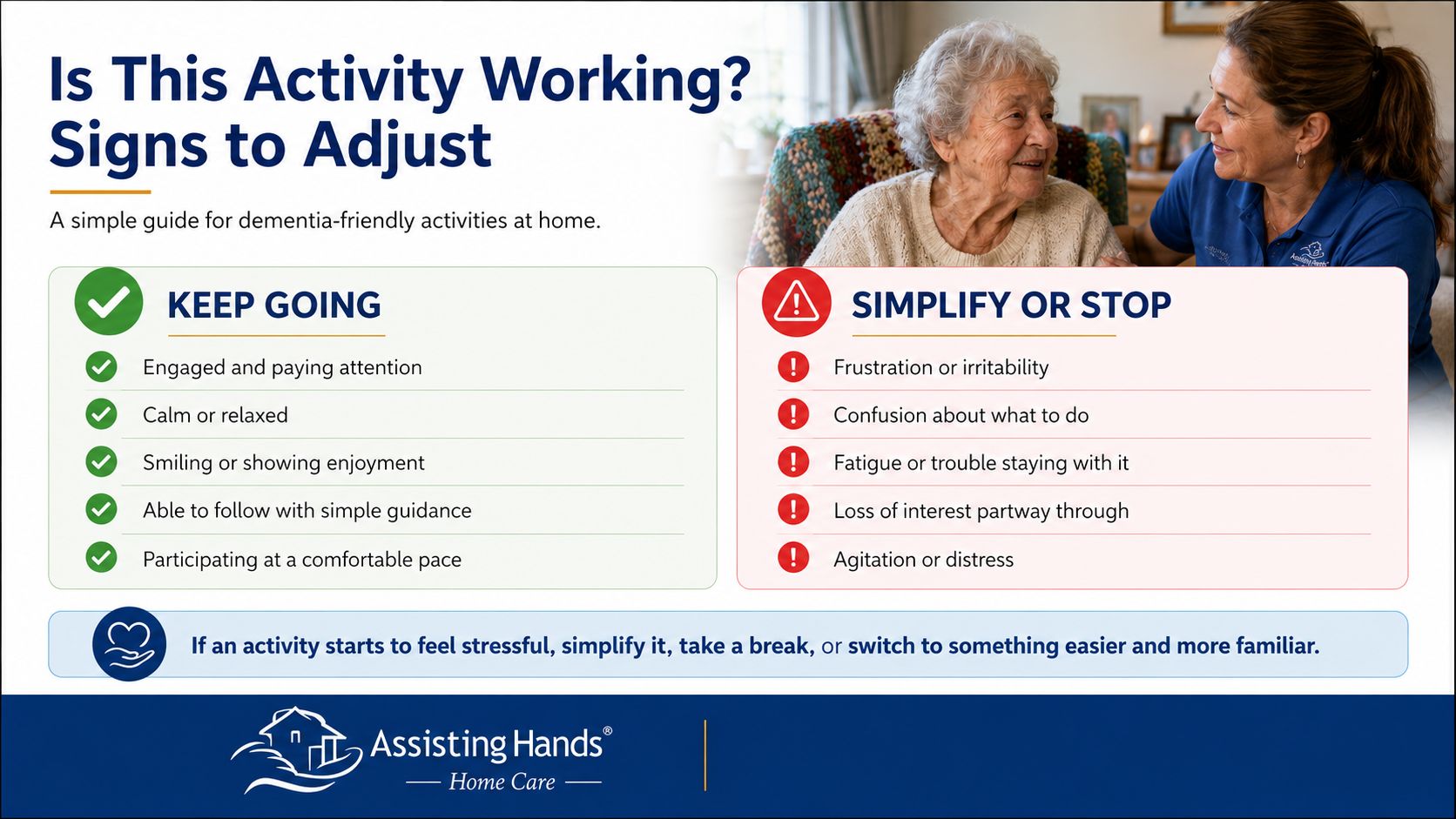
Pay attention to how your loved one responds and let their reaction guide you. Signs that an activity may be too difficult include:
- Frustration or irritability
- Confusion about what to do
- Fatigue or trouble staying with it
- Loss of interest partway through
- Agitation or distress
When you notice these, don’t push through. Simplify the activity, take a break, or switch to something easier and more familiar. Abilities change over time with dementia, sometimes month to month, so an activity that fit perfectly a while ago may need to be scaled back. Adjusting is part of doing this well.
How In-Home Dementia Care Can Help
Leading engaging activities day after day, on top of everything else caregiving involves, is a lot to carry alone. Professional in-home caregivers can share that load. At Assisting Hands Home Care, our caregivers can:
- Lead cognitive and memory activities suited to your loved one’s abilities
- Support consistent daily routines that keep a person grounded
- Provide companionship and conversation throughout the day
- Encourage social interaction and connection
- Adapt activities as your loved one’s needs change over time
- Give family caregivers a chance to rest, run errands, or simply breathe
Our caregivers are trained, bonded, and experienced in Alzheimer’s and dementia care, and we build a personalized plan around your family’s situation. We serve Westlake, Avon, Avon Lake, and the surrounding Ohio communities.
If you’d like help caring for a loved one with dementia at home, call Assisting Hands Home Care of Westlake at 440-517-4623 or request a free in-home consultation. We’re glad to talk through your options and answer your questions.
Brain Exercises for Seniors with Dementia FAQs
What are the best brain exercises for seniors with dementia?
The best brain exercises are the ones your loved one enjoys and can do without frustration. Good options include memory matching games, large-print word searches and simple trivia, music and sing-along activities, sorting and folding tasks, and large-piece jigsaw puzzles. Match the activity to their current abilities and focus on engagement rather than getting the right answer.
Do brain games help people with dementia?
Brain games can help a person with dementia stay mentally engaged, use the skills they still have, and enjoy their day more. They can also reduce boredom and agitation and encourage social connection. Brain games do not cure or reverse dementia, but they can support cognitive function and quality of life.
How often should someone with dementia do cognitive activities?
A little each day tends to work well. Short, regular sessions of about 15 to 30 minutes are usually more effective than long or occasional ones. Watch your loved one’s energy and mood, and adjust the frequency to what feels comfortable for them.
Can puzzles slow dementia progression?
Puzzles and other mental activities support brain engagement and day-to-day function, and some research links regular cognitive activity to slower decline in certain skills. That said, puzzles are not a treatment and cannot stop or reverse dementia. Think of them as one helpful part of overall care.
Are memory games good for Alzheimer’s patients?
Yes. Memory games like picture matching and family photo matching gently exercise recall and attention, and they often spark conversation and positive emotion. Keep them simple enough to avoid frustration, and reduce the difficulty as needed over time.
What activities are best for late-stage dementia?
In later stages, the simplest and most sensory activities usually work best. Listening to familiar music, holding and looking at family photos, feeling different textures, gentle hand massage, and simple sorting tasks can provide comfort and connection even when words are difficult. The goal shifts toward reassurance and pleasant sensory experiences.
How long should brain exercises last?
Around 15 to 30 minutes is a good target but follow your loved one’s lead. If they’re tiring or losing interest sooner, stop earlier. It’s better to end while they’re still enjoying the activity than to push until they get frustrated.
What if my loved one refuses to participate?
Don’t force it. Try again at a different time of day, offer a different activity, or join in yourself to make it feel social rather than like a task. Sometimes a refusal means the activity is too hard, the timing is off, or they’re simply tired. Meeting them where they are usually works better than insisting.
Are music activities beneficial for dementia patients?
Very much so. Music often reaches people with dementia even in advanced stages, bringing back memories and lifting mood. Singing familiar songs, listening to favorites, or tapping along to a rhythm can calm agitation and create moments of real connection.
Can exercise and brain games be combined?
Yes, and combining them can be especially helpful. Physical activity supports brain health by improving blood flow, and pairing gentle movement with mental engagement, like chair yoga with counting or a nature walk with an observation game, works both body and mind at once. Check with a doctor before starting any new physical activity.
Should I correct my loved one when they get something wrong?
Generally, no. Correcting mistakes can cause embarrassment and frustration and rarely helps. Instead, gently offer the answer if needed, redirect, and keep the mood light. Participation and enjoyment matter far more than accuracy.
What time of day is best for brain exercises for dementia seniors?
For many people with dementia, mornings or early afternoons are best, when they tend to be more rested and alert. Later in the day, restlessness and confusion can increase. Notice your loved one’s own patterns and schedule activities during their calmer, sharper hours.
Do I need special equipment or games?
Not at all. Many effective activities use things you already have, like a deck of cards, family photos, a laundry basket, or household buttons. Purpose-made dementia activity products exist and can be helpful, but they aren’t required to get started.

