
Quick answer: To strengthen weak legs in the elderly, do strength exercises like sit-to-stands, calf raises, and step-ups 2 to 3 days a week. Start seated or with chair support, add balance practice, and progress slowly. Many seniors notice improvement within 4 to 8 weeks.
The first signs of leg weakness are often easy to miss, such as needing an extra push to get out of the recliner or reaching for the kitchen counter to steady themselves. These small changes may not seem like much at first, but they can be early signs that an older adult is losing leg strength, stability, and confidence when moving around.
For seniors in Melrose Park, winter can make the problem worse. Icy sidewalks and shorter days often mean less time outdoors and more hours spent sitting inside. Over time, that drop in activity can lead to weaker leg muscles and make everyday movements more difficult. The encouraging news is that it’s possible to build strength at any age, even in your 80s and 90s, with exercises suited to your abilities.
In this guide, we’ll cover two simple at-home tests to help identify leg weakness, three levels of leg-strengthening exercises for seniors (from gentle movements in bed to standing exercises that improve balance), and an easy weekly routine to help build strength over time.
Before beginning any new exercise routine, consult a doctor or physical therapist, particularly if your loved one has recently fallen, been hospitalized, or lives with a heart or lung condition.
What Causes Weak Legs in the Elderly?
Weak legs in older adults usually come from a combination of age-related muscle loss, too little activity, and health conditions that affect the joints, nerves, or blood flow.
- Sarcopenia: Muscle mass and strength decline gradually with age, and the large muscles of the thighs and hips are among the first to lose ground.
- Inactivity or a recent hospital stay: Muscles weaken quickly when they aren’t used. A week or two in a hospital bed can take away strength that took months to build.
- Arthritis: Painful knees and hips lead people to move less, and the muscles around those joints weaken as a result.
- Neuropathy and poor circulation: Nerve damage (common with diabetes) and circulation problems like peripheral artery disease can cause numbness, heaviness, cramping, or fatigue in the legs.
- Medication side effects: Some medications, including certain cholesterol drugs, steroids, sedatives, and blood pressure medications, can cause muscle aches, fatigue, or dizziness. Ask a pharmacist to review the full list.
- Low protein, vitamin D, or B12: Muscles need protein to rebuild, vitamin D supports muscle function, and a B12 deficiency can damage the nerves that control the legs.
When Is Leg Weakness a Medical Emergency?
Gradual weakness that builds over months is a reason to see a doctor and start exercising. Sudden leg weakness may be a medical emergency. Call 911 right away if leg weakness:
- Comes on suddenly, over minutes or hours
- Affects one side of the body, or one arm and leg together
- Comes with numbness, tingling, or a face that droops on one side
- Comes with confusion, slurred speech, trouble understanding words, or vision changes
- Comes with a sudden, severe headache or loss of balance
These symptoms can indicate a stroke, when every minute matters. Call 911 immediately, note when the symptoms first appeared, and let emergency responders transport the person rather than driving them to the hospital yourself.
Sudden weakness in both legs accompanied by new back pain or loss of bladder or bowel control also requires emergency medical attention. The same is true of sudden weakness along with a fever and new confusion, which may point to a serious infection in an older adult.
How to Test Leg Strength at Home Before You Start
These two tests come from the CDC’s STEADI (Stopping Elderly Accidents, Deaths & Injuries) program, which doctors use to screen older adults for fall risk. They take about five minutes and give you a starting number to measure progress against. Always have a second person stand close by during both tests.
30-Second Chair Stand Test
You’ll need a sturdy straight-backed chair without armrests (a seat about 17 inches high) pushed against a wall, and a timer.
- Sit in the middle of the chair with feet flat on the floor.
- Cross the arms at the wrists and place the hands on the opposite shoulders.
- On “go,” stand all the way up, then sit all the way back down.
- Repeat as many times as possible in 30 seconds and count the full stands.
If the person needs their arms to get up, stop the test and give them a score of zero. Compare the result to the CDC’s below-average scores:
| Age | Men: Below average if fewer than | Women: Below average if fewer than |
|---|---|---|
| 60 to 64 | 14 | 12 |
| 65 to 69 | 12 | 11 |
| 70 to 74 | 12 | 10 |
| 75 to 79 | 11 | 10 |
| 80 to 84 | 10 | 9 |
| 85 to 89 | 8 | 8 |
| 90 to 94 | 7 | 4 |
Source: CDC STEADI 30-Second Chair Stand assessment. A below-average score indicates a risk for falls.
Use the score to pick a starting level in the exercise section below. A score of zero (needs arms to stand) points to Level 1. A below-average score points to Level 2. An average score or better means Level 3 is likely a good fit.
4-Stage Balance Test
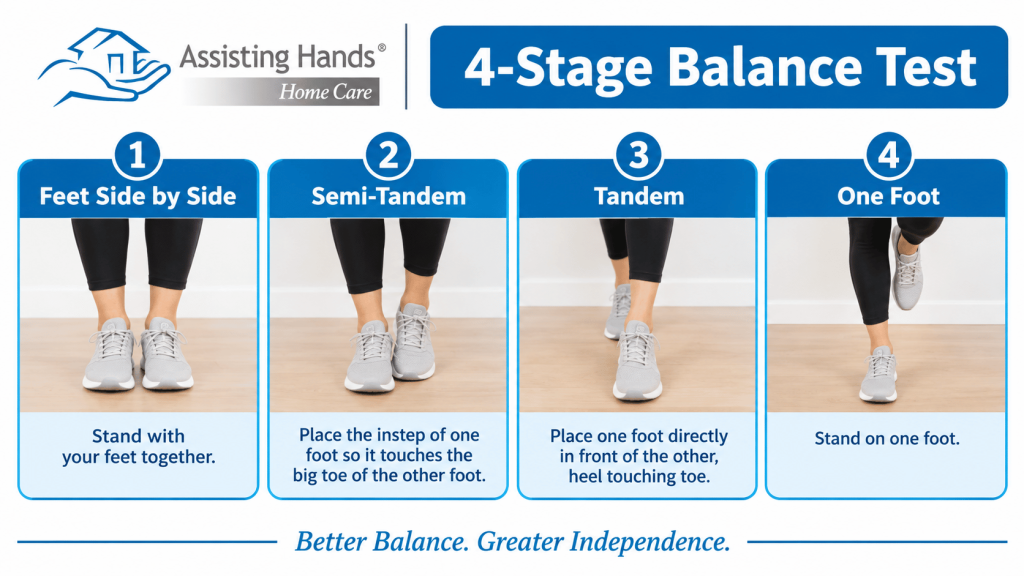
This test checks standing balance in four positions, each one harder than the last. Try to hold each position for 10 seconds without moving the feet or grabbing for support. Arms can move to help with balance. Don’t use a cane or walker during the test and keep the eyes open. If a position can’t be held for 10 seconds, stop there.
- Feet side by side.
- Semi-tandem: place the instep of one foot so it touches the big toe of the other foot.
- Tandem: place one foot directly in front of the other, heel touching toe.
- One foot: stand on one foot.
According to the CDC, an older adult who can’t hold the tandem stance (stage 3) for at least 10 seconds is at increased risk of falling. If that’s the case, keep a hand on the counter for every balance exercise and ask the doctor about a physical therapy referral.
Retest every 2 weeks. Write down the chair stand count and the balance times with the date. Seeing the numbers move is one of the best ways to stay motivated, and it tells you when to move up a level.
Leg Strengthening Exercises for Seniors by Ability Level
Each exercise below follows the same format. Move slowly, breathe normally (don’t hold your breath), and stop if anything causes sharp pain, chest pain, dizziness, or unusual shortness of breath.
Level 1: Seated and In-Bed Exercises for Very Weak Legs
Start here if standing up from a chair isn’t possible without the arms, or after a hospital stay or long illness. Use a sturdy chair without wheels or do the in-bed moves lying on the back.
Seated Marches
- Targets: Hip flexors and front of the thighs
- How to do it: Sit tall toward the front of the chair with feet flat. Lift the right knee a few inches, lower it slowly, then lift the left. Keep the back upright instead of leaning back.
- Reps: 10 per leg, 1 to 2 sets
- Make it easier: Lift only the heel and keep the toes on the floor or hold the sides of the seat.
- Daily task it helps: Lifting the feet into the car, over a door threshold, or into bed
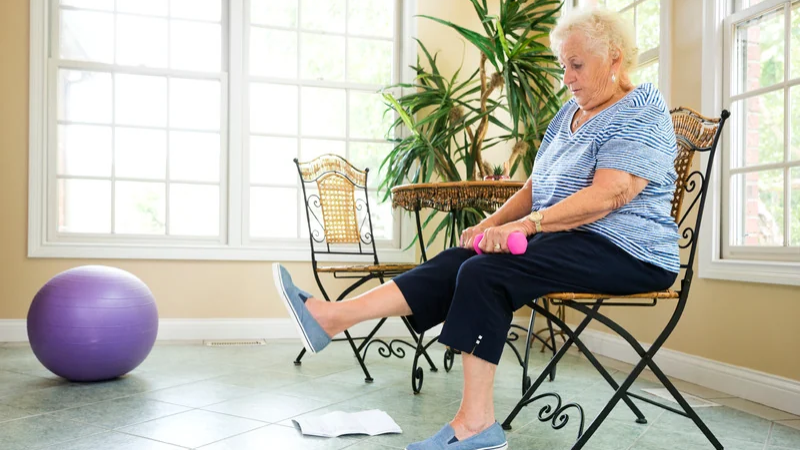
Seated Knee Extensions
- Targets: Quadriceps (front of the thigh)
- How to do it: Sit back in the chair. Straighten one knee until the leg is level with the floor, tighten the thigh muscle, hold for 3 seconds, then lower over 3 seconds.
- Reps: 8 to 12 per leg
- Make it easier: Straighten the knee only partway.
- Daily task it helps: Standing up from a chair and keeping the knees from buckling on stairs
Ankle Pumps
- Targets: Calves and shins, plus blood flow in the lower legs
- How to do it: Sitting or lying down, point the toes away, then pull them back toward the shins. Keep a steady rhythm.
- Reps: 15 to 20, several times a day
- Make it easier: Work one foot at a time with a smaller range.
- Daily task it helps: Lifting the toes while walking so they don’t catch on rugs, and reducing stiffness after sitting
Seated Heel Raises
- Targets: Calves
- How to do it: With feet flat and knees bent, press through the balls of the feet and lift both heels as high as possible. Hold for 2 seconds and lower slowly.
- Reps: 12 to 15
- Make it easier: Lift one heel at a time.
- Daily task it helps: Pushing off with each step when walking
Glute Squeezes
- Targets: Gluteal (buttock) muscles
- How to do it: Sitting or lying on the back, squeeze the buttock muscles together and hold for 5 seconds. Relax fully between reps.
- Reps: 10
- Make it easier: Hold for 2 to 3 seconds.
- Daily task it helps: Standing up straight and scooting or rolling over in bed
Heel Slides
- Targets: Hamstrings, quadriceps, and knee and hip mobility
- How to do it: Lie on the back with legs straight. Slide one heel toward the buttocks, bending the knee as far as comfortable, then slide it back out.
- Reps: 10 per leg
- Make it easier: Shorten the slide or place a plastic bag under the heel so it glides more easily on the sheet.
- Daily task it helps: Bending the knees to get in and out of bed and to pull on pants and socks
Level 2: Chair-Supported Standing Exercises
Move here once Level 1 feels easy, or if the person can stand from a chair but scores below average on the chair stand test. Use a kitchen counter or the back of a heavy chair for support.
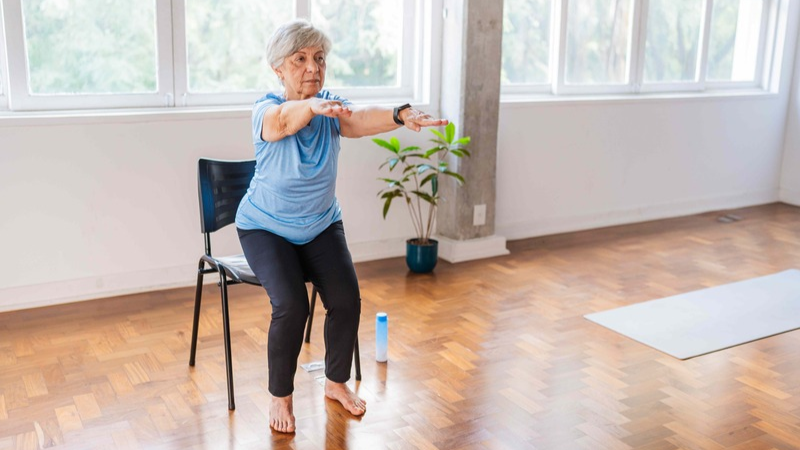
Sit-to-Stand (The Single Best Exercise)
If you only do one exercise, make it this one. It works every major leg muscle at once and copies the movement older adults rely on dozens of times a day.
- Targets: Quadriceps, glutes, hamstrings, and core
- How to do it: Push a sturdy chair against the wall. Scoot to the front edge with feet hip-width apart and slightly behind the knees. Lean forward (“nose over toes”), press through the heels, and stand up tall. Pause, then reach back for the seat and sit down slowly, taking about 3 seconds.
- Reps: 5 to 10, building to 12, for 1 to 2 sets
- Make it easier: Push off the armrests or add a firm cushion to raise the seat.
- Daily task it helps: Getting up from the toilet, a dining chair, or the car seat
Counter Calf Raises
- Targets: Calves and the small muscles that steady the ankles
- How to do it: Stand facing the kitchen counter with both hands resting on it. Rise onto the balls of the feet, hold for 1 to 2 seconds, and lower slowly.
- Reps: 10 to 15
- Make it easier: Rise only an inch or two and keep a firm grip.
- Daily task it helps: Walking with a stronger push-off and staying steady while standing at the stove or sink
Standing Side Leg Raises
- Targets: Outer hips (gluteus medius)
- How to do it: Stand behind a chair and hold the backrest. Keep the toes pointing forward and lift one leg out to the side 6 to 12 inches without leaning the upper body. Lower slowly.
- Reps: 8 to 12 per leg
- Make it easier: Make the lift smaller and hold the chair with both hands.
- Daily task it helps: Staying steady when turning around or stepping sideways around furniture
Standing Hamstring Curls
- Targets: Hamstrings (back of the thigh)
- How to do it: Hold the chair back. Bend one knee and bring the heel up toward the buttocks, keeping the knees side by side. Lower slowly.
- Reps: 8 to 12 per leg
- Make it easier: Do it seated by sliding one foot back under the chair as far as it goes, then forward again.
- Daily task it helps: Lifting the foot high enough to climb a stair or clear a curb
Mini Squats
- Targets: Quadriceps and glutes
- How to do it: Stand at the counter with feet hip-width apart. Bend the knees and push the hips back a few inches, as if starting to sit. Keep the knees in line with the toes and stand back up.
- Reps: 8 to 12
- Make it easier: Bend only an inch or two.
- Daily task it helps: Lowering under control onto a chair or toilet, and bending to pick up something light
Level 3: Standing Strength and Balance Exercises
Move here once Level 2 feels easy, or if the chair stand score is average or better. Keep a counter, railing, or sturdy chair within reach for every exercise, even if you don’t need to hold it.
Step-Ups
- Targets: Quadriceps, glutes, and balance
- How to do it: Stand at the bottom stair with a hand on the railing. Step up with the right foot, bring the left foot up to meet it, then step down with the right foot first. Do all reps on one side, then switch.
- Reps: 8 to 10 per leg
- Make it easier: Use a lower step (about 4 inches) and hold the rail with both hands.
- Daily task it helps: Climbing stairs, front steps, and curbs
Heel-to-Toe Walk
- Targets: Balance and the small stabilizing muscles in the ankles and hips
- How to do it: Walk along a kitchen counter or hallway wall. Place the heel of one foot directly in front of the toes of the other with each step. Look ahead, not down.
- Reps: 10 to 20 steps, 2 to 3 times
- Make it easier: Keep one hand on the counter and leave a small gap between heel and toe.
- Daily task it helps: Walking through narrow spaces like hallways and bathrooms, and on uneven ground
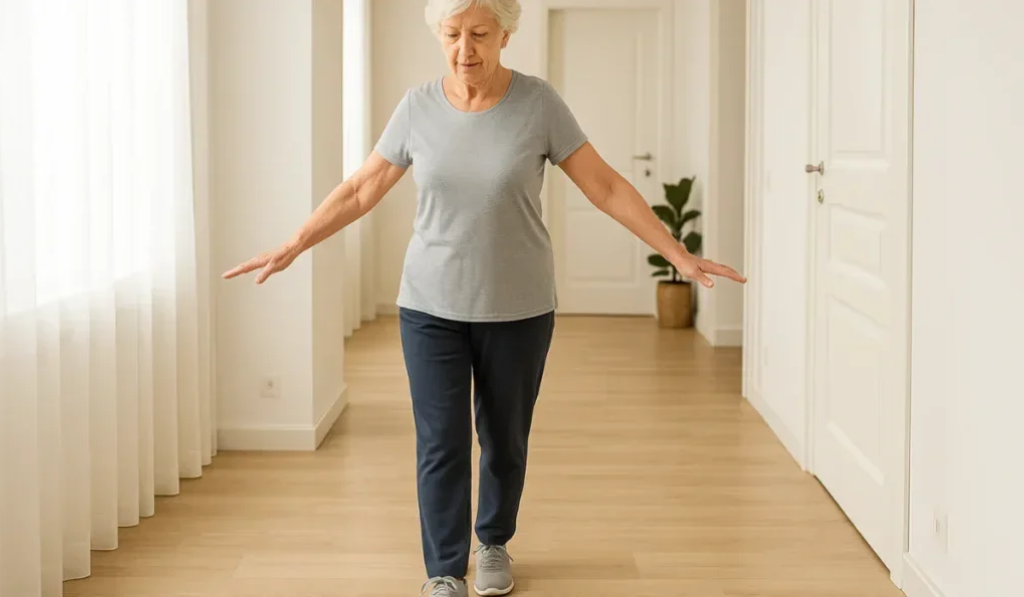
Single-Leg Stance
- Targets: Balance, hips, and ankles
- How to do it: Stand at the counter with hands resting lightly on top. Lift one foot slightly off the floor and hold, working up from 10 seconds toward 30.
- Reps: 3 holds per leg
- Make it easier: Rest the toes of the lifted foot on the floor or hold the counter with both hands.
- Daily task it helps: Stepping into pants, stepping over a pet, and getting in and out of the car
Resistance Band Side Steps
- Targets: Outer hips and side-to-side balance
- How to do it: Place a light loop band just above the knees. Stand with feet hip-width apart and knees slightly bent. Take 10 small steps to the side along the counter, then 10 steps back.
- Reps: 2 rounds each direction
- Make it easier: Skip the band until the movement feels steady.
- Daily task it helps: Catching your balance after a sideways stumble and moving around crowded rooms
Sit-to-Stand Without Using Hands
- Targets: Quadriceps, glutes, hamstrings, and core
- How to do it: Cross the arms over the chest, just like the chair stand test. Stand up tall without pushing off anything, then sit down slowly.
- Reps: 8 to 12, for 1 to 2 sets
- Make it easier: Rest one hand lightly on the thigh or raise the seat with a cushion.
- Daily task it helps: Getting up from low couches with your hands full or holding a cane
A Simple Weekly Leg Strengthening Plan for Seniors
This schedule follows the Physical Activity Guidelines for Americans from the U.S. Department of Health and Human Services. The guidelines call for adults 65 and older to get 150 minutes of moderate activity a week (about 30 minutes, 5 days a week), muscle-strengthening work on 2 or more days, and regular balance training.
| Day | Activity | Time |
|---|---|---|
| Monday | Strength: exercises from your current level | 15 to 20 minutes |
| Tuesday | Walking plus balance practice | 20 to 30 minutes |
| Wednesday | Strength: exercises from your current level | 15 to 20 minutes |
| Thursday | Walking plus balance practice | 20 to 30 minutes |
| Friday | Strength: exercises from your current level | 15 to 20 minutes |
| Saturday | Rest or a light walk | Optional |
| Sunday | Rest or a light walk | Optional |
When the weather turns, indoor laps around the house or a walk through a shopping mall can stand in for an outdoor walk. Someone starting at Level 1 won’t reach 150 minutes right away, and that’s fine. The guidelines say to be as active as abilities and conditions allow, then build from there.
The progression rule: When 12 reps of an exercise feel easy for 2 sessions in a row, move that exercise up to the next level. You can be at Level 2 for sit-to-stands and still at Level 1 for heel raises.
How Long Does It Take to Strengthen Weak Legs in Seniors?
Most seniors feel exercises get easier within 2 to 4 weeks, and noticeable muscle growth typically takes 8 to 12 weeks of consistent training.
The early progress comes mostly from changes in the nervous system rather than muscle growth. The brain becomes more efficient at sending signals to the muscles and coordinating movement, making exercises feel easier and allowing seniors to complete more repetitions.
That’s why repeating the chair stand test every two weeks is helpful. It provides a measurable way to track improvements in strength and mobility, even before physical changes become visible.
The key is consistency, not intensity. Muscle strength can begin to decline after just a few weeks without activity, so if your loved one misses a week, it’s better to ease back into the routine gradually than try to make up for lost time with an overly strenuous workout.
Leg Exercise Modifications for Common Conditions
Not every exercise is right for every senior. Arthritis, balance problems, joint pain, and other health conditions may affect which movements feel comfortable and safe. A few simple modifications can make leg-strengthening exercises more manageable while still helping older adults build strength and maintain mobility.
Arthritis
Warm up with ankle pumps and seated marches and use a smaller range of motion on bad days. Mild discomfort during exercise is common, but if joint pain is worse 2 hours after a session than before it, scale back next time.
After Surgery or a Hospital Stay
Follow the discharge exercise plan from the hospital or physical therapist first, and don’t add new exercises until they approve it. After hip or knee replacement, ask which movements to avoid. Level 1 is usually the right restart point.
Parkinson’s
Plan sessions for the times of day when medication is working best. Big, deliberate movements and counting out loud help with rhythm. Keep a chair right behind the person during standing work in case of freezing or loss of balance.
Dementia
Show each move instead of explaining it and give one short instruction at a time. Do the exercises at the same time every day, keep sessions to 10 to 15 minutes, and try familiar music to keep the pace steady.
Wheelchair Users
All Level 1 exercises except heel slides can be done from the wheelchair with the brakes locked and footrests swung away. A physical therapist can add safe standing or transfer practice if it’s a goal.
Osteoporosis
Weight-bearing exercises like sit-to-stands and step-ups are good for bones. Avoid bending forward at the waist, toe touches, and twisting the spine, especially while holding weight. Ask the doctor about any limits based on bone density results.
Nutrition That Supports Stronger Legs
Exercise helps strengthen muscles, but the body needs the right nutrients to repair muscle tissue and build strength. Good nutrition, especially enough protein, plays an important role in supporting stronger legs and maintaining mobility as we age.
- Protein at every meal: Eggs, Greek yogurt, cottage cheese, fish, chicken, beans, and lentils all count. Older adults with small appetites often do better with protein spread across three meals and a snack than with one large serving at dinner.
- Vitamin D: It supports muscle and bone health, and levels often drop in Illinois winters when there’s less sunlight. A simple blood test shows whether levels are low.
- Hydration: The sense of thirst weakens with age, and even mild dehydration can cause dizziness and fatigue. Keep water nearby during exercise and throughout the day.
Talk with a doctor before starting any supplement, including vitamin D, B12, or protein shakes. Some interact with medications or aren’t safe with kidney disease.
How Caregivers Can Help Seniors Exercise Safely
Having a family member or professional caregiver nearby can help seniors feel more confident, stay consistent, and exercise safely. The right support also makes it easier to turn occasional workouts into a lasting routine.
Safety Tips for Caregivers
- Clear the space first: Remove throw rugs, cords, and clutter. Push the exercise chair against a wall so it can’t slide.
- Stand on the weaker side: Position yourself slightly behind and to the side of the person’s weaker leg, close enough to steady them.
- Use a gait belt: A gait belt around the waist gives you a secure grip if the person loses balance. Ask a physical therapist to show you how to hold it.
- Check for dizziness before standing: Have the person sit on the edge of the chair or bed for a minute before standing, especially first thing in the morning or after a nap.
- Watch for warning signs: Stop if you notice dizziness, chest pain, unusual shortness of breath, sudden pain, or confusion.
- Keep a log: Record the date, the exercises and reps completed, and the chair stand and balance test scores every 2 weeks. Bring the log to doctor and therapy appointments.
If you can’t be there for every session, a trained caregiver can be. Call (708) 578-5663 to talk through what your loved one needs.
In-Home Care Support in Melrose Park & Westchester
Strong legs make every part of daily life safer, from getting out of bed to walking to the mailbox. But building that strength takes consistency, and it’s hard to stay consistent alone, especially for an older adult who lives by themselves or a family caregiver juggling work and kids.
At Assisting Hands Home Care, our caregivers help older adults in Melrose Park, Westchester, and surrounding Cook County communities stay active and maintain the daily routines that support their strength and mobility. We can provide standby assistance during exercises recommended by a doctor or physical therapist, accompany seniors on daily walks, prepare protein-rich meals, and help keep walkways clear of tripping hazards.
Every caregiver receives in-house training that includes instruction from our fall-prevention specialist and a physical therapist. Because our services are non-medical, we work alongside your loved one’s healthcare providers and therapy team to reinforce their recommendations and support safe progress at home.
Call (708) 578-5663 to schedule a free in-home assessment or learn more about our senior in-home care services.
How to Strengthen Weak Legs in Seniors FAQs
What is the best exercise for weak legs in the elderly?
The sit-to-stand is the best single exercise for weak legs in the elderly. It strengthens the thighs, hips, and core at the same time and trains the exact movement used to get up from a chair, toilet, or car seat. Start with armrest support and progress to standing without using the hands.
Can an 80-year-old rebuild leg muscle?
Yes. In a 1990 study published in JAMA, frail nursing home residents averaging 90 years old increased their leg strength by an average of 174% after 8 weeks of resistance training. A larger 1994 trial in the New England Journal of Medicine found that residents averaging 87 years old more than doubled their muscle strength in 10 weeks.
Is walking enough to strengthen weak legs?
Walking is good for endurance, circulation, and heart health, but it usually isn’t enough by itself to rebuild leg strength. Federal guidelines recommend older adults add muscle-strengthening exercise on at least 2 days a week, plus balance training. Exercises like sit-to-stands and step-ups load the muscles more than walking does.
What causes sudden leg weakness in the elderly?
Sudden leg weakness can be caused by a stroke, a spinal problem, a serious infection, dehydration, low blood sugar, or a medication reaction. Weakness on one side, numbness, confusion, or slurred speech can signal a stroke. Call 911 right away for any sudden weakness rather than waiting to see if it passes.
What vitamin deficiency causes weak legs?
Low vitamin B12 can damage nerves and cause weakness, numbness, and balance problems in the legs. Low vitamin D is linked to muscle weakness and a higher fall risk. Both deficiencies are common in older adults, and a doctor can check levels with a simple blood test before recommending a supplement.
Should seniors do leg exercises every day?
Strength exercises work best 2 to 3 days a week with a rest day in between, because muscles get stronger during recovery. Gentle movements like ankle pumps and seated marches, along with balance practice and walking, are safe to do every day for most seniors.
How do you help an elderly person with weak legs get up from the floor?
First check for injury. If they’re hurt, can’t move, or hit their head, don’t lift them; call 911. If they’re uninjured, have them roll onto their side, get onto hands and knees, and crawl to a sturdy chair. With hands on the seat, they place the stronger leg forward, push up, then turn and sit. Never lift an adult by the arms.

