
The question families ask most often is not “what is palliative care?” It is: “Did we wait too long?”
That guilt is one of the most common things families carry after a loved one’s serious illness. Families who did not know palliative care was available at diagnosis. Families who waited until their loved one was days from death before calling hospice. Families who thought choosing comfort care meant giving up.
This guide explains what palliative care and hospice care each provide, the exact point where one ends and the other begins, and why starting earlier, with either, almost always leads to better outcomes for the patient and the family.
What Is Palliative Care?
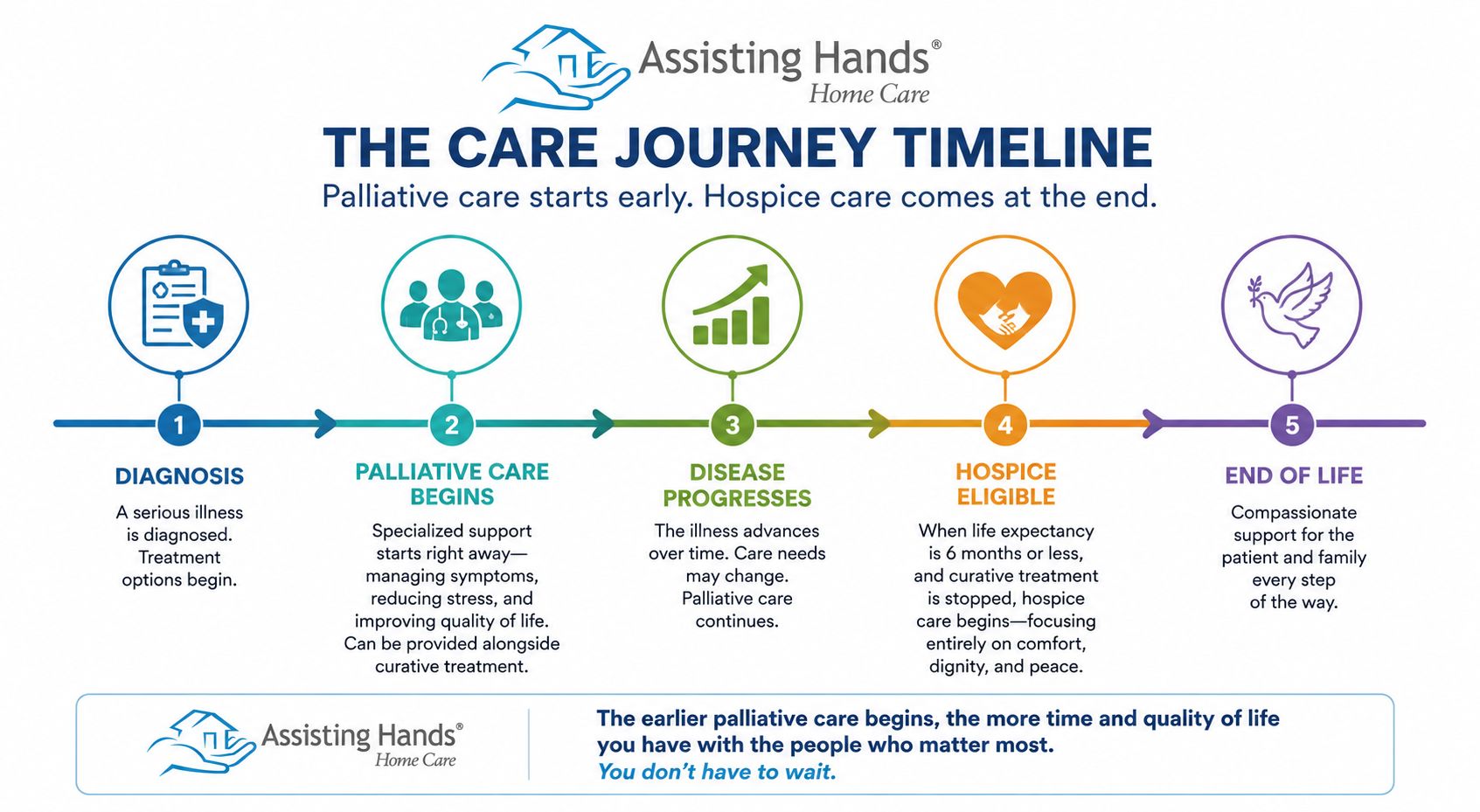
Palliative care is specialized support for anyone living with a serious illness, at any stage of that illness. It does not require a terminal diagnosis. It does not mean stopping treatment.
A palliative care team, typically made up of doctors, nurses, social workers, chaplains, and counselors, works alongside a patient’s existing medical team to manage symptoms and reduce the burdens that serious illness creates: pain, fatigue, shortness of breath, anxiety, nausea, and the emotional weight that comes with all of it.
Patients receiving chemotherapy, managing heart failure, living with COPD, Parkinson’s disease, multiple sclerosis, or chronic kidney disease can all receive palliative care at the same time as their curative treatment. It is not either/or.
One thing families rarely hear from their doctor: palliative care can start the same week as a diagnosis. A 2010 study published in the New England Journal of Medicine found that lung cancer patients who received early palliative care reported better quality of life, less depression, and lived an average of 2.7 months longer than those who received standard oncology care alone.
What Is Hospice Care?
Hospice care is a specific form of palliative care designed for the final stage of life. Two physicians must certify that a patient has a life expectancy of six months or less if the illness follows its expected course. At that point, the patient chooses to stop pursuing curative treatment and shift focus entirely to comfort.
Hospice does not accelerate death. It manages pain, maintains dignity, and supports the patient and their family through what comes next. The team includes physicians, nurses, social workers, chaplains, and bereavement counselors who follow the patient wherever they are, most often at home.
Hospice care is covered under Medicare Part A with little to no out-of-pocket cost for most covered services. Despite this, the median length of hospice enrollment in the United States was just 18 days in 2022, according to the National Hospice and Palliative Care Organization (NHPCO). Most hospice professionals say patients and families benefit most when enrolled weeks or months earlier.
Palliative Care vs. Hospice Care
The table below highlights the key differences. The “Why It Matters” column is the part most families do not hear until it is too late.
| Palliative Care | Hospice Care | Why It Matters | |
|---|---|---|---|
| When it starts | Any stage, even at diagnosis | Life expectancy of 6 months or less | Earlier access to palliative care means more time for symptom relief. |
| Curative treatment | Continues alongside treatment | Stopped; focus shifts to comfort only | Families often misunderstand this as the biggest dividing line. |
| Who qualifies | Anyone with a serious illness | Terminally ill; certified by two physicians | No terminal diagnosis is required for palliative care. |
| Primary goal | Quality of life and symptom management | Comfort, dignity, and peace | Both share the same values; the timeline is what differs. |
| Where it’s given | Hospital, clinic, home, or nursing facility | Primarily at home or in an inpatient hospice setting | Most patients prefer receiving care at home. |
| Medicare coverage | Medicare Part B (outpatient), with applicable copays | Medicare Part A, with little to no cost for covered services | Hospice benefits are often underused because families wait too long to enroll. |
| Duration | As long as medically necessary | Two 90-day benefit periods, followed by unlimited 60-day renewals if eligible | Hospice is not a fixed endpoint; patients may continue receiving benefits if they remain eligible. |
What Palliative Care and Hospice Care Have in Common
Both are built around the same belief: that quality of life matters as much as length of life. Neither approach is about giving up. Both work through interdisciplinary teams that treat the whole person, not just the diagnosis.
Key shared features include:
- Pain and symptom management
- Emotional, psychological, and spiritual support for the patient
- Practical support and guidance for family caregivers
- Coordination across all members of the care team
- Coverage through Medicare, Medicaid, and most private insurance plans, depending on setting and eligibility
How Medicare Covers Each
Palliative Care and Medicare
Medicare Part B typically covers palliative care services provided on an outpatient basis, including physician consultations, counseling, and symptom management. There are no specific eligibility requirements tied to life expectancy. Patients continue receiving curative treatment while also accessing palliative support.
Deductibles, copayments, and coinsurance may apply depending on the patient’s plan. Medicare Advantage plans may offer additional coverage.
Hospice Care and Medicare
Medicare Part A covers hospice services when two physicians certify a life expectancy of six months or less and the patient formally chooses comfort-focused care. Coverage includes nursing, medications for symptom management, medical equipment, counseling, and family caregiver support.
The benefit period begins with two consecutive 90-day periods, followed by unlimited 60-day renewal periods as long as the patient continues to meet eligibility criteria. Out-of-pocket costs are minimal for most covered services.
Medicaid and most private insurance plans also cover hospice, but benefits vary. Families should confirm coverage details with their insurance provider before enrollment.
How to Know Which One Is Right
Choose Palliative Care If…
Your loved one has been diagnosed with a serious illness and is still receiving or considering active treatment. Palliative care is appropriate from the moment of diagnosis and can continue for months or years. It is especially valuable when symptoms are interfering with daily life or when the emotional burden of illness is affecting the patient or family.
Consider Hospice When…
A physician determines that a patient has six months or less to live under the illness’s expected progression, and when the goals of care shift from treatment toward comfort. Families often reach this point when curative options are exhausted or when the burden of treatment has become greater than the benefit it provides.
Hospice is also appropriate when a patient’s primary wish is to spend their remaining time at home, surrounded by people they love, with professional support available around them.
Can You Switch Between the Two?
Yes. And more families need to know this.
A patient receiving palliative care can transition to hospice as their condition progresses. A patient enrolled in hospice can leave hospice and resume curative treatment if their condition stabilizes. If they later decline again, they can re-enroll.
This flexibility means that choosing hospice is not a permanent decision. It is a care level that can change as the patient’s needs and goals change.
Five Things Most Families Believe About Hospice That Are Not True
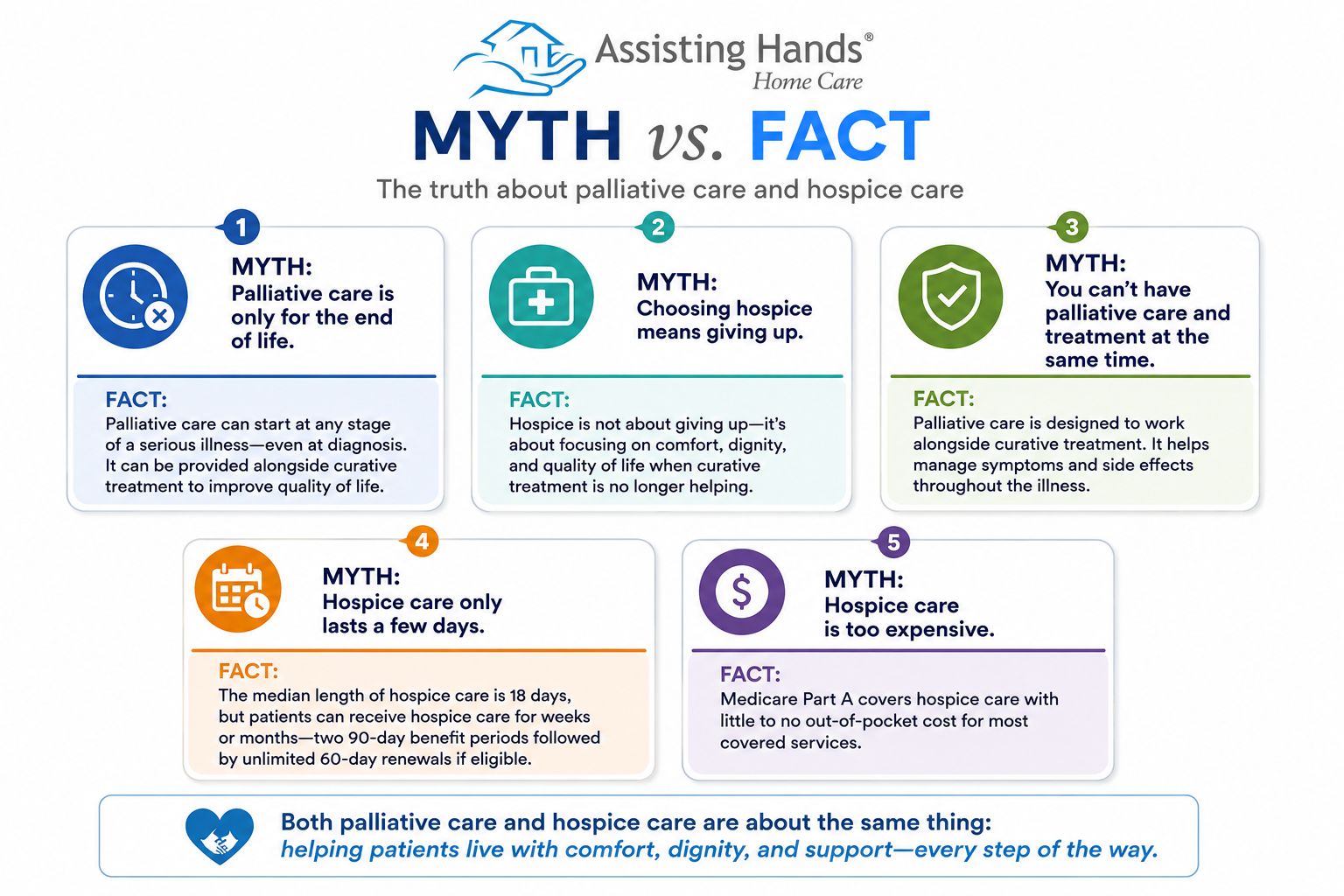
“Palliative care means we’re giving up.”
Palliative care works alongside curative treatment. Patients can receive it while continuing chemotherapy, dialysis, or any other therapy. It does not signal the end. It signals that someone is paying attention to more than just the disease.
“Hospice is only for cancer patients.”
Hospice serves patients with any terminal diagnosis, including heart disease, advanced COPD, Alzheimer’s disease, kidney failure, Parkinson’s disease, ALS, and other serious conditions. Cancer is not a requirement.
“Choosing hospice will shorten my loved one’s life.”
Research suggests the opposite. The 2010 NEJM study referenced earlier found that patients receiving early palliative and comfort-focused care often lived longer than those who continued aggressive treatment. Hospice reduces hospitalizations, manages pain more effectively, and creates conditions for better physical stability.
“We’ll have to move into a facility.”
Hospice care is most often provided in the patient’s own home. Inpatient hospice facilities exist for patients whose symptoms cannot be managed at home, but home is where most patients and families prefer to be, and it is where most hospice care happens.
“Hospice is only for the last few days.”
Hospice enrollment can begin months before the end of life. Earlier enrollment means more time to establish a care plan, manage symptoms effectively, reduce family caregiver burnout, and access emotional and spiritual support before crisis sets in.
How to Talk to Your Doctor About Palliative and Hospice Care
Many families wait for their doctor to bring it up. Doctors, under time pressure and focused on treatment, often do not. These conversations are worth starting yourself.
Questions worth asking:
- “Would my loved one benefit from a palliative care consultation right now?”
- “At what point would hospice care become the right choice for our situation?”
- “Can you refer us to a palliative care specialist who can work alongside your team?”
- “What symptoms should we watch for that would indicate it is time to reassess the care plan?”
A palliative care specialist can be involved at any stage of illness, providing an additional layer of support without replacing the primary care team or oncologist.
Got it. Here is the revised section:
Home Hospice Care and Palliative Care Support in Westlake, Ohio
There is an important distinction most families discover only after hospice begins: the medical hospice team handles clinical care, but someone still needs to help with the daily tasks that keep a person safe and comfortable at home.
That is where non-medical home care comes in.
Assisting Hands Home Care provides professional non-medical support for both hospice and palliative care patients in Westlake, OH and surrounding communities. Whether your loved one is managing a serious illness while continuing treatment or has transitioned to end-of-life care, our caregivers are trained to meet them where they are.
Our caregivers cover the practical needs that fall outside clinical services: bathing, grooming, meal preparation, light housekeeping, mobility assistance, companionship, and relief for family caregivers who need rest. They work alongside the medical hospice or palliative care team to ensure nothing essential falls through the cracks.
When it is time to bring additional support home, call Assisting Hands Home Care at (440) 517-4623. We serve Westlake and the surrounding areas with around-the-clock availability.
Frequently Asked Questions
Is hospice the same as palliative care?
No. Hospice is one type of palliative care, but the terms are not interchangeable. Palliative care is available at any stage of serious illness and can run alongside curative treatment. Hospice is specifically for individuals nearing the end of life who have chosen to focus on comfort rather than treatment.
Can a patient receive palliative care and still get chemotherapy?
Yes. Palliative care is designed to work alongside curative treatment. It can help manage the side effects of chemotherapy, reduce symptom burden, and support the patient’s ability to continue treatment.
How do I know when it is time for hospice?
Hospice is typically appropriate when two physicians certify that a patient has a life expectancy of six months or less and when the patient and family decide to shift focus from curative treatment to comfort. Signs that hospice may be the right step include frequent hospitalizations, treatments that are no longer producing meaningful improvement, and increasing symptom burden that is affecting daily quality of life.
Does Medicare pay for hospice care at home?
Yes. Medicare Part A covers hospice care, including services provided in the home, when eligibility requirements are met. Most patients pay little to no out-of-pocket cost for covered hospice services. Medicaid and most private insurance plans also provide hospice coverage, though benefits vary.
Can someone leave hospice care if they get better?
Yes. Patients can leave hospice at any time if their condition improves or if they choose to resume curative treatment. If their condition later declines again, they may re-enroll in hospice care as long as they continue to meet eligibility criteria.
What does a palliative care team do day to day?
A palliative care team focuses on managing symptoms including pain, nausea, fatigue, shortness of breath, anxiety, and depression. They also help patients and families understand medical conditions and treatment options, coordinate with other providers, assist with care decisions, and connect families to resources such as support groups, financial assistance, and community services.
What is the difference between non-medical home care and hospice?
Medical hospice services are provided by a licensed hospice agency and include nursing, physician oversight, medications, and counseling. Non-medical home care, like the services provided by Assisting Hands, covers personal care tasks: bathing, grooming, meals, housekeeping, companionship, and family caregiver respite. The two work together; they are not substitutes for each other.

