
“The driving conversation” is one of the hardest ones a family will ever have. It rarely starts with a dramatic incident. It starts small: a scraped bumper nobody wants to explain, a missed exit on a route someone has driven for thirty years, a phone call that starts with “I got a little turned around today.” By the time most families reach out to Assisting Hands, they’ve already noticed something. What they’re missing is a plan for what to do about it, and a way to raise it without turning the conversation into a fight.
The guidance below reflects what caregivers at Assisting Hands see play out in homes across the Westlake and greater Cleveland area, alongside Ohio’s actual rules and current medical recommendations.
The Signs Families Notice Before They Admit What They’re Seeing
Most families don’t catch cognitive decline first. They catch driving changes first, because driving is one of the few remaining tasks that demands split-second judgment under pressure. A parent who seems perfectly sharp over Sunday dinner can still be dangerously slow to react at a four-way stop.
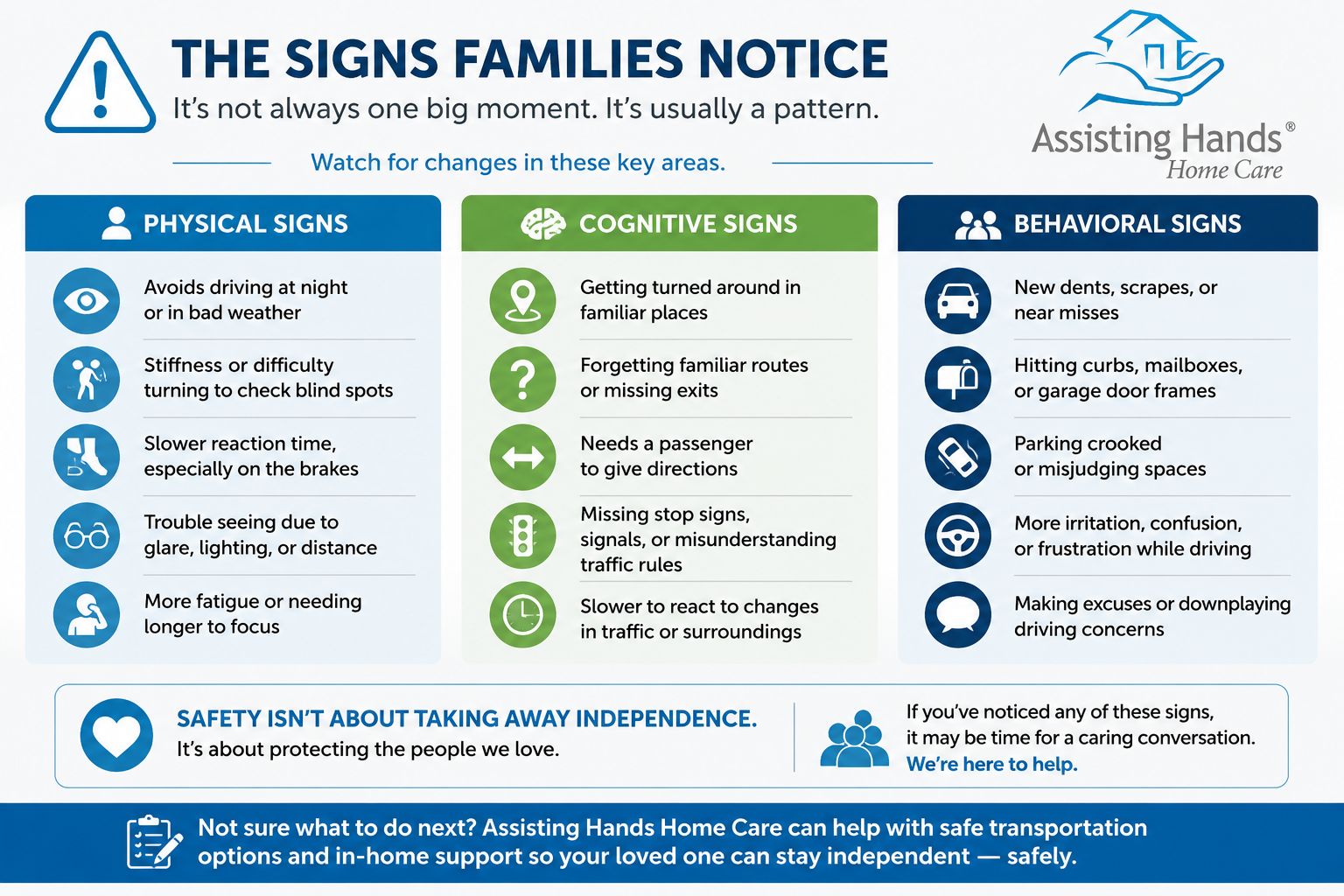
The physical signs tend to show up as excuses before they show up as admissions: “I just don’t like driving at night anymore” often means glare has become genuinely disorienting, not a preference. Stiffness that makes it hard to turn and check a blind spot, or a leg that hesitates half a second longer than it used to on the brake pedal, are the kind of changes a driver rationalizes long before a family member sees them directly.
Cognitive changes are harder to catch because they’re intermittent. Someone might drive a familiar five-mile route flawlessly and then, a week later, miss a stop sign on the same road. Watch for a pattern rather than a single incident: getting turned around in a neighborhood they’ve lived in for decades, needing a passenger to call out turns they used to know by heart, or reacting to traffic a beat slower than the situation calls for.
And then there are the signs that show up in the car itself, not the driver: fresh scrapes on a garage doorframe that weren’t there last month, a mailbox that’s mysteriously been replaced twice, a parking job that’s noticeably crooked. Neighbors sometimes mention these before family does. If a neighbor brings it up to you, that’s usually not the first time they’ve noticed.
Medical Conditions That Affect Driving
Certain health conditions can significantly impact a senior’s ability to drive safely. While not every diagnosis means driving must stop immediately, many medical conditions affect reaction time, coordination, judgment, vision, or alertness, all critical skills behind the wheel. Understanding how these conditions influence driving safety can help families make proactive, informed decisions.
Dementia and Alzheimer’s Disease
Conditions such as Alzheimer’s disease and other forms of dementia are among the most serious concerns when it comes to senior driving safety. Even in the early stages dementia can impair:
- Memory and navigation skills
- Decision-making ability
- Judgment in complex traffic situations
- Reaction time
- Awareness of surroundings
Seniors with dementia may become lost in familiar areas, forget traffic rules, or misjudge distances. As cognitive decline progresses, the risk of accidents increases significantly. In many cases, doctors recommend discontinuing driving as symptoms advance.
Stroke History
A previous stroke can leave lasting physical and cognitive effects that make driving unsafe. Depending on the severity, a stroke may cause:
- Weakness or paralysis on one side of the body
- Slower reaction times
- Vision changes
- Reduced coordination
- Impaired judgment or concentration
Even if recovery appears strong, subtle deficits can remain. A formal driving evaluation is often recommended before returning to the road after a stroke.
Parkinson’s Disease
Parkinson’s disease is a progressive neurological condition that affects movement and coordination. Symptoms that may interfere with safe driving include:
- Tremors
- Muscle stiffness
- Slowed movement (bradykinesia)
- Difficulty turning the head or body
- Delayed reaction time
As Parkinson’s advances, the physical demands of driving such as quick braking, steering corrections, and scanning traffic can become increasingly difficult.
If your loved one has recently been diagnosed, understanding how the condition progresses can help families plan ahead and monitor safety changes over time. You can learn more in our related guide on How Quickly Does Parkinson’s Progress in Seniors?
Vision Impairment
Clear vision is essential for safe driving. Conditions such as cataracts, macular degeneration, and glaucoma can cause blurred vision, blind spots, reduced depth perception, and increased sensitivity to glare. Seniors with significant vision impairment may struggle to:
- Read road signs
- See pedestrians or cyclists
- Detect traffic signals
- Drive safely at night
Regular eye exams are critical, but worsening vision often signals the need to reconsider driving privileges.
Medication Side Effects (Drowsiness & Slowed Reflexes)
Many older adults take multiple medications, and some prescriptions can directly impact driving ability. Common side effects that pose risks include:
- Drowsiness
- Dizziness
- Confusion
- Blurred vision
- Slowed reflexes
Sedatives, certain pain medications, anti-anxiety drugs, and sleep aids are frequent contributors. Even over-the-counter medications can impair alertness. Families should regularly review medications with a physician to assess driving safety.
Diabetes and Risk of Low Blood Sugar
Seniors living with diabetes face a unique driving risk: hypoglycemia (low blood sugar). A sudden drop in blood glucose can cause:
- Dizziness
- Confusion
- Blurred vision
- Weakness
- Loss of consciousness
If blood sugar levels are not well-managed, a hypoglycemic episode behind the wheel can be extremely dangerous. Drivers with diabetes should carefully monitor levels and follow medical guidance about driving.
If your loved one has been diagnosed with any of these medical conditions, it’s important to discuss driving safety directly with their healthcare provider. In some cases, modifications or restrictions may be appropriate. In others, transitioning away from driving may be the safest choice for everyone on the road.
What Doctors & DMVs Recommend
When families begin questioning whether a senior should continue driving, healthcare providers and state motor vehicle agencies offer important guidance. Doctors and Departments of Motor Vehicles (DMVs) focus on objective evaluations that measure whether an older adult can safely operate a vehicle. Understanding these recommendations can help families approach the situation.
Vision Tests for Senior Drivers
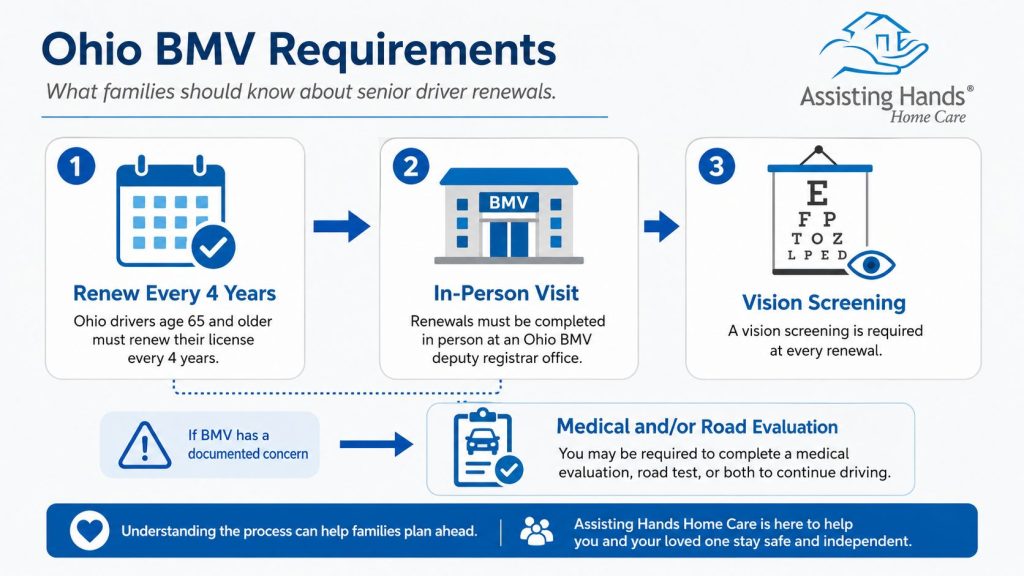
Clear vision is one of the most critical components of driving safety. Most states require regular vision screenings for older drivers during license renewal. For example, in Ohio, vision screening may be required during in-person renewals, especially if there are medical concerns.
Vision tests assess clarity, peripheral awareness, and the ability to detect traffic signals and road signs. If a senior fails a vision exam, corrective measures such as updated glasses may be recommended, or driving privileges may be restricted.
Reaction Time & Medical Evaluations
Doctors may recommend formal driving fitness evaluations when medical conditions raise safety concerns. These evaluations often measure:
- Reaction time
- Cognitive processing speed
- Motor coordination
- Decision-making ability
In some cases, physicians are required (or permitted) to report unsafe drivers to the DMV, depending on state laws. Occupational therapists who specialize in driver rehabilitation can also conduct behind-the-wheel assessments to determine whether a senior can continue driving safely.
Driver Refresher Courses
Many DMVs and safety organizations encourage older adults to take driver refresher courses. These programs help seniors:
- Review updated traffic laws
- Learn defensive driving strategies
- Improve awareness of age-related changes
- Identify safe driving adjustments
Completing a refresher course may also qualify seniors for insurance discounts. More importantly, it provides an opportunity to objectively assess whether continued driving is appropriate.
State-Specific License Renewal Policies
Each state has different rules regarding senior license renewals, and these policies are designed to balance independence with public safety.
Common requirements may include:
- Shorter renewal periods for older drivers
- In-person renewals instead of online
- Mandatory vision tests
- Written or road tests in certain cases
- Medical clearance forms
Families should check their state’s DMV website for the most current senior driving regulations. These policies are not meant to punish older drivers; they are safeguards that ensure everyone on the road remains safe.
If you’re unsure whether your loved one should continue driving, start with a conversation with their primary care physician. Medical professionals and state guidelines can provide an objective framework for making what is often a very emotional decision.
How to Have “The Talk” About Driving
Talking about driving safety with a senior loved one can feel uncomfortable but approaching the conversation with empathy and respect can make this talk more productive. Focus on safety, not control, and choose a calm moment to express your concerns.
Avoid confronting them in anger or issuing ultimatums. Instead, use supportive language like:
- “I’m worried about your safety.”
- “I know how important driving is to you, and I want to make sure you stay safe.”
- “Let’s explore other ways to get around.”
Be prepared with practical transportation alternatives before suggesting they stop driving. Options may include family support, ride-share services, community transportation, grocery and prescription delivery, or in-home care assistance.
If medical conditions such as Alzheimer’s disease or a history of stroke are involved, consider asking a doctor for guidance, medical input can help ground the conversation in objective safety concerns.
Whenever possible, create a gradual transition plan rather than abruptly taking away the keys. Protecting their safety while preserving dignity should remain the priority.
Alternatives to Driving
If it’s time to reduce or stop driving, having reliable transportation alternatives in place can make the transition smoother and less stressful. Planning ahead helps seniors maintain independence, stay connected, and attend important appointments without relying on a personal vehicle.
The following are practical transportation options for seniors who no longer drive:
- Family rotation system: Family members can coordinate schedules to share transportation responsibilities. A simple calendar system can make rides predictable and reduce pressure on one person.
- Ride-sharing apps & taxis: Services like Uber and Lyft offer convenient transportation for shorter trips, errands, and social outings. For seniors who are comfortable using smartphones or tablets, this can be a flexible option.
- Community senior transportation programs: Many local governments, nonprofits, and faith-based organizations provide discounted or free transportation specifically for older adults. These programs often include rides to medical appointments, grocery stores, and community events.
- Grocery & prescription delivery: Delivery services from local supermarkets and pharmacies allow seniors to receive essential items without leaving home. This is especially helpful for those with mobility challenges or limited transportation access.
- Professional home care transportation assistance: For seniors who need more consistent support, professional caregivers can provide safe, reliable transportation while also offering companionship and assistance during outings.
With the right support system in place, seniors can maintain their routines and independence, even after they stop driving.
If you are exploring more transportation solutions, read our helpful guide on How Can Seniors Get Around Without a Car? which explains additional transportation options available to older adults.
When It’s an Emergency to Stop Driving Immediately
While many driving concerns can be addressed gradually through monitoring and planning, there are situations where driving should stop right away for safety reasons. In these cases, delaying action can put your loved one and others on the road at serious risk.
Driving should stop as soon as possible if any of the following occur:
- Recent accident: A crash, even a minor one, may signal declining reaction time, impaired judgment, or physical limitations that make driving unsafe.
- Diagnosed moderate or advanced dementia: A diagnosis of moderate dementia or progression of conditions like Alzheimer’s disease significantly impacts memory, awareness, and decision-making. At this stage, safe driving ability is often severely compromised.
- Failing a vision test: If a senior fails a required vision screening and cannot meet the minimum standard with corrective measures, they should stop driving until the issue is resolved or addressed.
- Doctor’s written recommendation: When a physician formally advises that a patient should no longer drive, especially due to medical conditions such as a stroke or other neurological concerns, that guidance should be taken seriously and acted upon immediately.
- Repeated traffic violations or near misses: A pattern of tickets, warnings, at-fault incidents, or frequent close calls often indicates declining driving safety and increasing risk.
In emergency situations like these, protecting everyone’s safety must come first. Taking swift action may feel difficult, but it prevents potentially life-altering consequences and allows families to focus on supportive alternatives and care planning instead.
Driving & Safety Statistics That Families Should Know
Looking at real data on senior driving safety helps families better understand the actual risks and make informed decisions about whether their loved ones should continue driving. Objective statistics provide clarity during what can often be an emotional and difficult conversation.
Older Drivers & Crash Risk
- According to the Centers for Disease Control and Prevention, drivers age 70 and older have higher crash death rates per mile traveled than middle-aged drivers, partly because physical frailty increases injury severity.
- Per-mile fatal crash rates start rising noticeably at age 70–74 and continue increasing with age, with the highest rates among drivers age 85 and older.
Older Adults & Traffic Fatalities
- In recent data, there were thousands of traffic deaths involving drivers 65 and older, accounting for a significant percentage of overall traffic fatalities.
- Nationwide trends show that older drivers’ involvement in fatal crashes has increased in recent years as the population ages and more seniors maintain their licenses.
Vision, Reaction Time & Aging
- Age-related changes in vision, processing speed, and reaction time are documented contributors to increased crash risk among older drivers.
- Research also links poorer cognitive function in older adults to higher crash rates, even in drivers without diagnosed dementia.
Understanding these trends can help families spot when driving risks may be increasing and start conversations early, before a crisis occurs.
Protecting Safety While Preserving Independence
Deciding when a senior should stop driving is rarely simple, but families do not have to navigate this transition alone. When driving becomes limited or no longer safe, having dependable transportation support makes all the difference in preserving dignity, independence, and quality of life.
At Assisting Hands Home Care, we provide compassionate in-home senior care, including reliable transportation, so seniors can continue attending medical appointments, running errands, and enjoying social activities without depending on family members for every trip.
Through our specialized transportation services for the elderly and disabled, caregivers provide safe rides and hands-on assistance to help seniors get where they need to go with confidence and comfort. Whether it’s a doctor visit, grocery shopping, pharmacy stop, or community outing, our team ensures safe arrival and attentive support throughout the trip.
Let us help you create a safe transition plan that protects independence while prioritizing safety. Call Assisting Hands Home Care at (440) 517-4623 to learn how our caregivers can support your family with trusted transportation and personalized senior care services in Westlake, OH and the surrounding areas.
Senior Driving FAQs
Can a doctor legally stop someone from driving?
A doctor cannot directly revoke a driver’s license, only the state’s Department of Motor Vehicles (DMV) has that authority. However, physicians can recommend that a patient stop driving and, in many states, they are permitted or required to report medical conditions that may impair driving safety. A doctor’s written recommendation often carries significant weight with the DMV and families when evaluating whether driving should continue.
At what age should seniors stop driving?
There is no specific age at which everyone must stop driving. Age alone does not determine driving ability. Some seniors remain safe drivers well into their 80s or beyond, while others may need to stop earlier due to medical conditions, vision changes, or cognitive decline. The key factors are overall health, reaction time, vision, and safe driving performance, not simply reaching a certain birthday.
How do you report unsafe elderly drivers?
If you’re concerned about an older driver’s safety, you can report your concerns to your local DMV. Many states allow family members or medical professionals to submit confidential reports requesting a driving evaluation. In some cases, law enforcement can also intervene if there is immediate danger. Check your state’s DMV website for specific reporting procedures and forms to ensure you follow the correct process.
How do you report a driver you’re concerned about?
You can contact the Ohio BMV directly to request a re-examination. Many states, including Ohio, allow confidential reporting by family members or medical professionals. If there’s immediate danger, local law enforcement can also get involved. Check the Ohio BMV website for the specific reporting form.
Is there a new senior driver policy in Ohio?
No, and the rumors that circulated in 2025 about a new law weren’t accurate. House Bill 96, which took effect that September, changed BMV fees and vehicle registration processes but left senior licensing requirements exactly where they were, a point the Ohio Department of Public Safety confirmed directly.
What’s actually true, and has been for a while, is that drivers 65 and older lose access to the eight-year renewal option and have to renew in person every four years instead, with a vision screening required at that visit. There’s still no age cap on holding a license, and Ohio doesn’t run road tests based on age alone. A written or on-road evaluation only comes into play if the BMV has a documented reason, typically a report from a physician or law enforcement, to question whether someone can still drive safely.

