
Summary:
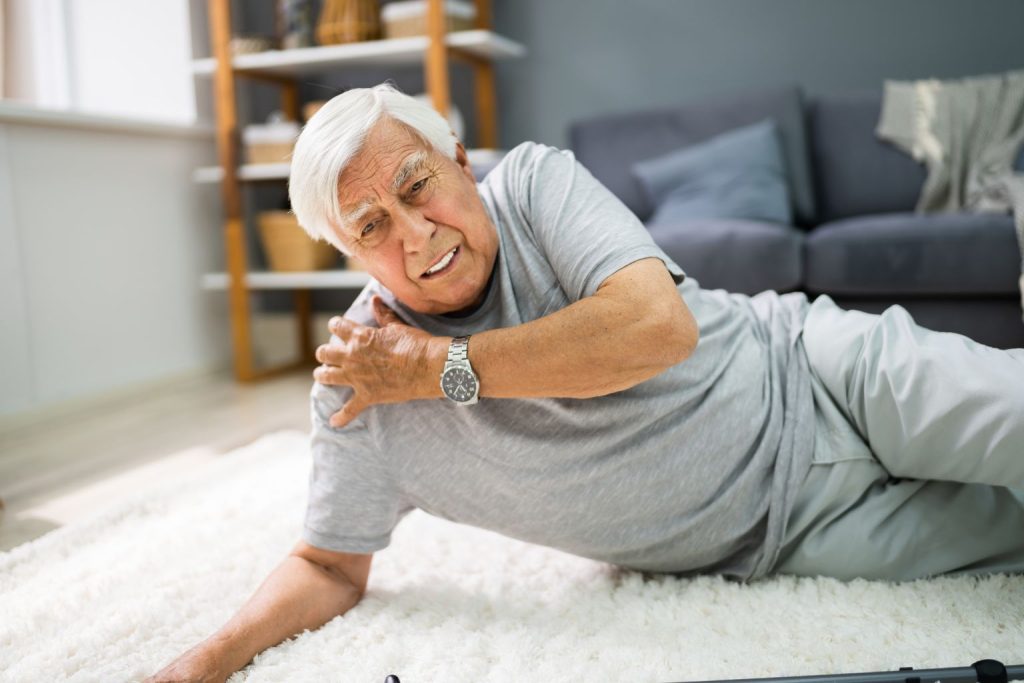
The most dangerous rooms in the house for seniors are the bathroom, bedroom, kitchen, staircase, living room, and laundry room or garage. The bathroom leads, sending roughly 235,000 older adults to emergency rooms each year, mostly from falls on wet floors and during bathtub entry and exit. The bedroom ranks second due to nighttime trips taken under low light and medication side effects. The kitchen carries fire and burn risk, the staircase produces the most severe fracture injuries, and the living room contributes through loose rugs, cords, and low furniture that families stop noticing over time. None of these injuries are accidents. They are predictable outcomes in familiar spaces that have not been updated to match a body that has changed.
Each year, approximately 3 million older adults are treated in U.S. emergency departments for fall-related injuries, according to CDC data updated in January 2026. In that same year, falls caused nearly 39,000 deaths among adults 65 and older. One in four adults in this age group falls annually, and falling once doubles the risk of falling again within the following year.
The location of these events is not random. The vast majority happen inside the home, concentrated in specific rooms that share common physical characteristics: hard flooring, wet surfaces, inadequate lighting, confined spaces, or the daily physical demands they place on aging bodies. The annual healthcare cost of non-fatal falls alone reached $80 billion as of 2020, a figure the NCOA projects will exceed $101 billion by 2030.
This guide identifies each high-risk room by injury burden, explains the specific mechanisms that cause harm, and outlines the modifications with the strongest evidence behind them. Falls are not an inevitable part of aging and research consistently confirms they are preventable. The goal here is not general awareness. It is actionable information about where injuries happen and exactly what reduces them.
1. The Bathroom: The Highest-Injury Room in the Home
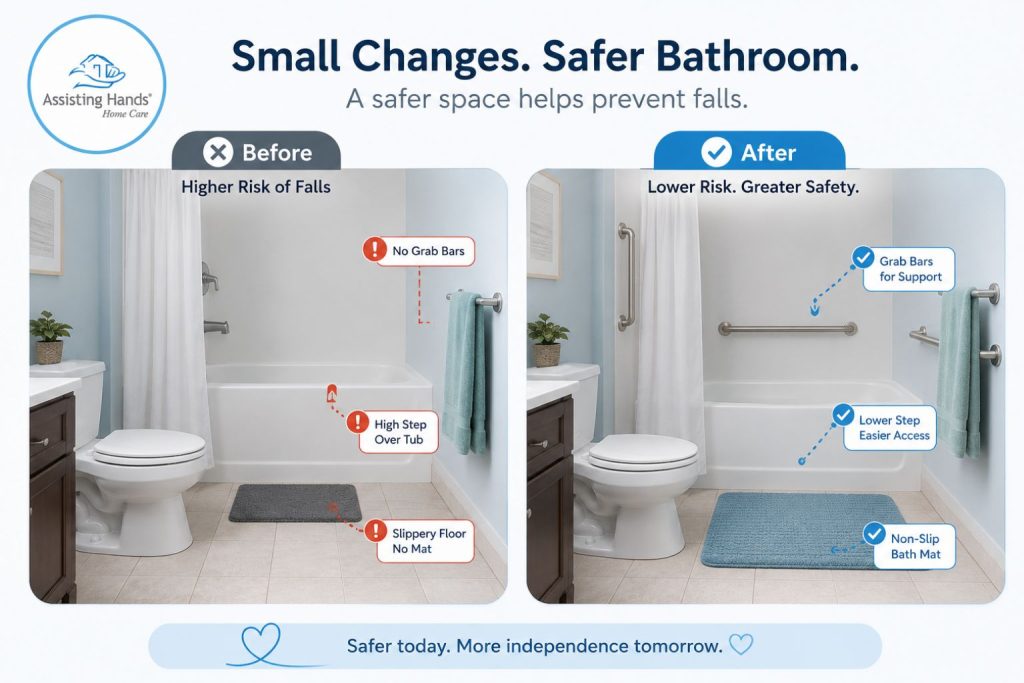
The bathroom generates more fall-related emergency room visits among older adults than any other room in the house. According to CDC research cited consistently through 2025, approximately 235,000 people visit emergency rooms annually due to bathroom injuries, with adults 65 and older experiencing the highest injury and hospitalization rates of any age group. Among those injuries, 81 percent are caused by falls, and 37 percent occur specifically during bathing, showering, or transitioning in and out of the tub, according to CDC surveillance data.
Research published in peer-reviewed literature reinforces the severity: a fall in the bathroom is 2.5 times more likely to result in injury than a fall in the living room. The reason is architectural. Bathrooms combine wet tile or porcelain with metal fixtures, hard floors, and confined dimensions that offer no clear fall recovery path. There is nowhere to grab that is engineered to hold body weight, and most standard towel bars are not load-bearing in a fall scenario.
The bathtub step-over is one of the most mechanically dangerous daily tasks older adults perform. A standard bathtub ledge stands 14 to 18 inches high. Clearing it requires stepping over on a single leg on a surface that may be wet, while fatigued, often in low light. The toilet presents a separate but equally consistent risk. Standard toilet height is 15 inches. Sitting and rising from that height requires significant quadriceps and hip strength, muscle groups that decline markedly with age. For seniors with arthritis, post-surgical weakness, or sarcopenia, this is a physically demanding repetitive task performed multiple times daily.
Modifications with documented impact:
- Install ADA-compliant grab bars anchored into wall studs beside the toilet and inside the shower. Grab bars must be rated to support a minimum of 250 pounds. Towel bars are not a substitute; they are not structurally designed to bear body weight and routinely pull away from drywall under load.
- Add non-slip mats with suction-cup backing inside the shower and directly outside it. Standard decorative bath mats bunch at the edges and slide; they do not perform the same function.
- A raised toilet seat or comfort-height toilet (17 to 19 inches from floor to seat) substantially reduces the effort required to sit and stand. The mechanical advantage at higher seat heights is significant for anyone with lower limb weakness.
- A handheld showerhead with a wall bracket allows bathing from a seated position, which eliminates the sustained balance demand of standing in a wet shower.
- Motion-activated night lights placed at floor level between the bedroom and bathroom address nighttime trips, which are among the highest-risk fall scenarios due to low lighting, reduced alertness, and medication side effects.
- For any senior no longer transitioning safely over a bathtub ledge, a walk-in shower with a zero-threshold or low-threshold entry removes the step-over entirely. This is a structural modification with strong fall prevention evidence and should be prioritized when budget allows.
2. The Kitchen: Burns, Scalding, and Fire Risk in a High-Use Space
The kitchen’s injury profile differs from the bathroom. Falls occur here too, primarily on wet floors near the sink and stove. However, the injuries specific to the kitchen involve heat exposure, fire, and the physical demands of cooking on a body that has undergone measurable physiological changes.
According to the National Fire Protection Association, cooking is the leading cause of reported home fires in the United States, accounting for 49 percent of all home fires annually. An average of 187,500 cooking fires per year in residential buildings result in approximately 165 deaths, 3,325 injuries, and nearly $1.5 billion in property damage, according to the U.S. Fire Administration. Adults 65 and older are more than twice as likely to be killed or injured in a cooking fire compared to the general population, a figure that reflects how decreased mobility, sensory changes, and early cognitive decline interact with the demands of an active kitchen.
Peripheral neuropathy, which affects roughly 26 percent of adults with diabetes and is common in other conditions as well, reduces hand and foot sensation. A senior with significant neuropathy may not register a burn quickly enough to withdraw from the heat source before tissue damage occurs. Additionally, the early stages of cognitive decline, before a formal dementia diagnosis, are often first visible in tasks like cooking, where a person must track multiple things simultaneously. Leaving a burner on unattended is one of the earliest and most consistent behavioral signals.
Kitchen modifications that address the primary hazards:
- Automatic stove shutoff devices detect prolonged inactivity at the stove and cut power to the burners. These devices address the most serious fire hazard in a senior kitchen without requiring behavioral change from the person cooking.
- Set the household water heater to 120 degrees Fahrenheit or lower. This is the threshold recommended by the American Burn Association to prevent scalding injuries. Older adults have thinner skin than younger populations, which means the tissue damage threshold is reached faster at equivalent water temperatures.
- Reorganize cabinet contents so all frequently used items are accessible between waist and shoulder height. Reaching overhead and crouching to low cabinets both introduce balance demands that increase fall risk. This reorganization requires no renovation and can be completed in an afternoon.
- Use kitchen-grade non-slip mats at the sink and stove positions. These should have full non-slip backing and lie completely flat. Decorative rugs are not equivalent and should be removed from kitchen floors.
- A lightweight electric kettle with an automatic shutoff eliminates the risk of a stovetop kettle left boiling unattended and reduces the burn risk from carrying heavy pots of boiling water.
- Keep a Class B and C rated fire extinguisher in an accessible cabinet, not above the stove or in a location requiring a search to find.
3. The Staircase: Where Severity of Injury Is Highest
Stair-related fractures among adults 65 and older increased by 56 percent between 2012 and 2021, according to research published in a peer-reviewed analysis using National Electronic Injury Surveillance System data. The hospitalization rate for these injuries rose 38 percent over the same period. Among all home fall scenarios, stair falls produce some of the most severe injury patterns: head trauma, hip fractures, spinal injuries, and internal injuries from contact with multiple hard surfaces during a single fall event.
The mechanism is unforgiving. On a flat surface, a person who loses balance often has a recovery step. On a staircase, a single misjudged placement of the foot triggers a rapid fall with no recovery opportunity, frequently involving contact with three to five steps. Depth perception changes measurably with age. Cataracts, which affect more than 24 million Americans over 40 and are particularly prevalent in adults over 75, make it harder to distinguish step edges accurately. Reduced lower-limb strength means less ability to arrest a stumble before momentum takes over.
Many residential staircases were built with no consideration of aging use. Handrails that terminate before the first or last step, carpet worn at the nosing of each tread, no lighting at the base of the stairs, and steep risers from older construction codes are all fixable problems that remain unfixed in most homes.
High-priority staircase interventions:
- Extend handrails to run the full length of the staircase, including past the top and bottom steps where structurally feasible. The majority of stair falls happen at the beginning and end of the staircase, precisely where handrails most often stop.
- Install bright, evenly distributed lighting with switches accessible at both the top and bottom of the stairs. Sensor-activated lighting that engages automatically when someone is on the stairs removes the risk of navigating in darkness when a switch is out of reach.
- Apply non-slip grip tape or rubber treads across the full width of each step, with emphasis on the nosing (front edge), where the foot makes initial contact and where worn carpet is most likely to cause a slip.
- Add high-contrast tape or paint along the front edge of each step. For seniors with reduced depth perception or early cataract changes, visual differentiation between tread and riser significantly reduces misjudged step placement.
- Any carpet that is lifted, bunched, or coming loose from tack strips at any step edge should be repaired or replaced immediately. Partial carpet lifts at step edges are among the most consistent and preventable stair fall causes.
4. The Bedroom: Nighttime Falls and the Medication Factor
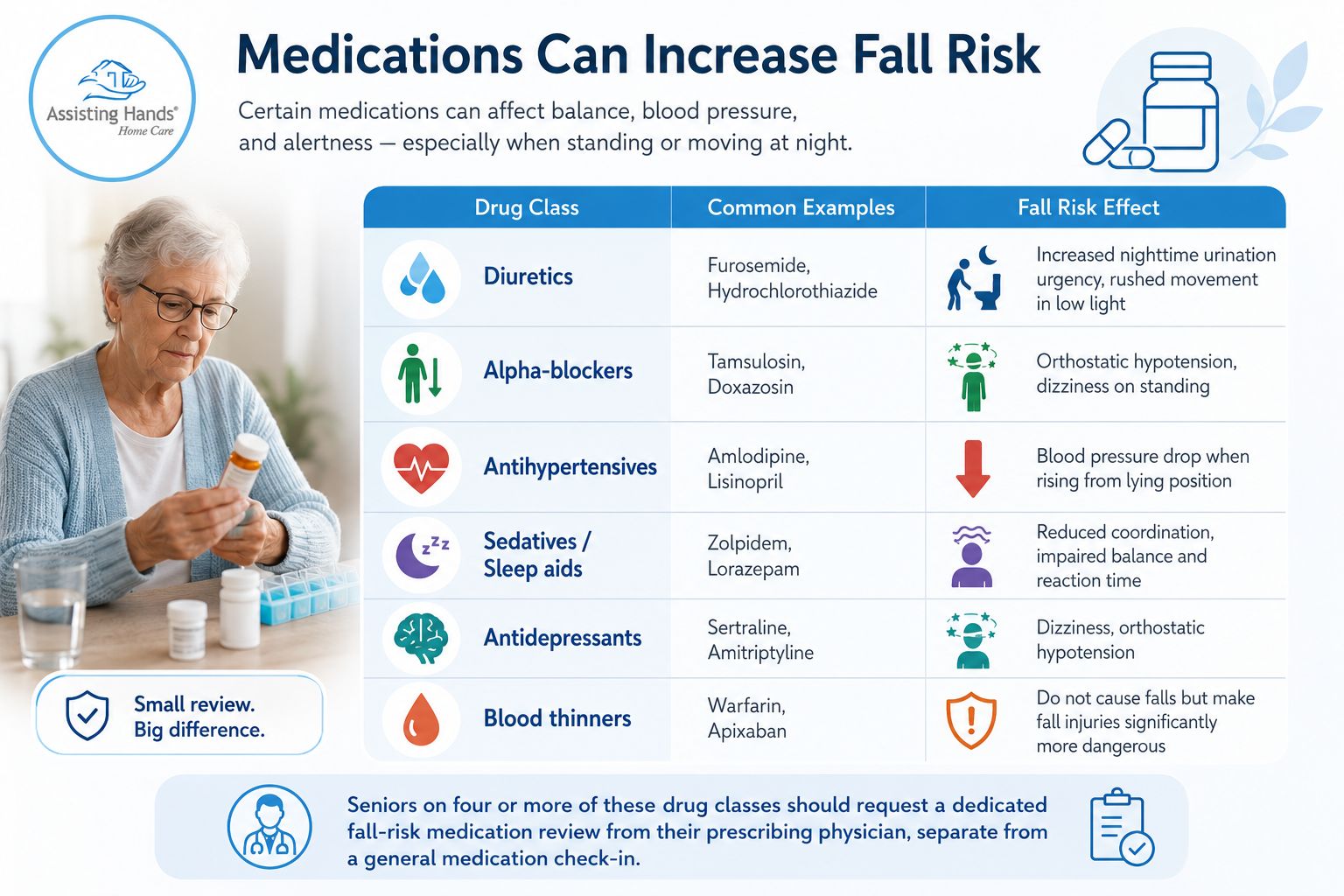
Bedroom falls cluster in a specific time window: midnight to 5 a.m. The primary driver is nocturia, the need to urinate during the night, which is reported by up to 77 percent of adults over 70 according to published urological research. Nocturia frequency increases with age and is worsened by several common conditions including heart failure, diabetes, benign prostatic hyperplasia, and diuretic use, which is itself among the most commonly prescribed drug classes in this population.
According to a 2025 peer-reviewed study published in the World Journal of Emergency Medicine using National Electronic Injury Surveillance System data from 2014 to 2023, an estimated average of 320,751 bed-related fall injuries presented to emergency departments annually, with hospital admission required in 34.1 percent of cases. The study identified medication use at the time of injury as a significant independent risk factor for hospitalization following a bed-related fall.
The medication connection deserves direct attention. Alpha-blockers and certain antihypertensives cause orthostatic hypotension, a measurable drop in blood pressure when a person transitions from lying to standing. This produces several seconds of dizziness that, combined with nighttime darkness and post-sleep grogginess, is sufficient to cause a fall before the person reaches the bathroom door. Sedatives and sleep aids reduce coordination and reaction time. Diuretics create urgency that leads to rushed movement. These are not rare side effects. They are documented, common, and addressable through medication review.
Bedroom fall prevention measures:
- Adjust bed height so that the senior’s feet rest flat on the floor when sitting on the edge. The target height from floor to mattress top is typically 20 to 23 inches. Bed risers raise height; a lower-profile box spring or platform frame reduces it.
- Install a bed assist handle or safety rail that provides a stable push-off point when rising and a controlled lowering support when lying back down. These attach under the mattress without requiring any structural modification.
- Clear all floor space between the bed and the door, and between the bed and the bathroom. This means no shoes on the floor, no cords, no furniture corners protruding into the walking path.
- Place motion-activated floor-level night lights so they engage as soon as the person sits up, illuminating the path without requiring a light switch to be found in the dark.
- Request a dedicated fall-risk medication review from the prescribing physician, specifically for any senior on four or more medications. This is a targeted conversation about polypharmacy and fall risk, distinct from a general medication check-in. It should include a review of timing: some medications are more appropriately taken in the morning rather than at night to reduce nighttime side effect burden.
5. The Living Room: Accumulated Hazards in the Most-Used Space
Living rooms in older homes accumulate furniture, rugs, cords, and objects over years and decades. The cumulative result is a high-traffic space with multiple low-level tripping hazards that individual family members stop registering because nothing has gone wrong yet. The hazards here are individually smaller than in the bathroom or on the staircase, but the living room’s high usage frequency means the probability of an event is proportionally higher.
Deep, low-slung sofas and armchairs present a specific and underappreciated problem. Rising from a low, cushioned seat requires the legs to generate substantial force from a position of reduced mechanical advantage. Older adults who struggle with this develop compensating habits, using armrests aggressively, rocking forward, using momentum. These strategies work until a moment of weakness or dizziness changes the outcome.
Living room changes to prioritize:
- Remove or fully secure all area rugs and throw rugs. Any rug not backed with full non-slip material and lying completely flat is a tripping hazard. High-priority removal locations are any rug between seating areas and exit paths, and any rug adjacent to furniture the senior uses to rise or lower themselves.
- Reroute all power cords and extension cords against baseboards and secure them. A cord crossing a walking path is one of the most preventable and most common fall causes in living spaces.
- Replace deep, low seating with chairs and sofas that have firm cushions and armrests that extend to the full front edge of the seat. The armrest must reach to where the person sits, not just to the back of the seat, to provide usable leverage for standing.
- Address lighting at the perimeter of the room, particularly near seating areas used in the evening. Overhead lighting in the center of a room often leaves corners and pathways dim enough to obscure floor-level hazards.
6. The Laundry Room and Garage: The Rooms Most Commonly Overlooked
Neither the laundry room nor the garage appears on most home safety checklists. Both carry consistent, documented risks for older adults.
Laundry rooms present slippery floors from detergent and water spillage, front-loading appliances that require deep bending which challenges balance and loads the lumbar spine, and the routine task of carrying a laundry basket that blocks forward sightlines during ambulation. The transition from the laundry room back to the main living area often involves a threshold step that catches a person whose attention is on the load they are carrying rather than the floor.
Garages have uneven concrete floors, oil and moisture accumulation, frequently poor overhead lighting, stored items on the floor creating tripping hazards, and the garage-to-house entry step, which produces a disproportionate number of fall events because it is navigated at the end of a trip when attention and energy are lower.
- Install high-output LED lighting in both spaces. Lighting that is adequate for a younger adult with normal vision is frequently insufficient for a senior with any degree of age-related visual change.
- Use a wheeled laundry cart to transport clothes. Carrying a laundry basket that blocks forward vision while walking is an avoidable risk.
- Apply rubber matting or non-slip tape at the garage-to-house transition step. This is a single high-frequency hazard point that can be addressed for under twenty dollars.
- Evaluate whether the current washer and dryer configuration requires bending that is safe for the senior to perform. Front-loading appliances at floor height can be replaced with top-loading models or elevated on pedestal risers.
- Maintain a clear, unobstructed walking path from the vehicle to the house entry. Items stored on the garage floor along this path should be relocated to shelves or removed.
For a broader checklist of changes across the entire home, this guide on how to safe-proof your elderly parent’s home covers room-by-room steps families in Hinsdale and the surrounding area can take immediately.
Questions About Senior Home Safety
Which room in the house is most dangerous for seniors?
The bathroom is the most dangerous room in the house for older adults. CDC data consistently identifies it as the location of the highest number of fall-related emergency visits in adults 65 and older, with approximately 235,000 such visits per year. Falls account for more than 81 percent of those injuries. The bedroom is the second most hazardous room, primarily because of nighttime trips to the bathroom taken under conditions of low lighting, post-sleep grogginess, and medication side effects.
How do I make my elderly parent’s home safer without spending a lot of money?
The highest-impact low-cost changes are: installing load-bearing grab bars anchored into studs beside the toilet and in the shower (not towel bars), adding non-slip suction-backed bath mats inside and outside the shower, placing motion-activated floor-level night lights between the bedroom and bathroom, and removing loose area rugs from all high-traffic walking paths. These four changes address the majority of common fall scenarios and can be completed in a single day for well under two hundred dollars. A raised toilet seat is an additional inexpensive modification that provides significant daily functional benefit.
What should I look for when assessing an elderly person’s home for fall risks?
Walk every room and specifically check for: loose or unsecured area rugs, power cords crossing walking paths, toilet height and grab bar absence in the bathroom, handrails that do not run the full staircase length, lighting gaps in hallways and at staircase bases, overhead items requiring reaching, and bed height that makes standing difficult. Then separately assess medication use. Drug side effects including orthostatic hypotension, dizziness, increased urinary urgency, and sedation are among the most consistent fall risk factors and are invisible in a visual walkthrough.
Can medications cause falls in elderly people even when the home is safe?
Yes. Medications are one of the most significant modifiable fall risk factors for older adults. Diuretics increase the frequency and urgency of nighttime urination, leading to rushed movement in low light. Sedatives and sleep aids reduce coordination and balance. Antihypertensives and alpha-blockers cause orthostatic hypotension, the blood pressure drop that occurs when standing quickly from a reclining position, producing several seconds of dizziness. A 2025 peer-reviewed study identified medication use at the time of injury as an independent risk factor for hospitalization following a bed-related fall. Any senior on four or more medications should have a dedicated polypharmacy review focused specifically on fall risk with their prescribing physician.
Are throw rugs and area rugs dangerous for elderly people at home?
Loose throw rugs and unsecured area rugs are among the most common tripping hazards for older adults, and fall prevention guidelines consistently recommend their removal from high-traffic floor areas, particularly hallways, beside the bed, and in the kitchen. Any rug that is not lying completely flat with full non-slip backing secured on all edges presents a fall risk. The priority removal areas are any rug positioned between the bedroom and bathroom, any rug adjacent to furniture used for rising, and any rug on a hard floor surface without complete non-slip underlayment. Purpose-designed non-slip bath mats with suction backing serve a different function and should replace standard decorative bath mats in the bathroom.
When should an elderly person consider a stairlift for their home?
A stairlift becomes worth evaluating when any of the following is present: a fall or near-fall on the stairs within the past twelve months, visible difficulty maintaining balance or gait on flat surfaces, requiring significant arm-strength effort on the handrail to ascend or descend, a diagnosis of Parkinson’s disease, severe osteoporosis, or a bleeding disorder that increases injury severity from a fall, or progressive lower-limb weakness that a physical therapist assessment identifies as incompatible with safe independent stair use. A physical therapist evaluation of functional stair ability is the appropriate first step before making a stairlift decision.
What is the safest type of shower or bath setup for an elderly person?
A walk-in shower with a zero-threshold or low-threshold entry is the safest setup for most older adults. It eliminates the bathtub step-over, which is one of the most mechanically demanding and highest-risk daily physical tasks for seniors. Within that shower, the configuration should include a fold-down or removable shower seat, a handheld showerhead on a slide bar, grab bars on at least two walls, and a non-slip mat inside the shower and immediately outside it. If a full renovation is not possible, a tub transfer bench that sits across the bathtub edge allows a person to sit outside the tub and swing their legs over rather than stepping over the ledge, which substantially reduces the fall risk of bathtub entry and exit.
How can I talk to an elderly parent who refuses to make safety changes to their home?
Resistance to home safety modifications is common and typically comes from not wanting to feel old, or not wanting the home to look institutional. Both responses are understandable. The most effective approach frames each change as a practical upgrade rather than a safety intervention. Modern grab bars are available in finishes that match standard bathroom hardware and read as intentional design rather than medical equipment. Removing a rug can be framed as simplifying the room. Starting with a single low-visibility change, letting the person experience it without incident, and building from there tends to work better than presenting a comprehensive list. When family advocacy stalls, a direct recommendation from the person’s own physician consistently carries more weight. Requesting that the physician address fall risk at the next scheduled visit is a practical step.
Home Care and Fall Prevention Services in Hinsdale, IL
For families in Hinsdale, Downers Grove, La Grange, Westmont, Burr Ridge, Oak Brook, and the surrounding western suburbs of Chicago, fall risk inside the home is a concern that does not wait for a convenient moment to become urgent. A modified environment reduces hazard exposure. It does not provide the physical support and consistent presence that prevents falls during the moments that matter most: the early morning transfer out of bed, the nighttime bathroom trip, the post-meal kitchen cleanup when fatigue and medication timing overlap.
Professional in-home caregivers trained in fall prevention work alongside seniors in these exact moments. They provide hands-on transfer assistance, monitor changes in gait or balance that signal increasing risk, and communicate those changes to family members and medical providers before a fall event occurs. For families in DuPage and Cook County managing a parent’s care from a distance, that ongoing ground-level observation is something a modified home cannot replicate.
If your family is evaluating in-home care options in Hinsdale, Downers Grove, La Grange, or any nearby community, contact our team to discuss what level of support makes the most sense for your specific situation. A conversation costs nothing. A fall in a bathroom or on a staircase that could have been prevented costs far more than most families anticipate. Call (630) 407-1932 today.

