

Key Takeaways
People with Parkinson’s are more likely to fall because the disease affects their balance, walking, and ability to react quickly. Falls often happen when turning, getting out of a chair, or walking through doorways. Freezing of gait, muscle stiffness, and dizziness can make these everyday movements harder. While not every fall can be prevented, physical therapy, a safer home setup, and extra help with daily activities can make a difference.
Falls can become a frustrating and sometimes frightening part of life with Parkinson’s disease. Seniors with Parkinson’s are more likely to fall because the disease can affect balance, walking, muscle movement, and the body’s ability to react quickly when something changes. Steps may become shorter and slower, muscles can feel stiff, and turning or getting started may take more effort. Some people also experience freezing of gait, when their feet suddenly feel as though they are stuck to the floor.
Other Parkinson’s-related changes can make falls even more likely. Blood pressure may drop when someone stands up, causing dizziness or lightheadedness. Medications can sometimes contribute to sleepiness or dizziness, and movement problems may become more noticeable as a medication dose wears off. When several of these factors occur together, even walking a familiar route from the bedroom to the kitchen can become difficult.
Still, Parkinson’s affects everyone differently. Some people maintain good balance for years, while others begin having trouble with falls much earlier. If you’re caring for a parent or spouse with Parkinson’s, understanding why falls happen can help you recognize risks and take practical steps to make everyday movement safer.
What Causes Frequent Falls in Parkinson’s Patients?
Parkinson’s raises fall risk because it affects balance, movement, posture, blood pressure, and reaction time. Most falls come from a combination of these, not a single cause.
Balance and Postural Instability
Postural instability means the body has a harder time staying upright and catching itself. Most of us recover from a stumble without thinking about it. We take a quick step or shift our weight. Parkinson’s slows or weakens those automatic reflexes, so a small bump, lean, or misstep that someone else would shake off can turn into a fall.
Shuffling and Shorter Steps
Many people with Parkinson’s walk with smaller, slower steps and may shuffle instead of lifting their feet. Shuffling feet catch more easily on rug edges, thresholds and uneven pavement. Some people also experience festination, where steps get faster and shorter as if they’re chasing their own center of gravity, which can tip them forward.
Freezing of Gait
Freezing of gait is one of the most disruptive Parkinson’s symptoms. The person wants to walk, but their feet suddenly won’t move, as if they’re glued to the floor. Because the upper body often keeps moving forward while the feet stay put, freezing is a common cause of falls.
Freezing tends to happen when starting to walk, turning, going through doorways, moving in tight spaces or switching from carpet to tile. Stress, rushing and trying to do two things at once can trigger it too. For some people, freezing is more common during medication “off” periods, when a dose is wearing off. We cover freezing in more detail below.
Trouble Turning
Turning is harder than it looks. It requires shifting weight, coordinating both legs and changing direction smoothly. People with Parkinson’s often turn in several small, stiff steps, or try to pivot on one foot, which causes balance to give out. Getting around furniture, turning to sit in a chair, or spinning around at the kitchen counter are all common moments for falls.
Muscle Stiffness and Slow Movement
Rigidity (muscle stiffness) and bradykinesia (slowness of movement) make it harder to take a full step, swing the arms, or react quickly. If someone starts to tip, stiff muscles and slow responses give them less time and less range to recover.
Stooped Posture
Parkinson’s often causes a forward-leaning, stooped posture. That shifts the body’s center of gravity ahead of the feet, which makes forward falls more likely. Some people also lean backward or to one side, which brings its own balance problems.
Dizziness When Standing
Parkinson’s can affect the nervous system’s control of blood pressure. Some people experience orthostatic hypotension, a sudden drop in blood pressure when they stand up. The result is lightheadedness, blurred vision, or even fainting, often right after getting out of bed or rising from a chair. Some Parkinson’s medications can make this worse.
Medication Effects
Medications for Parkinson’s and other conditions can cause sleepiness, confusion, dizziness, or low blood pressure. Parkinson’s symptoms also tend to fluctuate with medication timing. Movement is usually better when a dose is working (“on”) and worse when it wears off (“off”). Some people also develop involuntary movements called dyskinesia, which can throw off balance.
If you notice a pattern between medication timing and falls, tell the person’s doctor or neurologist. Never change, skip, or stop a medication without talking to their healthcare provider first.
When Are People with Parkinson’s Most Likely to Fall?
People with Parkinson’s are most likely to fall during transitions like turning, standing up, sitting down, starting to walk, and avoiding obstacles. Straight-line walking on a clear path is usually safer than any moment that asks the body to change what it’s doing.
Watch for these high-risk situations:
- Turning around or changing direction
- Starting to walk or coming to a stop
- Getting up from a chair, bed, or toilet
- Sitting down, especially into a low or soft seat
- Bending over to pick something up
- Walking through doorways or narrow hallways
- Stepping around furniture, pets, or other obstacles
- Walking on uneven ground, thresholds, or changing floor surfaces
- Moving too quickly or rushing to answer the phone or door
- Carrying something or talking while walking
- Getting up at night to use the bathroom, when it’s dark and the person may be groggy or dizzy
Nighttime bathroom trips deserve extra attention because several fall risks can come together at once. A senior may be getting out of bed in low light, standing up quickly after lying down, experiencing a drop in blood pressure, or dealing with Parkinson’s symptoms as medication wears off overnight. That combination can make a familiar trip to the bathroom unexpectedly difficult and increase the chance of a fall.
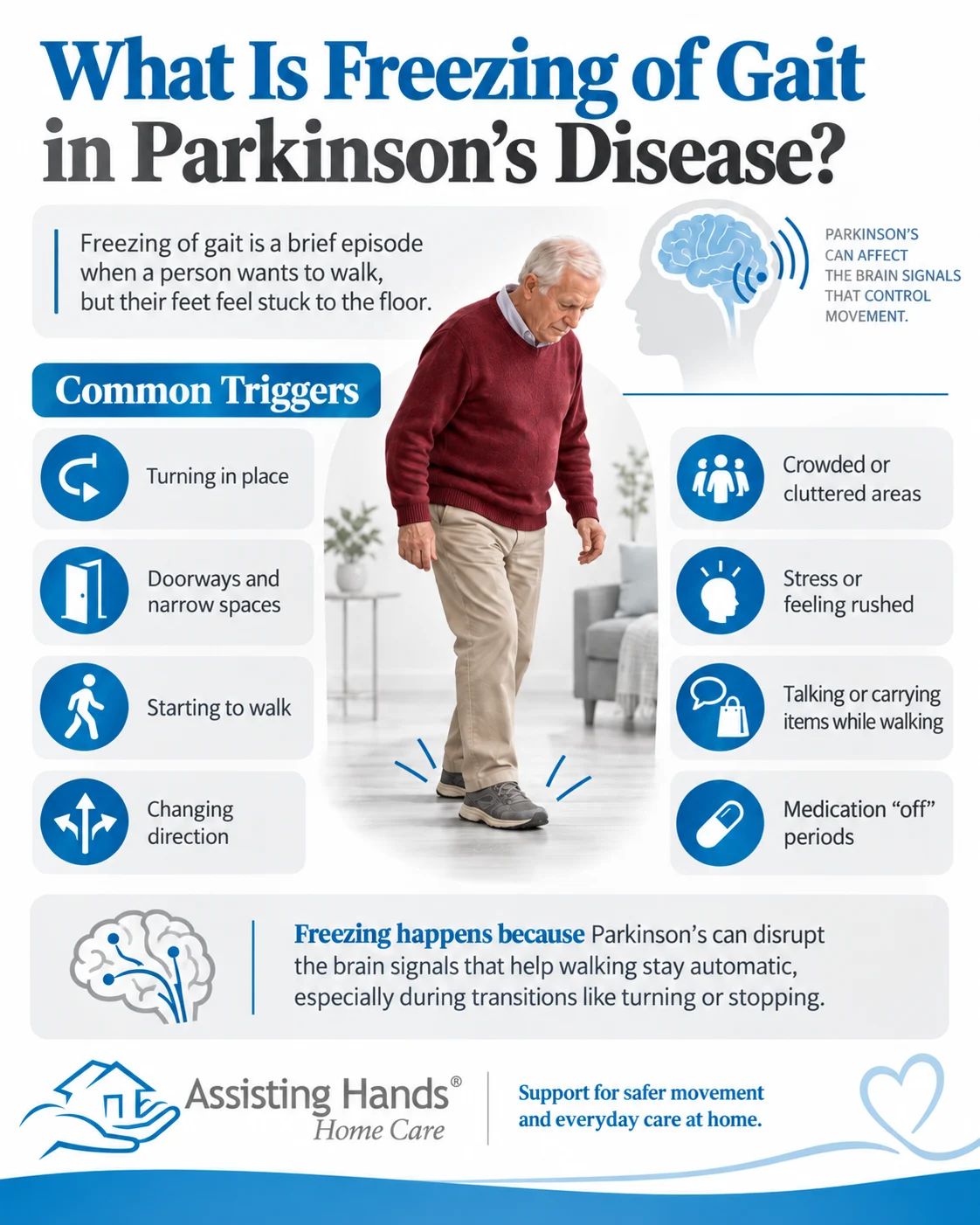
What Is Freezing of Gait in Parkinson’s Disease?
Freezing of gait is a temporary, involuntary inability to move the feet, often described as feeling stuck to the floor. It usually lasts only a few seconds, although it can feel much longer to the person experiencing it. Many people describe knowing exactly where they want to go, but their legs simply will not respond.
Freezing is closely linked to how the brain controls automatic movement. Walking is normally something we do without consciously thinking about each step. Parkinson’s can disrupt the brain circuits that help maintain that automatic rhythm, so situations that require a change in movement, such as turning, stopping, or passing through a narrow doorway, can cause the rhythm to stall.
Common triggers include:
- Turning, especially in place
- Doorways and narrow spaces
- Starting to walk
- Changing direction or approaching a destination, like a chair
- Crowded or cluttered areas
- Stress, anxiety or feeling rushed
- Multitasking, such as talking or carrying items while walking
- Medication “off” periods
How to Help Someone During a Parkinson’s Freezing Episode
Stay calm, give the person time, and never push or pull them forward. Forcing movement while the feet are stuck is a fast way to cause a fall. Instead, help them break the freeze with a deliberate movement or a cue.
Here’s what tends to help:
- Stay calm and patient: Rushing adds stress, and stress makes freezing worse.
- Don’t push or pull: Let the person keep their own balance.
- Encourage them to stop and reset: Standing tall and shifting weight from side to side can help unlock the feet.
- Use a rhythm or count: Counting “one, two, three” out loud, clapping, or humming a steady beat can give the brain a pattern to follow.
- Try a visual cue: Some people step over a line on the floor, a piece of tape, or a laser line projected by a cane or walker. Others picture stepping over an imaginary object.
- Encourage a big, deliberate first step: Thinking about taking a large step, rather than “just walking,” can help.
- Ask about therapy: A physical or occupational therapist experienced with Parkinson’s can teach cueing strategies that work for that specific person.
Every person responds differently, so it’s worth practicing a few strategies when the person isn’t frozen. That way, the cue feels familiar when they need it.
At What Stage of Parkinson’s Disease Do Falls Begin?
There is no single stage when everyone with Parkinson’s begins to fall. However, falls tend to become more common as balance and postural stability decline. On the Hoehn and Yahr scale, Stage 3 is marked by impaired balance and more frequent falls, although some people may experience falls earlier or later in the disease.
The Hoehn and Yahr scale is one of the tools doctors use to describe how Parkinson’s progresses:
- Stage 1: Symptoms on one side of the body. Balance is usually unaffected.
- Stage 2: Symptoms on both sides. Posture and walking may change, but balance is still mostly intact.
- Stage 3: Balance problems appear and falls become more frequent. The person is usually still physically independent.
- Stage 4: Symptoms are severe. The person can stand and walk, often with a walker, but needs help with many daily activities.
- Stage 5: The person may be unable to stand or walk and often needs a wheelchair or is confined to bed without help.
Stages are a general guide, not a timeline. Parkinson’s progresses differently for everyone, and many people don’t fit neatly into a single stage.
One important exception is significant balance trouble or frequent falls very early in the disease. These aren’t typical of Parkinson’s and can sometimes suggest an atypical form of parkinsonism, such as progressive supranuclear palsy (PSP) or multiple system atrophy (MSA). If your loved one begins falling within the first few years after diagnosis, mention it to their neurologist. Early falls are worth investigating rather than simply assuming they are a normal part of Parkinson’s progression.
What Should You Do When a Parkinson’s Patient Keeps Falling?
When someone with Parkinson’s keeps falling, tell their healthcare provider, track when and how the falls happen, and ask about physical and occupational therapy. Repeated falls are a sign that something in their care plan, home, or routine needs to change. They shouldn’t be treated as just part of the disease.
1. Tell Their Healthcare Provider
Every repeated fall deserves a conversation with the person’s doctor or neurologist, even if there were no injuries. The provider may review medications, check blood pressure when sitting and standing, or look for other causes like vision changes, infections or foot problems.
2. Look for a Pattern
A simple fall log can tell the care team a lot. For each fall or near-fall, write down:
- The date and time
- What the person was doing (turning, standing up, walking to the bathroom)
- Where it happened
- Whether they froze first
- Whether they felt dizzy or lightheaded
- When they last took their medication
- Whether it happened at night
- Any injuries
Patterns often jump out after a week or two. Falls clustered late in the afternoon may line up with a dose wearing off. Falls in one hallway may point to a lighting or layout problem.
3. Ask About Physical Therapy
A physical therapist with Parkinson’s experience can work on balance, strength, gait, and safer ways to turn, stand up, and sit down. Many therapists also teach cueing techniques for freezing. Ask the person’s doctor for a referral.
4. Consider Occupational Therapy
An occupational therapist looks at how the person handles daily tasks, like bathing, dressing, and getting in and out of bed, and suggests changes to make them safer. Many OTs will also evaluate the home itself.
5. Review the Home
Walk through the home with fresh eyes. Look for loose rugs, clutter, electrical cords, dim lighting, bathroom hazards, stairs without sturdy railings, and furniture that blocks walking paths. Pay close attention to the route from the bed to the bathroom. Our post on how to safe-proof your elderly parent’s home walks through this room by room.
6. Review Mobility Aids
A cane or walker can help, but the wrong device can make things worse. Some standard walkers are hard to use for people who freeze or shuffle. A physical therapist can recommend the right aid and make sure it’s fitted and used correctly.
7. Consider Whether Additional Help at Home Is Needed
If falls keep happening even with these changes, the person may need more hands-on support during the day, at night, or both. A trained caregiver can help with walking, bathroom trips, and daily routines, and can give family members a break from being on constant alert.
How to Prevent Falls in Seniors with Parkinson’s Disease
Fall prevention with Parkinson’s comes down to two things: making the home safer and helping the person move through it more safely. Neither can prevent every fall, but together they can significantly reduce the risk.
Safer Movement Habits
- Slow down, rushing is one of the most common triggers for falls and freezing.
- Focus on walking, avoid talking, carrying things, or reading while on the move.
- Take deliberate, larger steps and try to lift the feet.
- Turn in a wide arc, like walking around a clock face, instead of pivoting in place.
- Pause after standing up and count to five before walking, especially if dizziness is a problem.
- Sit down only after the back of the legs touch the chair.
- Use prescribed mobility equipment every time, not just on bad days.
- Wear supportive, well-fitting shoes with non-slip soles. Skip loose slippers and socks on bare floors.
How to Make a Home Safer for Someone with Parkinson’s
A safer home for someone with Parkinson’s starts with clear pathways, good lighting, secure bathroom grab bars, and fewer tripping hazards. Begin with these practical changes:
- Remove throw rugs or secure them firmly to the floor
- Keep walkways clear of clutter, cords, and pet bowls
- Rearrange furniture to create wide, open paths with room to turn
- Improve lighting in hallways, stairwells, and entryways
- Add nightlights along the path from the bedroom to the bathroom
- Install grab bars near the toilet and in the shower or tub
- Use a shower chair, raised toilet seat, and non-slip bath mats
- Keep everyday items on easy-to-reach shelves to avoid bending or using step stools
- Make sure stairs have sturdy railings on both sides and good lighting
- Wipe up spills right away and keep floors dry
- Consider tape or contrasting strips on the floor at doorways where freezing tends to happen
If you’re not sure where to start, our article on which rooms in the house are most dangerous for seniors is a good place to begin.
What Should You Avoid When Helping Someone with Parkinson’s Walk?
Don’t rush someone with Parkinson’s or pull them forward when they freeze. Even well-intentioned help can make a loss of balance more likely. Instead, give them time to regain their footing and avoid these common mistakes:
- Don’t rush them: Hurrying increases freezing and loss of balance.
- Don’t pull or push during freezing: Their feet are stuck, but their body isn’t, so a tug can topple them.
- Don’t assume falls are just weakness: Freezing, dizziness, medication timing, and turning problems often play a bigger role than strength.
- Don’t ignore repeated falls: Even falls without injury are worth reporting to their doctor.
- Don’t adjust medications on your own: Changes to timing or dose should come from their healthcare provider.
- Don’t make them feel embarrassed: Shame can lead people to hide falls or skip asking for help, which raises the risk.
- Don’t distract them while walking: Save conversations and questions for when they’re seated or standing still.
When Should Someone with Parkinson’s Seek Medical Help After a Fall?
Call 911 or seek emergency medical care if a person with Parkinson’s falls and shows signs of a serious injury. These situations should not be managed at home:
- Loss of consciousness, even briefly
- A hard hit to the head, especially if they take blood thinners
- Severe pain, particularly in the hip, back, neck, or wrist
- A limb that looks deformed or can’t bear weight, which may mean a fracture
- Inability to stand or walk
- New or worsening confusion
- New weakness, numbness, or slurred speech
- Severe dizziness that doesn’t pass
- Difficulty breathing
- Bleeding that won’t stop
If the person seems fine but you’re unsure, call their doctor the same day. Some injuries, including bleeding in the brain after a head injury, may not cause symptoms right away. If they can’t get up on their own, don’t try to lift or pull them up, as this could cause further injury. Instead, call for help.
What Do Frequent Falls Mean for Someone with Parkinson’s Disease?
Frequent falls often mean a person needs more support to stay safe and independent at home. The injuries are only part of the problem. Repeated falls can start a cycle that’s hard to break:
- Fear of falling makes the person move less
- Less activity leads to weaker muscles and worse balance
- Lower confidence makes them avoid outings, chores and hobbies
- More dependence on family for everyday tasks
- Trouble with daily activities like bathing, dressing and cooking
- Higher injury risk with each fall, including fractures and head injuries
- More stress on family caregivers, who may feel they can never leave the person alone
Breaking that cycle usually means keeping the person moving safely, with the right therapy, the right home setup and the right level of help.

Concerned About Falls? Get Fall Prevention and In-Home Parkinson’s Care in Hinsdale
If your loved one with Parkinson’s is falling more often, freezing in doorways, struggling to turn, or having a harder time with daily tasks, you don’t have to handle it alone. Assisting Hands Home Care in Hinsdale provides fall prevention support and non-medical in-home care to help seniors with Parkinson’s throughout DuPage and Cook counties, including Hinsdale, La Grange, Downers Grove, Western Springs, Burr Ridge, Clarendon Hills, Oak Brook, Darien and Willowbrook.
Our caregivers can assist with walking and transfers, bathroom trips, bathing and dressing, meal preparation, and medication reminders. We also offer overnight and 24-hour care for families who need help through the night. Every care plan is built around your loved one’s routines, abilities and the guidance of their medical team.
We start with a free, no-obligation in-home consultation. We’ll talk through daily routines, mobility and safety concerns, and recommend the level of care that fits.
Call Assisting Hands Home Care at (630) 407-1932 or contact us online to schedule your free consultation.
Frequently Asked Questions About Parkinson’s Disease and Falls
Families caring for someone with Parkinson’s often have questions about sudden falls, walking difficulties, and when additional assistance may be necessary. Here are answers to some common concerns.
Why do Parkinson’s patients fall backwards?
Parkinson’s patients may fall backwards because postural instability affects their ability to maintain balance and correct sudden changes in body position. This is sometimes associated with retropulsion, where a person has difficulty recovering when their weight shifts backward.
Can Parkinson’s cause sudden falls without warning?
Yes. Parkinson’s can cause sudden falls due to freezing of gait, impaired balance, or drops in blood pressure. Some falls occur without an obvious trip or obstacle. New or unexplained sudden falls should be evaluated by a healthcare professional to identify possible causes.
Should someone with Parkinson’s use a walker?
A walker may improve stability for some people with Parkinson’s, but not every walker is suitable. People who experience freezing of gait may need specialized mobility equipment. A physical therapist can assess walking difficulties and recommend an appropriate device.
Can physical therapy help prevent falls in Parkinson’s patients?
Yes. Physical therapy can help reduce fall risk by improving strength, balance, walking patterns, and movement coordination. Parkinson’s-specific physical therapy may also include exercises for safer turning, getting out of chairs, and managing freezing episodes. Results vary depending on individual symptoms.
Can someone with Parkinson’s live alone safely?
Some people with Parkinson’s can live alone safely, particularly when their symptoms are mild and well-managed. However, frequent falls, freezing episodes, dizziness, or cognitive changes may make living alone unsafe. A professional assessment can help determine whether additional supervision is necessary.
When does someone with Parkinson’s need a caregiver?
Someone with Parkinson’s may need a caregiver when walking becomes unsafe, falls happen frequently, or everyday activities require assistance. Difficulty bathing, dressing, using the bathroom, or getting around at night can indicate that additional in-home support is needed.
Does Parkinson’s increase the risk of falling at night?
Yes. People with Parkinson’s may face greater fall risks at night because of reduced visibility, stiffness, difficulty getting out of bed, dizziness, or medication wearing off. Nighttime bathroom trips can be particularly challenging, especially when someone needs assistance standing or walking.

