

When families start looking into home care for a parent, the first question is almost always about money. How much is this going to cost? It depends, and that answer frustrates people at first. Home care isn’t a single product with one price tag. It’s built around one person’s needs, and those needs are different for everyone.
That works in your favor. You’re not paying for a rigid package that includes things your loved one doesn’t need. You’re paying for the specific help and hours that benefit them most. It also means the number your neighbor got quoted might have nothing to do with what you’ll pay.
This guide walks through what actually drives the cost of senior home care in the Naperville and DuPage County area, along with current local and national rate benchmarks.
How Much Does Home Care Cost in Illinois in 2026?
Before getting into what drives the price up or down, here’s a real number to start with.
As of 2026, the median hourly rate for professional home care in Illinois runs about $35. At that rate, a typical monthly budget looks something like this:
| Hours of Care per Week | Estimated Monthly Cost |
|---|---|
| 12 hours | About $1,820 |
| 20 hours | About $3,030 |
| 40 hours | About $6,060 |
| Live-in / 24-hour care | Usually priced as a daily rate rather than hourly. Ask for a quote specific to your loved one’s schedule. |
These are planning numbers, not quotes. Your actual rate depends on the factors below, and on where in DuPage County you live.
Rates through independent caregiver marketplaces, where a family hires a caregiver directly instead of going through an agency, often run lower than a licensed agency’s rate. That gap usually comes down to what an agency rate includes that a direct hire doesn’t: caregiver screening and background checks, liability insurance, supervision, and backup coverage if your regular caregiver is sick or on vacation. When you’re comparing quotes, ask what’s included, not just the hourly number.
Key Factors That Affect the Cost of Home Care
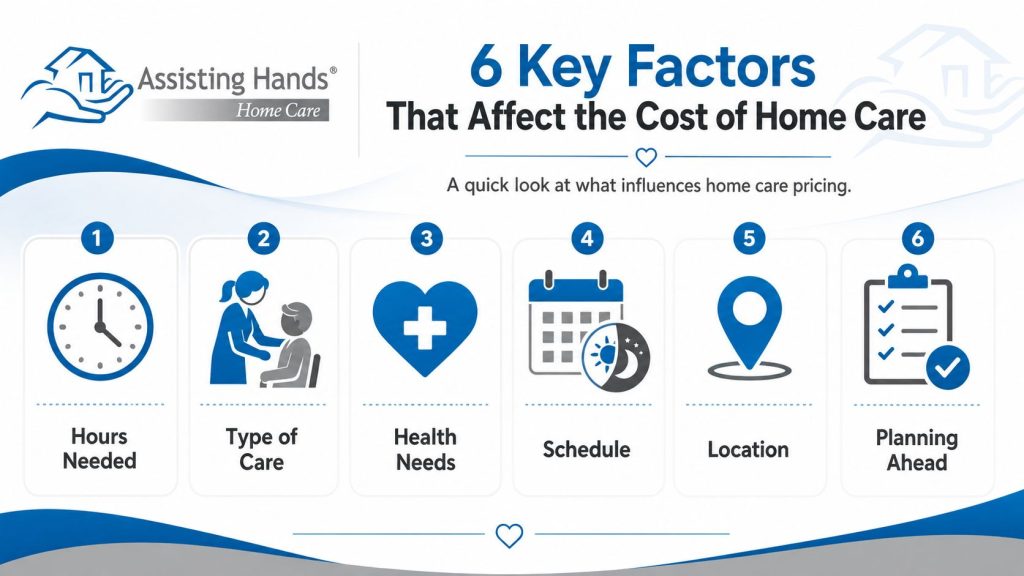
Six factors determine what you’ll actually pay for home care: hours needed, type of care, health conditions, schedule, location, and how you plan ahead. Each one is broken down below, along with what you can do to manage it.
1. How Many Hours of Care You Need
This is the big one. More than anything else, the amount of care someone needs each week drives the cost.
Some seniors do fine with a few hours of help a couple of times a week. Maybe someone comes by to handle errands, tidy up, prepare a couple of meals, and provide some company. For families whose parents are mostly independent but could use a hand here and there, that light schedule covers it.
Other situations call for daily help, several hours at a time, with things like bathing, dressing, meals, and getting around the house safely. Some families need someone in the home around the clock, either overnight, or through live-in and 24-hour care when safety is a real concern and someone needs to be awake and nearby at all times.
Seniors who start with a lighter schedule often need more hours over time as their needs change. That’s why the monthly estimates above are worth checking every few months instead of treating them as fixed.
2. Type of Home Care Services: Companion Care vs. Personal Care
The next biggest factor in the cost of home care is the type of care needed. Two seniors who receive the same hours of care each week will likely not pay the same, because their needs call for different types of care.
At the lighter end is companion care, in which caregivers keep your loved ones company and build a personal connection through activities like conversations, games, a walk, and help with the shopping list. For a lot of seniors who live alone, companion care keeps their spirits up.
Personal care is more hands-on and includes help with activities of daily living (ADLs) such as bathing, dressing, using the restroom, and moving from a bed to a chair. It takes more training and more attention from the caregiver, which is part of why the two levels aren’t priced the same.
Plenty of families land somewhere in between or move from one to the other over time. A parent might start with companionship and gradually need more personal assistance as the months go on. The care plan shifts with them, not locked into whatever made sense a year ago.
3. Health Conditions That Affect Home Care Costs
A person’s health has a direct effect on how their care is set up, and that shapes the cost too.
If your loved one is affected by memory loss or dementia, the plan usually needs more supervision and more consistency. A familiar routine and a caregiver who understands what triggers confusion can make a real difference at home. When balance or mobility is the concern, a caregiver may be there mainly to help with transfers and walking, and to keep an eye out so a fall doesn’t happen.
Recovery is another common reason care gets more involved for a while. After a hospital stay or a surgery, families often bring in help for a few weeks to manage medications, get around, and handle daily tasks while their parent regains strength. That kind of care is temporary by design, and a lot of families are surprised by how much smoother the recovery goes with it.
4. When Care Is Scheduled: Overnight, Weekend, and Holiday Rates
The clock and the calendar matter more than people expect.
Overnight help is its own thing. If a senior gets up during the night, or there’s a worry about what happens between bedtime and morning, having a caregiver there overnight helps ensure their safety, and it’s scheduled and planned differently than daytime hours.
Weekends and holidays factor in too, along with how steady the schedule is week to week. A predictable routine with the same days and same hours tends to be easier to staff and easier to plan around than a schedule that keeps shifting. Families who settle into a consistent rhythm early on usually find the whole arrangement runs more smoothly.
5. Where You Live: Home Care Costs in Naperville and DuPage County
Cost of care isn’t the same everywhere. Wages, local demand for caregivers, and the general cost of living all feed into what home care costs in a given area.
Illinois costs vary by market. Higher-cost metro areas like Chicago typically run above the statewide median, and agency rates in DuPage County suburbs like Naperville, Wheaton, and Lisle typically track with or above the statewide benchmark of about $35 an hour cited above. National averages give you a rough sense of things. A real quote, based on where you live and what your loved one needs, is what actually matters.
6. How to Plan for and Pay for the Cost of Home Care
Some of these factors, like your loved one’s health, are out of your hands. Others you can plan for, and that planning is what helps manage the cost.
The families who feel most in control are usually the ones who start the conversation early, before a crisis forces a rushed decision. Beginning with a lighter schedule and adding hours as needs grow tends to be smoother and easier on the budget than scrambling to arrange full-time care after a fall or a hospital stay.
Home care can often be paid for in ways families don’t expect. Many of our clients use long-term care insurance, and veterans or their spouses may be eligible for VA Aid and Attendance benefits that help cover the cost. Our own team can also walk you through VA benefits specific to home care. For a fuller look at your options, see our guide on 7 Ways to Pay for Non-Medical Home Care in Illinois.
Comparing price sheets isn’t usually the best place to start. A conversation about what your parents need now, and what they might need down the road, gets you further.
Why Families Trust Assisting Hands Home Care
Rich and Jennifer Ueberfluss lead our Naperville team with more than 35 years of combined experience in physical therapy, rehabilitation, and home care services. That clinical background shapes how we build every care plan, with an eye toward safety, recovery, and what actually helps someone stay independent at home.
Assisting Hands Home Care is a member of the Home Care Association of America, accredited through CARING.com, and recognized by the Home Care Standards Board. We’re also active in the Naperville community, including participation in the Walk to End Alzheimer’s and local fall prevention education. That doesn’t change your rate, but it’s part of who’s behind the care plan you’re getting.
Schedule a Free Home Care Cost Consultation in Naperville, IL
At Assisting Hands Home Care, we start with a free in-home consultation. One of our care coordinators comes to your loved one’s home, evaluates their condition and care needs, and talks through your options with your family. From there, we build a plan around their needs and walk you through the cost.
Call Assisting Hands Home Care at (630) 634-9316 to learn more about our senior home care services or set up a free in-home consultation.
Cost of Home Care FAQs for Naperville and DuPage County Families
How much does home care cost per hour in Illinois?
Home care in Illinois runs about $35 an hour on average as of 2026, based on statewide cost-of-care benchmark data. Your actual rate depends on the type of care needed, how many hours you book each week, and where in DuPage County you live. Personal care and specialized needs like dementia care usually cost more per hour than companion care. Call us at (630) 634-9316 for a rate based on your family’s specific situation.
What is the biggest factor in the cost of home care?
The number of hours of care needed each week has the biggest effect on cost. A few hours of help a couple of times a week costs far less than daily visits or around-the-clock support. The type of care matters too, since personal care and specialized needs cost more than companionship. Health conditions like dementia or mobility issues can also add to the hours or supervision required.
How much does companion care cost compared to personal care?
Companion care usually costs less than personal care. Companion care covers company, supervision, and everyday tasks like errands and light housekeeping, while personal care includes hands-on help with bathing, dressing, and mobility. That hands-on work takes more caregiver training and oversight, which is why personal care costs more per hour. Many families start with companion care and add personal care services as their needs increase.
Can we start with a few hours of home care and add more later?
Yes, most families start with a light schedule and add hours as needs change. Starting with just a few hours a week and increasing gradually is usually easier to manage and easier on the budget than arranging full-time care during a crisis. Your care plan can be adjusted at any point, so you are never locked into the hours you started with.
Does home care cost more at night or on weekends?
Overnight, weekend, and holiday care are typically staffed and scheduled differently than standard weekday hours, which can affect your overall cost. A consistent, predictable schedule with the same days and hours each week is usually easier to coordinate than one that changes often. If your loved one needs overnight supervision for safety, ask about live-in care options, which are often priced differently than hourly overnight shifts.
Can insurance or veterans benefits help pay for home care?
Yes, many families use long-term care insurance or veterans benefits to help cover the cost of home care. We accept most long-term care insurance plans and can help you understand what your policy covers. Veterans or their surviving spouses may also qualify for VA Aid and Attendance benefits, which can be applied toward home care costs. Our team can walk you through your specific options during a free consultation.
How do I find out exactly what my family’s home care will cost?
The best way is to schedule a free in-home consultation with Assisting Hands Home Care. One of our care coordinators visits your loved one’s home, evaluates their needs, and builds a care plan with a clear, specific cost. Call us at (630) 634-9316 to schedule your free consultation and get real numbers for your family’s situation.

