
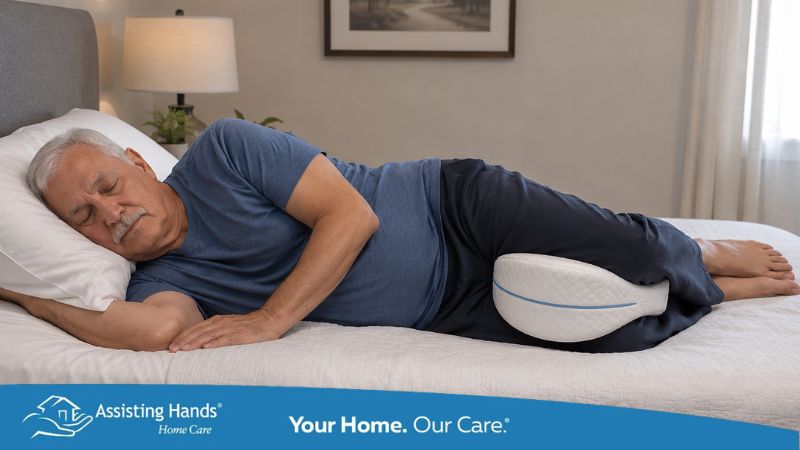
The best sleep position for most elderly adults is on their left side with a firm pillow placed between their knees. It supports circulation, keeps acid reflux from flaring up, reduces pressure on the joints, and helps the body breathe more easily through the night. That answer covers the majority of older adults, but the right choice depends on the individual, their health conditions, and what their body can realistically maintain for eight hours.
Sleep position is one of the first things we look at when we begin working with a new client at Assisting Hands. It does not get the attention it deserves. The wrong position, repeated night after night, quietly contributes to pressure wounds, worsened reflux, fragmented sleep, and increased fall risk the next morning. The right position, supported well, can change how a person feels and functions in ways that show up within days.
Sleep Position Becomes a Real Health Issue After 60
Most people think of sleep position as a comfort preference. In younger adults it mostly is. By the time someone reaches their late 60s or 70s, several things have shifted in ways that change that equation. Bone density decreases and spinal curvature changes, so positions that felt neutral for decades can now create genuine structural stress. Circulation slows, which means pressure on any part of the body builds faster and causes more damage. Chronic conditions like acid reflux, heart disease, sleep apnea, and Parkinson’s disease interact directly with how the body is positioned during sleep.
What makes this particularly important in caregiving is that many older adults cannot clearly feel when a position is harming them. Peripheral neuropathy, which is reduced sensation in the feet and legs, is common in seniors with diabetes or poor circulation. Cognitive changes can prevent someone from articulating that they are in pain. A person with mid-stage dementia may wake repeatedly, appear restless and agitated, and never be able to explain that their hip is aching from sustained pressure on one side.
There is also a less talked about dimension. Sleep architecture changes with age. Older adults spend less time in deep, restorative sleep and wake more easily. A position that causes even mild discomfort may not produce a visible wound but will generate repeated waking through the night that fragments sleep. Fragmented sleep in seniors compounds every other health concern in the picture. It slows healing, raises fall risk, worsens cognitive symptoms, and erodes quality of life in ways that look like aging but are at least partly preventable. The National Institute on Aging notes that sleep disorders and disrupted sleep become increasingly common with age, and that many older adults simply are not getting the restorative sleep their bodies need.
What Each Sleep Position Does to an Aging Body
The following covers what we see in real home care settings alongside what the research says. Each position is worth understanding on its own terms because what is right for one person can be genuinely harmful for another, and the reasons matter as much as the recommendation.
Left Side Sleeping (Best for Most Seniors)
Left side sleeping is what we recommend first for the majority of older adults and there are several reasons that build on each other. The most immediate benefit for many seniors is acid reflux control. When lying on the left side, the stomach sits below the valve that connects it to the esophagus. Gravity keeps acid where it belongs. For anyone dealing with nighttime heartburn or a history of esophageal damage, this alone makes a meaningful difference in sleep quality and long term health.
Circulation also benefits from the left side. The aorta, which is the body’s main artery, exits the heart and naturally curves to the left before running down through the body. Sleeping on the left side supports that natural orientation rather than working against it. The American Heart Association now considers sleep a core pillar of cardiovascular health, and for seniors with existing heart conditions, left side sleeping is often specifically recommended by cardiologists for this reason.
There is also research on the relationship between sleep position and brain health that we find worth sharing. The brain has a system for clearing metabolic waste overnight. Studies suggest this system works more efficiently when a person sleeps on their side compared to their back or stomach. The long term implications for dementia risk are still being studied, but the early findings are consistent enough to take seriously. You can read more about protecting brain health as you age and how sleep plays into that picture.
The single most overlooked detail with left side sleeping is the knee pillow. Without something firm placed between the knees, the weight of the top leg pulls the hip forward and downward, creating rotation through the lower back and lateral pressure at the hip joint. This causes or worsens the very hip and back pain that many seniors attribute entirely to arthritis. A firm pillow between the knees, not a soft decorative one, keeps the hips stacked and the spine in a neutral line. We see this fix resolve nighttime discomfort for clients regularly.
Back Sleeping (Good With the Right Support)
Back sleeping distributes body weight across the widest possible surface, which reduces concentrated pressure at any single point. For a senior without acid reflux, sleep apnea, or difficulty swallowing, back sleeping with appropriate support can work well. A pillow placed under the knees takes the arch out of the lower back and keeps the spine in a more comfortable position. Many seniors with joint or muscle pain find this genuinely comfortable and sleep better in it than in any other position.
The problem is that a significant number of older adults have at least one of the conditions that make back sleeping complicated. Obstructive sleep apnea, which is already more common in older adults than most people realize, worsens substantially when lying on the back. Gravity pulls the tongue and soft tissue toward the throat and narrows the airway. Snoring that seems like a minor irritation is often a sign of real oxygen drops through the night that affect cardiovascular health and cognitive function over time.
Aspiration is the other concern, and it is one that families frequently do not know to watch for. Aspiration means that saliva, liquid, or small food particles enter the airway during sleep rather than being swallowed. This happens more easily in the back sleeping position and is significantly more dangerous in seniors who have any degree of difficulty swallowing. Aspiration pneumonia is one of the most serious complications in elderly home care, and it develops quietly before any visible signs appear. Seniors with Parkinson’s disease, stroke history, or dementia are at higher risk and should not default to back sleeping without specific guidance from their physician.
For anyone who needs to sleep on their back for medical or comfort reasons, elevating the head of the bed to at least 30 degrees significantly reduces both reflux and aspiration risk. Turning the head gently to one side adds another layer of protection for those with swallowing concerns.
Right Side Sleeping (Acceptable With Conditions)
Right side sleeping is not inherently dangerous and for a senior without acid reflux or heart conditions it is a reasonable choice. The concerns are specific rather than universal. When lying on the right side, the stomach is oriented in a way that makes acid reflux more likely. The valve between the stomach and esophagus sits lower, and gravity works less in your favor. For anyone with chronic heartburn or a history of esophageal issues, left side sleeping is consistently the better option for this reason alone.
For seniors with heart failure specifically, the right side places more mechanical load on the heart and has been associated with increased discomfort and worsened symptoms in this group. Cardiologists managing heart failure patients tend to advise against it. If someone in your care has a heart failure diagnosis, this is worth raising directly with their care team at the next visit.
Outside of those conditions, right side sleeping shares most of the benefits of left side sleeping. It keeps the airway more open than back sleeping, avoids the structural problems of stomach sleeping, and still allows for the knee pillow technique that protects hip alignment. Comfort compliance matters more than people give it credit for. A person who is comfortable will hold their position through the night. A person who is not will shift repeatedly, generating the micro-awakenings that fragment sleep and undo the benefit of any position at all. If someone with no reflux or cardiac issues genuinely sleeps better on their right side, that comfort is worth honoring.
Stomach Sleeping (Avoid For Most Seniors)
Stomach sleeping is the most consistently problematic position for older adults, and the problems stack on top of each other in ways worth understanding individually. To breathe while lying face down, the neck must twist significantly to one side and hold that position for hours. The cervical spine in many seniors already has some degree of arthritis, disc narrowing, or bone spur formation. Sustained rotation under load aggravates all of it. Chronic neck pain, morning stiffness, persistent headaches, and worsening cervical degeneration are all associated with habitual stomach sleeping in older adults.
The lower back arches unnaturally in this position rather than maintaining the gentle curve that distributes load correctly. For anyone with lumbar arthritis, disc problems, or spinal stenosis, this means the condition is being actively aggravated every night. The arms typically end up either pinned under the body or stretched overhead, both of which compress shoulder structures and impair blood flow to the arms. The numbness and tingling that wakes many stomach sleepers through the night is not a coincidence.
For seniors with osteoporosis, the concerns are more serious. The ribs and vertebrae bear substantial sustained pressure in the arched prone position, and when bone density has declined significantly, repetitive stress over weeks and months carries real risk. For seniors with dementia, stomach sleeping tends to increase nighttime agitation and disorientation, likely because the position restricts full chest expansion and creates a mild sense of air hunger that is difficult to communicate.
The difficulty is that stomach sleeping is deeply habitual. Many older adults have slept this way for 40 or 50 years and associate it with the only position in which they can relax enough to fall asleep. Forcing an abrupt change rarely works and often makes sleep worse in the short term by adding anxiety to the problem. What works better is a gradual transition. Placing a firm bolster pillow along the front of the body gives the person the tactile security of something against their chest and abdomen while their body rests at a slight angle toward their side. Over two to three weeks, the angle can be increased until they are genuinely side sleeping. Most people adapt without significant resistance when the change is paced thoughtfully and the comfort of the original position is understood and respected rather than dismissed.

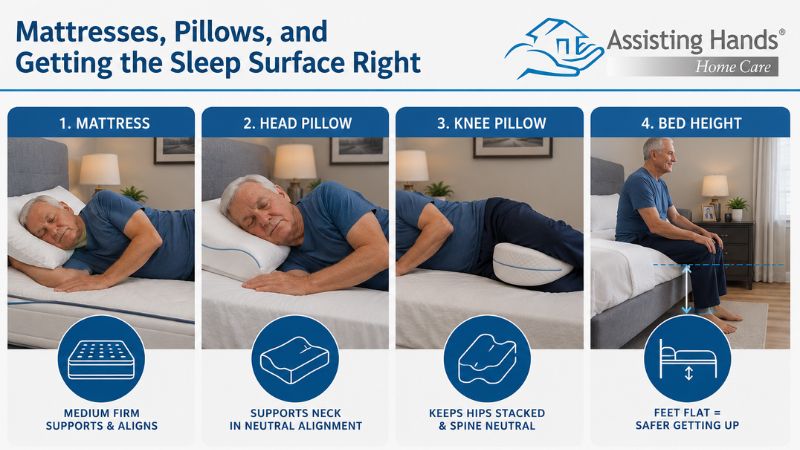
Mattresses, Pillows, and Getting the Sleep Surface Right
A senior who sleeps on their side on a mattress that is far too soft will sink unevenly into the surface, dropping the shoulder, rotating the hips, and allowing the spine to curve laterally. The position looks right from the outside but functions wrong for the body. Getting the physical setup right is part of the positioning itself, not a separate consideration.
Mattress
Medium firm is the sweet spot for most older adults. Soft mattresses create sinkage and misalignment that works against any sleep position. Very firm mattresses create pressure point pain that wakes people up through the night. Medium firm supports the body’s natural curves while distributing pressure evenly across the surface. Adjustable air beds can work well when two people in the same bed have different needs.
Head Pillow
The pillow needs to match the actual distance between the head and shoulder for side sleepers. Too flat and the head drops down, straining the neck. Too thick and the neck angles upward, which is equally problematic. Neither position is neutral and both cause pain that builds over weeks. A contoured memory foam pillow works well for many seniors because it holds its shape through the night rather than compressing flat by morning.
Knee Pillow
A firm pillow placed between the knees keeps the hips stacked and the lower spine neutral through the night. This single item resolves nighttime hip and back pain for many people we work with. It needs to be a firm dense pillow, not a soft decorative one that compresses flat within an hour of falling asleep. The difference in how someone feels the next morning is usually noticeable within the first few nights.
Bed Height
When seated at the edge of the bed, both feet should rest flat on the floor. A bed that is too high or too low increases the risk of a fall when getting up in the night. Getting out of bed at 2am in the dark is already one of the highest risk moments in elderly home care, and the wrong bed height makes it significantly more dangerous. This is worth checking and adjusting before anything else goes wrong.
Pressure Injuries and Why Repositioning Through the Night Is Not Optional
For seniors who are bedbound, have limited mobility, or cannot reposition themselves during sleep, pressure injuries represent an urgent and often underestimated concern. These wounds develop when sustained pressure cuts off blood flow to skin tissue and causes it to break down. In high risk individuals, tissue damage can begin in as little as two hours. Once a full pressure injury develops, it is very difficult to heal, deeply painful, and creates risk of serious infection that can become life threatening.
The most vulnerable areas are the heels, the tailbone, the hips, and the shoulder blades. The heels are particularly common and frequently overlooked until a wound has already formed. Families and caregivers often do not know what early skin changes look like, which means the window for easy intervention closes before anyone realizes it has opened.
- Reposition every two hours for any senior with limited mobility. Set an alarm if needed. One long stretch of unrelieved pressure is often where a wound begins.
- Elevate the heels completely off the mattress by placing a pillow lengthwise under the calves. This one adjustment prevents a large number of heel wounds. Do not place the pillow directly under the heels as that creates a new pressure point.
- Use a pressure redistributing mattress topper for any senior who cannot move independently. Standard mattresses are not adequate for high risk individuals even at medium firm density.
- Inspect the skin nightly at the heels, tailbone, and hips. Look for redness, warmth, or any change in skin color or texture. Early stage changes can reverse completely with prompt attention. Advanced wounds cannot be reversed.
- Keep a positioning log when multiple caregivers are involved. Miscommunication between shifts is one of the most common ways injuries develop. A simple written record of what position was used and when is basic injury prevention.
When Poor Sleep Is Telling You Something That Needs Medical Attention
Restlessness, repeated waking, refusing to stay in bed, or nighttime agitation are not always sleep habit problems or unavoidable consequences of aging. In our experience they frequently signal something specific: undertreated pain that the person cannot clearly describe, urinary urgency that becomes pressing in the middle of the night, medication side effects that alter sleep depth or cause vivid and disturbing dreams, or early cognitive changes that disrupt normal sleep cycles at a neurological level.
Sleep deprivation in older adults compounds every other health condition in the picture. It slows wound healing, raises fall risk, worsens cognitive symptoms, suppresses immune function, and erodes quality of life faster than most families expect. If positioning adjustments and surface changes are not helping after a few weeks, that conversation belongs with a physician and possibly an occupational therapist who specializes in positioning assessment. Families who are concerned about whether their loved ones are getting enough quality sleep as they age will find that the issue is often more manageable than it first appears once it is taken seriously.
Your Loved One Deserves Nights That Are Safe, Comfortable, and Watched Over
Nights are when the most serious problems happen quietly. A senior who cannot reposition themselves is developing pressure on vulnerable skin. Someone getting up confused in the dark is one wrong step from a fall that changes everything.
Assisting Hands Home Care in Naperville, IL provides overnight caregiving with someone physically in the home through the night. Our caregivers reposition clients on schedule, manage nighttime bathroom trips safely, and respond immediately when something changes.
If your loved one is in Naperville or the surrounding communities and you have concerns about how they are getting through the night, we would like to talk with you. There is no obligation and no pressure.
Call Assisting Hands Naperville today at (630) 634-9316 or request a free in-home consultation. We are available 24 hours a day.
FAQs
What are the four worst sleeping positions?
Stomach sleeping is the worst by a clear margin. It forces the neck to twist sideways for hours, arches the lower back unnaturally, and compresses the shoulders and arms. After that, flat back sleeping without head elevation is problematic for anyone with reflux or swallowing difficulties. Right side sleeping causes issues for people with acid reflux or heart failure specifically. And side sleeping without a knee pillow, while better than the others, still causes hip and lower back strain that builds up over time.
What is the most natural sleeping position?
Side sleeping is the most natural position for most people. The body tends to curl slightly when relaxed, which is why the majority of adults end up on their side through the night even when they start in another position. Left side sleeping in particular aligns with how the body’s internal organs are arranged and tends to cause the least disruption to breathing, digestion, and circulation.
What is the healthiest sleeping position for seniors?
Left side sleeping with a firm pillow between the knees. It keeps acid reflux down, supports heart circulation, reduces pressure on the joints, and appears to support the brain’s overnight waste-clearing process. The knee pillow is not optional. Without it, hip and lower back strain builds up and cancels out much of the benefit.
Why do elderly people wake up at 3am?
Several things happen at once. Deep sleep becomes shorter and lighter with age, so the body moves into lighter sleep stages earlier in the night and wakes more easily after that. Bladder capacity decreases, making nighttime bathroom trips more frequent. Pain from arthritis, pressure points, or poor positioning tends to surface once the initial tiredness wears off. Medications can also cause early waking as a side effect. If it is happening consistently, it is worth looking at the sleep surface, the position, pain management, and the medication list rather than accepting it as normal aging.
Which sleeping position is best to avoid dementia?
Side sleeping, and left side in particular. The brain clears metabolic waste including proteins linked to Alzheimer’s disease through a system that operates primarily during sleep. Research suggests this process works more efficiently in the side sleeping position compared to back or stomach. The science is still developing and side sleeping is not a guarantee of anything, but it is the position most consistently associated with better overnight brain clearing and it carries no downsides for most older adults.

