

One of the most common questions we get at Assisting Hands Home Care is: “How do we pay for in-home care services?” Or, we often hear families say, “My parents paid into this long-term care policy for years, but I’m not sure if your services are covered.”
The good news is that many of our clients successfully use their Long-Term Care Insurance (LTCI) policies to pay for in-home care. Not to worry, we’re happy to walk you through the process and help you understand what your policy covers.
What is Long-Term Care Insurance?
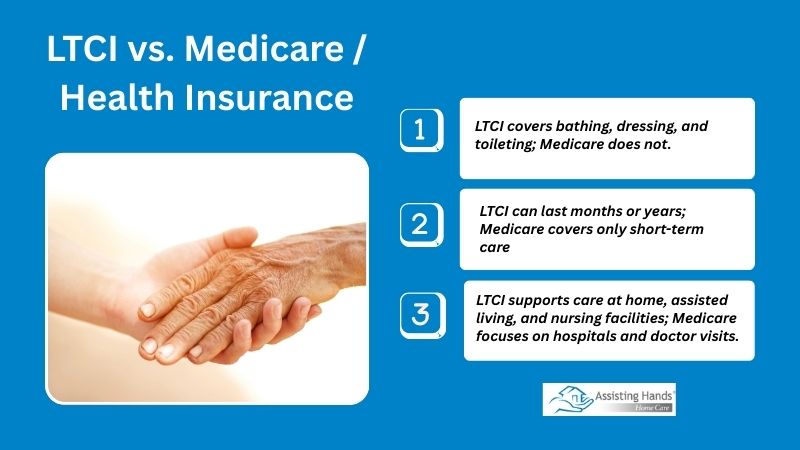
Long-Term Care Insurance (LTCI) helps cover the costs of care services that are not covered by Medicare or traditional health insurance. Each policy is unique, so it’s important to review your specific coverage. You may be eligible for more benefits than you realize, and we can guide you with helpful questions to ask your insurance provider.
Most policies include provisions for both community care and home care benefits. Older policies may be more restrictive and lean toward community-based care, while newer ones are often more flexible. Since more people now prefer to age in place at home, in-home care has become a standard option with LTC policies.
Understanding Long-Term Care and ADLs
The main purpose of LTCI is to help cover assistance with Activities of Daily Living (ADLs). These are often the criteria used to determine if someone qualifies for benefits. The primary ADLs include:
- Eating
- Dressing
- Bathing
- Transferring
- Toileting
- Continence care
If a policyholder struggles with at least two ADLs or shows signs of cognitive impairment, they may qualify to use their benefits.
Does Long-Term Care Insurance Cover In-Home Care?
The general answer is yes, most long-term care policies do cover in-home care. However, every insurance company and policy has its own requirements, limitations, and benefit triggers. Many policies also require that you use a licensed home care agency.
At Assisting Hands Home Care, we are a licensed agency and already have our credentials on file with most major LTC providers, making the setup process smoother.
Common Long-Term Care Policy Terms
When reviewing your policy, here are some key terms you should understand:
- Elimination Period – This is the waiting period before benefits start, often 90 days. Some policies count 90 actual service days, while others count 90 calendar days. We can work with you flexibly during this period.
- Daily or Monthly Benefit Amount – This is the maximum payout per day or per month.
- Benefit Triggers – These are the conditions that must be met to activate benefits, usually needing help with two or three ADLs or showing cognitive decline.
- Policy Maximum – This is the lifetime or total pool of money available under the policy.
- Approved Providers – Most policies require you to use a licensed care agency.
How to File a Claim for In-Home Care
Filing a claim with your long-term care insurance company may seem overwhelming at first, but breaking it into clear steps can make the process much easier. Here’s what to expect:
- Review Your Policy. Ask questions about the elimination period, benefit amounts, lifetime maximums, benefit triggers, and inflation riders.
- Notify Your LTC Company. Let them know you would like to open a claim. They may require an in-home evaluation.
- Gather Documentation. This may include a physician’s statement, a plan of care, and proof of need.
- Choose a Licensed Agency. Select an agency approved by your policy. If you choose Assisting Hands, let us know so we can expect communication from your LTC provider.
- Begin Care. Our caregivers provide in-home services and document daily activities. We send these notes and invoices to your LTC company on your behalf.
- Payment Process. You pay Assisting Hands directly for weekly care, and your LTC company then reimburses you shortly afterward.
By understanding your policy terms and following the right steps, you can make the process of filing an LTC claim smooth and stress-free.
At Assisting Hands Home Care, we work with families every day to navigate long-term care insurance and ensure benefits are applied properly. If you have questions, we’re here to help.
Major Standalone LTCI Companies
According to the American Association for Long-Term Care Insurance (AALTCI), a small number of insurers hold most of the active policies. Assisting Hands has experience working with nearly all of them:
| Company | Policies in Force (Approx.) | Market Share |
|---|---|---|
| Genworth | 1.17 million | 22% |
| John Hancock | 893,000 | 16.9% |
| MetLife | 449,000 | 8.5% |
| Continental Casualty (CNA) | 413,000 | 7.8% |
| Northwestern Mutual | 260,000 | 4.9% |
| Transamerica | 251,000 | 4.8% |
| Prudential | 212,000 | 4.0% |
| Mutual of Omaha | 200,000 | 3.8% |
| New York Life | 150,000 | 2.8% |
| Bankers Life | 132,000 | 2.5% |
Get Trusted Home Care in Arlington Heights and Nearby Areas
If you or your loved one is considering in-home care, Assisting Hands Home Care Arlington Heights is here to help. Our caregivers provide personalized support for seniors and adults, whether you need short-term assistance after an illness or ongoing long-term care. We proudly serve Arlington Heights and nearby communities such as Mount Prospect, Wheeling, Glenview, Prospect Heights and more.
Call us today at (847) 499-1307 to learn more about our compassionate home care services.

