
An elderly parent may lose interest in hobbies because of physical limitations, fatigue, depression, loneliness, grief, medication side effects, vision or hearing changes, fear of falling, or cognitive changes. Sometimes, a changing interest simply reflects changing abilities or preferences.
What matters most is whether your parent has stopped enjoying one particular activity or seems to have lost interest in nearly everything.
A sudden or widespread loss of interest, especially when accompanied by withdrawal, confusion, mood changes, or difficulty managing everyday activities, should be discussed with a healthcare professional.
When the garden goes untended, the woodworking bench starts collecting dust, or a parent stops attending their weekly card game, families naturally wonder what changed.
Sometimes there is a medical or emotional reason. Other times, the explanation is much simpler. Your father may still enjoy gardening but can no longer kneel comfortably. Your mother may still want to play cards but has trouble following the conversation because her hearing has changed.
The goal is to understand why the activity stopped, rather than assuming that losing interest automatically means depression or dementia.
Below are 10 common reasons seniors may lose interest in hobbies, signs families should pay attention to, and practical ways to help.
Is It Normal for Seniors to Lose Interest in Hobbies?
Yes, it can be normal for an older adult to lose interest in certain hobbies as their abilities, routines, social connections, and preferences change.
Someone who once gardened for hours may no longer have the stamina or balance for it. A lifelong golfer may stop playing because walking the course has become difficult. An avid reader may quietly stop reading because small print has become frustrating.
The more important question is whether your parent has lost interest in one activity or stopped enjoying most of the things they once liked.
If one hobby disappears while other interests continue, there may simply be a practical obstacle. A broader loss of interest that affects meals, conversations, social activities, personal care, and other parts of daily life deserves closer attention.
Why Do Elderly Parents Lose Interest in Their Hobbies?
Older adults may stop participating in hobbies because the activity has become physically difficult, tiring, socially isolating, frustrating, or confusing.
Here are 10 common reasons.
1. Physical Limitations or Chronic Pain
Arthritis, reduced mobility, muscle weakness, balance problems, shortness of breath, and chronic pain can make familiar activities much harder.
Your parent may still want to garden, sew, fish, cook, golf, or work around the house but may no longer be able to participate as comfortably as before.
Pain can also be easy for families to overlook because some older adults minimize their discomfort or simply adjust their routines without explaining why.
Rather than assuming your parent no longer enjoys an activity, ask whether there is something about it that has become physically difficult.
2. Fatigue or Low Energy
Low energy can quickly push hobbies to the bottom of the priority list.
Poor sleep, illness, recovery after hospitalization, medical conditions, and medication effects can all leave an older adult with less energy than usual.
When someone feels exhausted, they may use the energy they have for essential tasks such as eating, bathing, dressing, and attending medical appointments. Optional activities are often the first things they stop doing.
If your parent suddenly seems much more tired than usual, particularly if the change affects everyday activities, discussing it with their healthcare provider may be appropriate.
3. Depression
A loss of interest or pleasure in activities can be a symptom of depression.
Depression in older adults does not always appear as obvious sadness. Families may instead notice withdrawal from friends or family, low energy, irritability, changes in sleep or appetite, difficulty concentrating, or a loss of motivation.
If you are noticing several of these changes, learn more about the signs of depression in older adults and when it may be time to talk with a healthcare professional.
Depression is not considered a normal part of aging and can often be treated. Avoid trying to diagnose the cause yourself. If your parent has stopped enjoying most activities or you notice other significant mood or behavior changes, talk with their healthcare provider.
4. Loneliness and Social Isolation
Sometimes the enjoyment of a hobby comes as much from the people involved as the activity itself.
Your mother may not have loved playing euchre simply because of the game. She may have loved spending Thursday afternoons with the same friends she had played with for 30 years.
When friends move away, stop driving, become ill, or pass away, the activity may lose much of its meaning.
The same can happen with:
- Church groups
- Bowling leagues
- Volunteer activities
- Exercise classes
- Book clubs
- Senior center programs
- Regular coffee outings
In these situations, helping your parent rebuild the social connection around an activity may be more effective than simply encouraging them to restart the hobby.
5. Vision or Hearing Changes
Changes in vision or hearing can make hobbies more tiring and frustrating.
Reading may become difficult. Television may be harder to follow. Needlework, model building, puzzles, woodworking, and other detailed activities may require more visual effort.
Hearing changes can be especially isolating during social activities.
An older adult who struggles to follow conversations at a card game, restaurant, church gathering, or community event may quietly stop attending instead of explaining that hearing has become difficult.
Because sensory changes often develop gradually, your parent may not immediately connect them with losing interest in a favorite activity.
6. Medication Side Effects
Some medications can contribute to:
- Fatigue
- Drowsiness
- Dizziness
- Mood changes
- Reduced concentration
- Lower motivation
These effects may become more noticeable when an older adult takes several prescriptions.
If the change in your parent’s behavior began after starting a new medication or changing a dosage, consider asking the prescribing healthcare professional or pharmacist for a medication review.
Do not stop or change a prescription without professional medical guidance.
7. Cognitive Changes or Dementia
Memory and cognitive changes can make familiar hobbies unexpectedly difficult.
Dementia may affect memory, concentration, planning, decision-making, and the ability to complete steps in the correct order.
For example, someone who once enjoyed baking may begin struggling to follow a familiar recipe. A lifelong knitter may have difficulty following a pattern. Someone who managed household finances for decades may become confused when balancing a checkbook.
The person may stop doing the activity because it has become frustrating or confusing rather than because they no longer enjoy it.
Reduced motivation, sometimes called apathy, can also occur with dementia. However, apathy and depression are not the same condition, even though they may appear similar to family members.
8. Grief or a Major Life Change
Major changes can disrupt activities that were once part of an older adult’s routine.
These may include:
- The death of a spouse
- The loss of close friends
- Retirement
- Moving to a new home
- Losing a pet
- Giving up driving
- Moving in with family
- Changes in health or independence
Grief requires emotional energy and may temporarily change what someone feels capable of doing.
Activities that were closely connected to a spouse or friend may also become painful reminders of that relationship.
Giving your parent time while continuing to provide companionship and opportunities for connection can help.
9. Fear of Falling
A fall or even a near fall can cause an older adult to become much more cautious.
They may gradually stop:
- Gardening
- Walking outdoors
- Shopping
- Cooking
- Attending community events
- Going to church
- Visiting friends
- Participating in exercise programs
Families may hear, “I just don’t feel like going,” when the real concern is, “I’m afraid I might fall.”
If your parent has recently become hesitant about activities that involve walking, stairs, uneven surfaces, or leaving home, ask whether they feel physically safe doing them.
10. Difficulty Leaving the House
Transportation and mobility problems can bring several hobbies to an end at once.
Giving up driving may make it difficult to attend church, visit friends, participate in clubs, shop independently, or attend community activities.
Stairs can become intimidating. Walking long distances may become difficult. Bad weather can create another barrier.
For older adults living in Batavia, Geneva, St. Charles, Aurora, and surrounding Fox Valley communities, Illinois snow, ice, cold temperatures, and shorter winter days can make leaving home even more challenging.
If participating in a hobby requires a significant amount of effort simply to get there, your parent may gradually stop participating even though they still enjoy the activity itself.
When Should I Be Concerned That My Elderly Parent Has Lost Interest in Everything?
Families should pay closer attention when a loss of interest is sudden, affects most activities, lasts for several weeks, or occurs with other physical, emotional, or cognitive changes.
Watch for changes such as:
- Losing interest in nearly every activity
- Withdrawing from family or friends
- Confusion or new memory problems
- Significant personality or behavior changes
- Changes in eating or sleeping
- Unexplained weight changes
- Neglecting personal hygiene
- Difficulty bathing or dressing
- Difficulty preparing meals
- Trouble managing everyday routines
- Symptoms that appear suddenly rather than gradually
When Should You Call a Doctor?
Contact a healthcare professional if your parent suddenly loses interest in most activities, becomes increasingly withdrawn, shows signs of depression, develops confusion, experiences major behavioral changes, loses weight unexpectedly, or begins struggling with everyday activities.
Sudden confusion or a rapid change in mental status deserves prompt medical attention because it may be associated with an acute medical problem.
Call 911 or seek emergency medical care when your parent is experiencing severe or emergency symptoms.
Is Losing Interest in Hobbies a Sign of Dementia?
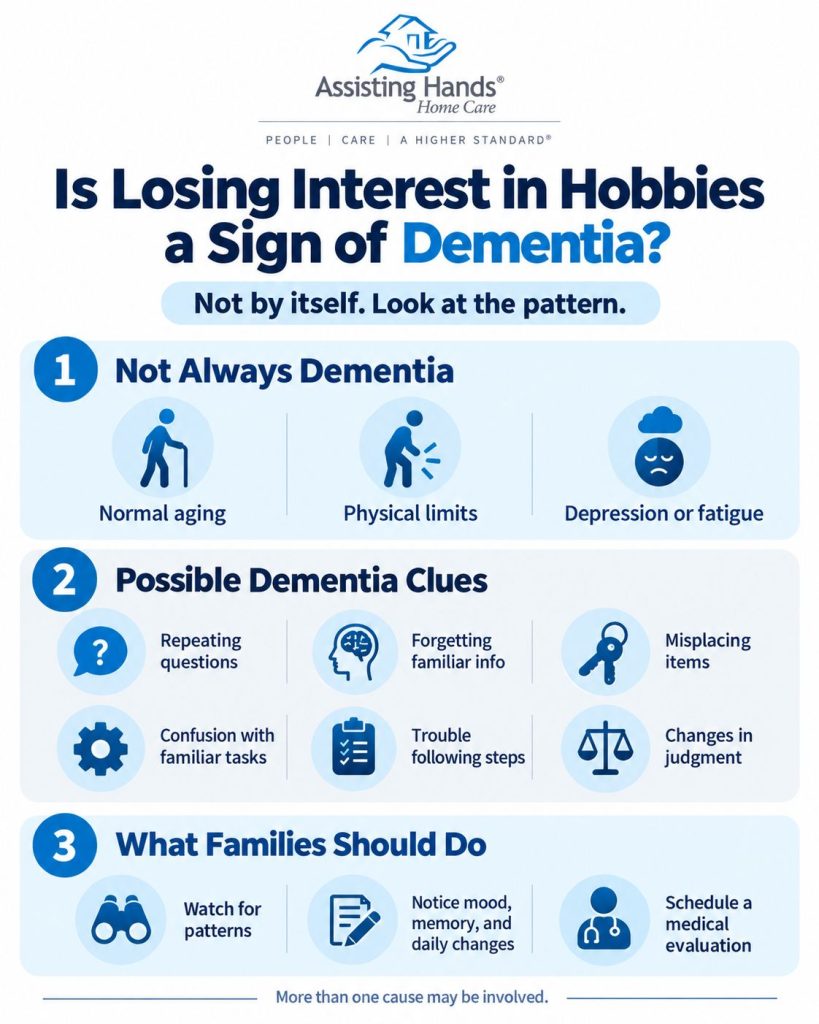
Losing interest in hobbies can occur with dementia, but losing interest alone does not mean someone has dementia.
The pattern of changes matters. With normal aging, someone may stop one activity while continuing to enjoy many others and can usually explain why they stopped.
With a physical limitation, your parent may still want to participate but feel frustrated because the activity is painful, tiring, or unsafe.
With depression, loss of interest is often broader and may occur along with persistent sadness, hopelessness, withdrawal, sleep changes, or appetite changes.
With dementia-related cognitive changes, families may notice additional difficulties such as:
- Repeating questions
- Forgetting familiar information
- Misplacing everyday items
- Becoming confused during familiar tasks
- Difficulty following instructions
- Problems planning or organizing
- Changes in judgment
A medical evaluation is the best way to determine what may be contributing to the change.
More than one factor may also be involved. An older adult can experience cognitive changes, depression, physical limitations, loneliness, and medication effects at the same time.
How Can I Help My Elderly Parent Become Interested in Activities Again?
Trying to force an older adult back into a hobby usually creates frustration. Instead, make activities easier, shorter, more social, and better suited to their current abilities.
Start With Small Invitations
Instead of saying, “You used to love gardening. Why don’t you garden anymore?” try:
“Would you like to sit outside with me for a few minutes?”
A smaller invitation may feel much more manageable.
Adapt Activities to Their Current Abilities
Look for ways to preserve the enjoyable part of an activity while reducing the difficult part.
For example:
- Try container gardening instead of a large garden.
- Choose audiobooks or large-print books instead of standard print.
- Try simple crafts instead of highly detailed projects.
- Take a short walk instead of a long outing.
- Cook one simple recipe rather than preparing an entire meal.
Keep Activities Short
Ten or 15 enjoyable minutes may be more successful than planning an entire afternoon.
Stopping while your parent is still comfortable can make them more interested in participating again another day.
Participate With Them
Companionship can change an activity completely.
Instead of encouraging your parent to complete a puzzle, walk outside, cook, watch a movie, or look through photographs alone, join them.
The connection may matter more than the activity.
Offer Two or Three Choices
Broad questions such as “What do you want to do today?” can be difficult to answer.
Instead, try:
“Would you rather listen to music, sit outside, or take a short walk?”
A few clear options make the decision easier.
Revisit Activities From Earlier in Life
Ask what your parent enjoyed when they were younger.
Familiar music, photographs, recipes, movies, hobbies, sports, and traditions can sometimes create stronger connections than newer activities.
Pay Attention to Patterns
Not every quiet day is a problem.
Everyone has days when they want less activity. Look for meaningful patterns rather than expecting your parent to stay busy every day.
What Are Good Activities to Do With an Elderly Parent?
The best activities for older adults are ones that match their current interests, physical abilities, cognitive abilities, and comfort level.
Activities at Home
Consider:
- Looking through family photo albums
- Listening to favorite music
- Watching familiar movies
- Cooking together
- Puzzles
- Simple crafts
- Container gardening
- Card games
- Board games
- Audiobooks
Social Activities
Depending on your parent’s interests, consider:
- Visits with family and friends
- Family meals
- Senior center activities
- Local community programs
- Religious gatherings
- Neighborhood events
- Small group activities
Physical Activities
Depending on your parent’s health and abilities, options may include:
- Short walks
- Chair exercises
- Gentle stretching
- Light gardening
- Simple household activities
If your parent has a medical condition or physical limitation that could affect their ability to participate safely, ask their healthcare professional which activities are appropriate.
How Can Companion Care Help an Older Adult Stay Engaged?
Companion care can help older adults maintain social interaction, everyday routines, and activities they still enjoy while remaining at home.
Families throughout Batavia, Geneva, St. Charles, Aurora, and Fox Valley South may understand exactly what their parent needs but simply cannot be available every day.
A professional caregiver can provide meaningful support while respecting your parent’s independence.
Support may include:
- Companionship
- Conversation and social interaction
- Encouragement to participate in appropriate activities
- Light meal preparation
- Help maintaining daily routines
- Assistance with household tasks
- Accompaniment to appointments or outings when available
- Respite care for family caregivers

Home care is not about keeping someone constantly occupied or forcing them to return to activities they no longer enjoy.
It is about providing reliable support and companionship that can make everyday life safer, more social, and easier to manage at home.
Assisting Hands Home Care provides non-medical senior home care for families in Batavia and surrounding Fox Valley South communities, including support for older adults living with Alzheimer’s disease and other forms of dementia through our Alzheimer’s and dementia care services.
Call Assisting Hands Home Care at (630) 948-8193 for a free consultation to discuss your parent’s needs and learn how in-home care may help them remain comfortable, connected, and supported at home.
Why Seniors Lose Interest in Their Hobbies FAQs
Why has my elderly parent stopped enjoying things they used to love?
The most common reasons are physical limitations, chronic pain, fatigue, depression, loneliness, grief, medication side effects, vision or hearing loss, and cognitive changes. One dropped hobby often has a practical explanation. A broad loss of interest across most activities is more likely to have a medical cause worth evaluating.
Is losing interest in hobbies a sign of depression?
It can be. Loss of interest or pleasure in activities is a core symptom of depression, and depression is common in older adults. Watch for sadness, irritability, withdrawal, and changes in sleep, appetite, or concentration alongside it. Depression is treatable, so share what you’re seeing with your parent’s doctor.
Is losing interest in hobbies a sign of dementia?
Not by itself. Apathy and reduced motivation do occur with dementia, but so do many other explanations. Dementia usually brings additional signs such as memory problems, repeated questions, confusion with familiar tasks, or difficulty following steps. A medical evaluation is the only way to know.
Why does my elderly parent not want to do anything?
Broad disinterest often reflects fatigue, depression, pain, or the cumulative effect of several medications. It can also follow a loss, a fall, or a move. If it appeared suddenly or has lasted for weeks, schedule a medical appointment rather than waiting it out.
How can I motivate my elderly parent?
Offer two or three specific choices instead of open-ended questions, start with short sessions, adapt old hobbies to current abilities, and do the activity with them. Companionship motivates more reliably than encouragement does. Avoid pressure, which usually produces resistance rather than participation.
Can loneliness cause an elderly person to lose interest in hobbies?
Yes. Many hobbies are social at their core, and when the group disappears, the activity loses its appeal. Loneliness and social isolation in older adults are also linked to poorer health outcomes, which makes regular social contact worth arranging deliberately.
Can home care help an elderly parent who is withdrawing from activities?
Often, yes. A caregiver provides consistent company, encouragement to take part in suitable activities, help with meals and routines, and support that makes leaving the house or staying engaged at home more manageable. Home care also gives family caregivers a break.