
By Richard E. Ueberfluss, PT and edited by David Brimm — Updated March 27, 2026
Download One-page Room-by-Room Safety Checklist (printable)
To safety-proof an elderly parent’s home, focus on four hazard categories: falls, medication or chemical poisoning, choking (dysphagia), and fire. Removing trip hazards, adding grab bars and lighting, securing medications, adjusting food textures for swallowing difficulty, and installing modern smoke and carbon monoxide alarms addresses the risks that send the most older adults to the hospital each year. The sections below give a room-by-room action plan for each hazard.
What Does “Safety-Proofing” a Senior’s Home Mean?
“Safety-proofing” also called “home modification for aging in place” means identifying and reducing hazards in a senior’s living environment through structural changes (grab bars, ramps, lighting), behavioral changes (medication review, mealtime routines), and technology (fall sensors, smart smoke detectors) so an older adult can live independently with lower injury risk.
How Can You Prevent Slips and Falls in an Elderly Parent’s Home?
Falls are the leading cause of injury-related death and hospital admission for older adults, and a prior fall strongly predicts a future one. The CDC’s STEADI initiative (Stopping Elderly Accidents, Deaths & Injuries) provides an evidence-based framework for screening, assessing, and reducing fall risk.
- Home hazards: remove clutter, secure or remove loose rugs, tuck cords into cable channels, and use non-slip mats in bathrooms and kitchens. Replace slippery flooring where possible.
- Lighting: install bright, glare-free LED lighting, motion-activated night lights in hallways and bathrooms, and illuminated stair-edge strips.
- Stairs & bathrooms: add continuous handrails on both sides of stairs; install professionally anchored ADA-style grab bars at toilets and in tubs/showers; consider a curbless walk-in shower or transfer bench for limited mobility.
- Footwear & mobility aids: ensure well-fitting, low-heeled, non-slip shoes; check that canes and walkers are the correct height and have non-slip tips.
- Exercise & therapy: encourage balance and strength programs such as Otago, Tai Chi, or physical-therapy-prescribed exercises, many of which are available virtually or through community centers.
- Medication review: arrange regular medication reconciliation and deprescribing conversations with a clinician or pharmacist, using the AGS Beers Criteria as a discussion guide for potentially inappropriate medications.
- Technology: consider wearable fall detectors, smartphone fall-detection features, and in-home sensors that alert caregivers automatically.
- Professional screening: use CDC STEADI screening tools with a clinician, or arrange a home safety evaluation by a physical or occupational therapist.
How Do You Prevent Medication and Chemical Poisoning at Home?
Preventing poisoning in a senior’s home starts with keeping an accurate, up-to-date medication list and locking up medications and chemicals so they can’t be mixed up or accessed accidentally. Polypharmacy and confusion between similar medications are common contributors to adverse drug events.
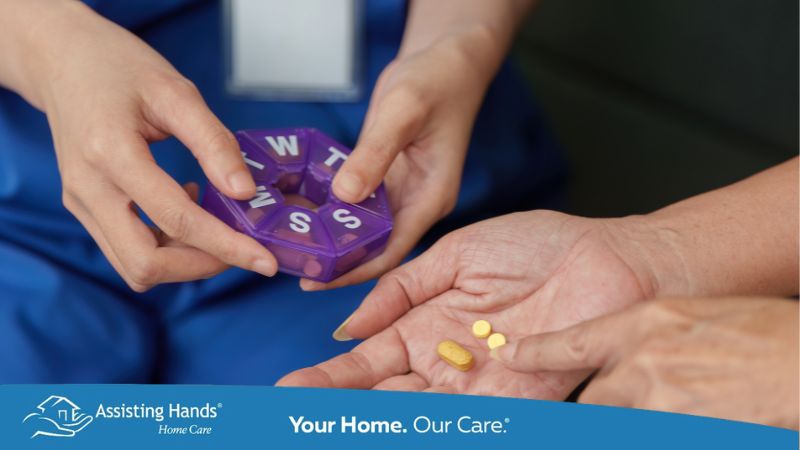
- Medication management: keep an up-to-date list of prescriptions, OTCs, and supplements. Use locked or automatic pill dispensers with alarms, or synchronized pharmacy blister packs.
- Storage & labeling: keep chemicals and medications in original, clearly labeled containers, stored in locked cabinets away from food and drinks.
- Separate families’ medications: never store multiple households’ medications together.
- Review & deprescribe: schedule periodic medication reviews with the prescriber or pharmacist, and ask about alternatives to high-risk drugs such as opioids, benzodiazepines, and anticholinergics.
- Education: teach caregivers the signs of overdose and emergency response. Keep naloxone on hand and know how to use it if opioids are present in the home.
Related: The Danger of Forgetting or Taking the Wrong Medication
How Do You Prevent Choking and Manage Dysphagia in Older Adults?
Preventing choking in someone with dysphagia (swallowing difficulty) starts with a formal swallow evaluation from a speech-language pathologist, followed by IDDSI-standardized food-texture and liquid-thickness guidance rather than guessing at consistency. Dysphagia raises the risk of aspiration and pneumonia.
- Seek assessment: coughing during meals, a wet or gurgly voice after eating, repeated chest infections, or unexplained weight loss are signs to request a formal swallow evaluation, and instrumental testing if appropriate.
- Follow IDDSI: use IDDSI-consistent texture and liquid modifications recommended by a clinician, and avoid sticky, dry, or hard-to-chew foods if advised.
- Mealtime strategies: sit upright during meals and for 30–60 minutes after, reduce distractions, offer small bites, use adaptive utensils, and address denture fit and oral health.
- Oral-motor therapy: a speech therapist can teach safe-swallowing exercises and techniques; in advanced cases, discuss feeding options and goals of care with clinicians.
How Do You Prevent House Fires in a Home With Elderly Residents?
Preventing fires in a senior’s home relies on interconnected smoke and carbon monoxide alarms on every level, safe cooking and heating habits, and a practiced two-exit escape plan, since older adults face a higher risk of dying in a home fire than younger adults.
- Smoke & CO detection: install interconnected smoke and CO alarms on every level and inside and outside sleeping areas. Prefer 10-year sealed-battery or hardwired alarms with battery backup, and test monthly.
- Cooking & smoking safety: supervise cooking, avoid loose clothing near stovetops, and consider smoke-free policies indoors. Smokers should use deep, heavy ashtrays and never smoke in bed.
- Heating & appliances: avoid portable space heaters; if used, keep a 3-foot clear zone. Have furnaces and chimneys inspected annually.
- Extinguishers & escape planning: keep a multi-purpose extinguisher accessible, and create and practice a simple escape plan with two exits from each room.
- Fire response technology: smart smoke detectors that alert phones and caregivers add an extra layer of protection.
What Room-by-Room Home Modifications Improve Senior Safety?
The table below maps the most common hazards to specific fixes for each area of the home.
| Room | Common Hazard | Recommended Fix |
|---|---|---|
| Entrance | Steps, ice, uneven pathways | Install ramps or threshold ramps, secure handrails, wear non-slip footwear, and keep walkways salted and cleared during winter. |
| Bathroom | Slippery, wet surfaces; low toilets | Install professionally anchored grab bars, use a raised toilet seat and shower seat, and add anti-scald or thermostatic mixing valves. |
| Kitchen | High or low storage; hot stovetop surfaces | Store frequently used items between waist and shoulder height and consider switching to an induction cooktop. |
| Stairs & Hallways | Poor lighting; single or no handrail | Install continuous handrails on both sides, bright LED lighting, and illuminated stair-edge strips. |
| Bedroom | Dark path to the bathroom at night | Use motion-activated night lights, keep walking paths clear, and place a phone or emergency call button within easy reach. |
What Caregiver and Community Resources Help With Home Safety?
- Healthcare coordination: use telehealth for medication reviews and therapy follow-ups, and request a STEADI fall-risk screen from primary care.
- Local services: contact your Area Agency on Aging for home-modification grants, caregiver support, and community exercise classes.
- Respite & paid help: if safety concerns persist, consider home health aides, adult day programs, or assisted living. Discuss advance directives and goals of care early.
Related: When a Spouse Becomes a Caregiver After Age 75: What Changes and Why It Matters
When Should You Consider Higher Levels of Care for an Elderly Parent?
Consider higher levels of care when multiple risks persist despite home modifications, such as recurrent falls, frequent choking or aspiration, uncontrolled medications, or an unsafe environment, or when you’re no longer comfortable leaving your parent alone. Discuss home caregiver support, short-term rehabilitation, or assisted living with clinicians and family.
What’s the Bottom Line on Elderly Home Safety?
Reducing the four biggest at-home risks for older adults (falls, poisoning, choking, and fire) comes down to a clinical fall screen (CDC STEADI), a medication review, a swallowing assessment if needed, and upto-date smoke and CO detection, combined with targeted home modifications, exercise, secure medication systems, and smart alerts.
Trusted Home Care in Lisle, IL and the Surrounding DuPage & Cook County, Illinois
Not sure your parent’s home is as safe as it could be? Assisting Hands Home Care offers free in-home safety assessments and home care services for families in Lisle, Naperville, Glen Ellyn, Warrenville, Westmont, Wheaton, and Woodridge. Our caregivers help with fall prevention, medication reminders, mobility support, and daily living assistance so your loved one can safely age in place.
Call (630) 634-9316 to schedule your free consultation today.
Frequently Asked Questions
What are the most common hazards in an elderly parent’s home?
The four most common and most preventable hazards are falls, medication or chemical poisoning, choking from swallowing difficulty (dysphagia), and home fires. Falls are the leading cause of injury-related death among older adults.
How much does it cost to safety-proof a senior’s home?
Basic fixes like grab bars and non-slip mats often cost under $200. Larger modifications, such as curbless showers, stairlifts, or entrance ramps, commonly run $1,500 to $10,000 or more. Local Area Agencies on Aging often offer home-modification grants that can offset the cost.
Do grab bars need to be professionally installed?
Yes. Grab bars must be anchored into wall studs or blocking, not just drywall, to safely support body weight during a fall. Professional installation is strongly recommended over adhesive or drywall-anchor models.
What is the CDC STEADI program?
STEADI (Stopping Elderly Accidents, Deaths & Injuries) is a CDC toolkit that helps clinicians screen older adults for fall risk, assess contributing factors, and recommend interventions such as exercise programs or medication review.
What foods should someone with dysphagia avoid?
Avoid dry, sticky, or hard-to-chew foods unless a speech-language pathologist has confirmed they’re safe. Texture and liquid thickness should follow IDDSI-standardized levels prescribed for that person, not general assumptions.
How often should smoke alarms be tested in a senior’s home?
Test smoke and carbon monoxide alarms monthly. Ten-year sealed-battery or hardwired alarms with battery backup are preferred over standard 9-volt units because they require less maintenance and are less likely to be disabled by a low-battery chirp.
When should an elderly parent stop living alone?
Consider higher levels of care when multiple risks persist despite home modifications, such as recurrent falls, frequent choking or aspiration, uncontrolled medications, or an unsafe environment, or when family members are no longer comfortable leaving the person alone.
Sources
- CDC — STEADI (Stopping Elderly Accidents, Deaths & Injuries) Toolkit: https://www.cdc.gov/steadi/index.html
- AGS Beers Criteria (American Geriatrics Society) — Potentially Inappropriate Medication Use in Older Adults: https://geriatricscareonline.org/guidelines/american-geriatrics-society-2019-beers-criteria/12/
- IDDSI (International Dysphagia Diet Standardisation Initiative): https://iddsi.org
- U.S. Fire Administration — Older Adults & Fire Risk: https://www.usfa.fema.gov/downloads/pdf/statistics/v19i7.pdf
- National Institute on Aging — Prevent Falls and Fractures: https://www.nia.nih.gov/health/prevent-falls-and-fractures
- AHRQ / Medication Management resources (deprescribing & reconciliation): https://www.ahrq.gov/patient-safety/resources/resources/medication-safety.html
- NIH / PubMed (balance & exercise programs e.g., Otago, Tai Chi meta-analyses): https://pubmed.ncbi.nlm.nih.gov (search “Otago exercise program falls” or “Tai Chi fall prevention older adults”)
- Emergency response & smoke/CO detector guidance (EPA/NFPA summaries): https://www.nfpa.org/Public-Education/By-topic/Top-causes-of-fire/Cooking and https://www.epa.gov/indoor-air-quality-iaq/indoor-carbon-monoxide
Click to Download One-page Room-by-Room Safety Checklist (printable)

