

It’s 9 p.m. You’ve helped your mom into bed, set out tomorrow’s pills, and wiped down the kitchen counter. Then you go downstairs and realize you didn’t say goodnight. You’re not angry with her. You just didn’t feel anything, and that bothers you more than the tiredness.
That moment is where caregiver burnout and compassion fatigue start to blur together. They feel similar from the inside, and most people use the terms interchangeably. But they have different causes, they show up differently, and they don’t get fixed the same way. If you pick the wrong fix, you can take a week off and come back feeling just as hollow.
Here’s how to tell which one you’re dealing with, using the frameworks researchers and clinicians actually use, plus the local Naperville resources that can help with each.
You’re not the only one feeling this
According to the AARP and National Alliance for Caregiving’s Caregiving in the U.S. 2025 report, 63 million Americans, nearly 1 in 4 adults, are now family caregivers. That’s 20 million more than in 2015. The same research found that about 1 in 4 caregivers provide 40 or more hours of care a week, and about 1 in 5 describe their own health as fair or poor.
In Naperville, those caregivers include adult children who work full days and handle evening care, spouses who’ve been the only caregiver for years, and families coordinating care from Edward Hospital back home. The hours add up, and so does the emotional weight. Those are two separate problems.
Burnout is about load
Psychologist Herbert Freudenberger coined the term “burnout” in 1974 to describe helping professionals worn down by chronic stress. Researcher Christina Maslach later broke it into three parts, and that model is still the standard: emotional exhaustion, a growing distance or cynicism toward the people you help, and a feeling that nothing you do is enough.
The World Health Organization classifies burnout as an occupational phenomenon, not a medical diagnosis. Family caregiving isn’t a job on paper, but it has every feature of one that causes burnout. There’s a heavy workload, not much control, no days off, and nobody to hand things to at 5 p.m.
Burnout tends to look like this:
- You’re tired in a way a full night’s sleep doesn’t touch
- You catch every cold going around
- Small things set you off, like a sibling’s text or a pharmacy hold message
- Your own dentist appointment has been pushed back three times
- You feel like you’re failing even though you’re doing everything
Burnout builds slowly, over months. It’s easy to see on a calendar. If you can’t name the last afternoon that was fully yours, start there.
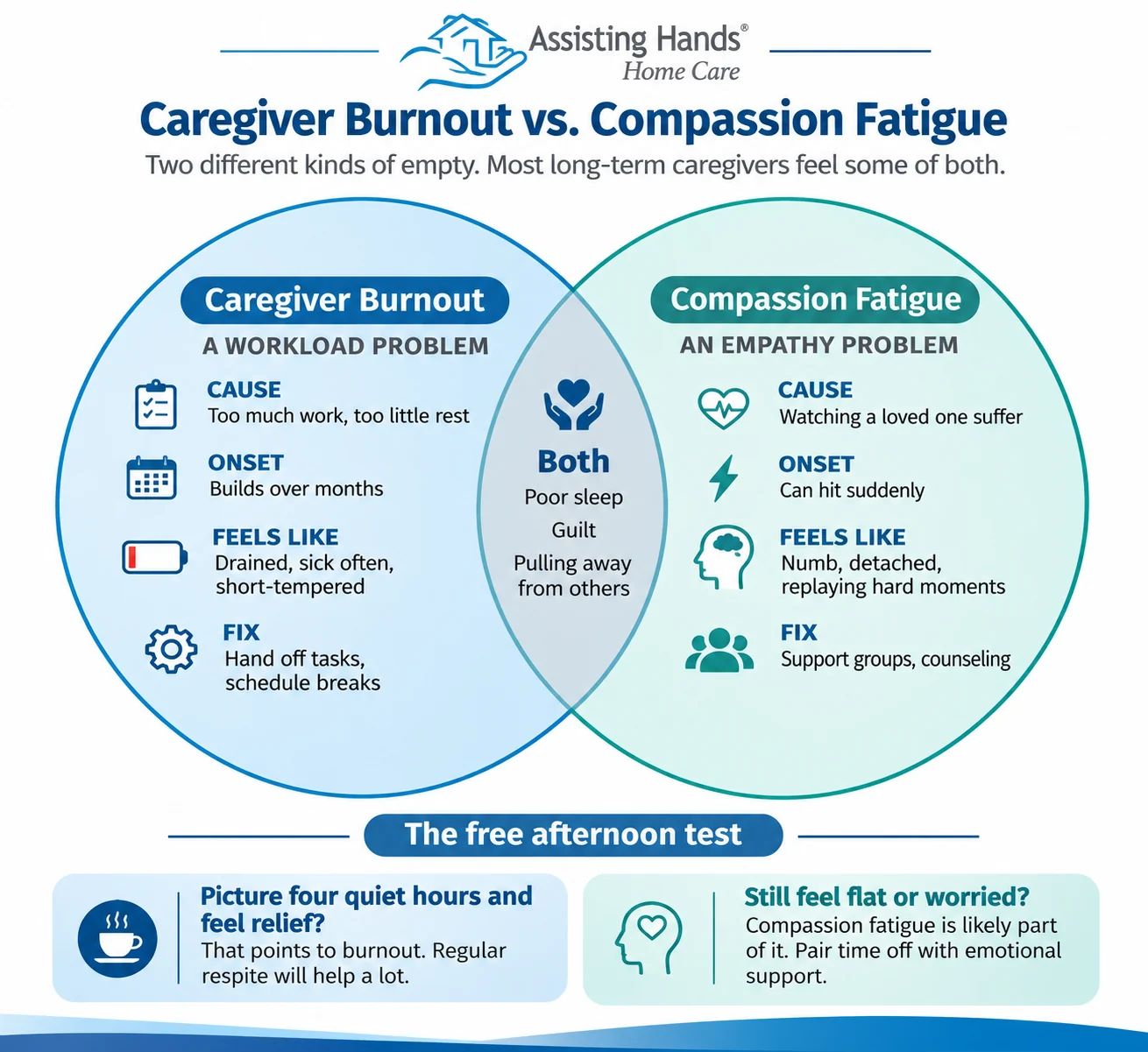
Compassion fatigue is about what you witness
Nurse Carla Joinson first used the phrase “compassion fatigue” in 1992 to describe nurses who had lost the ability to nurture. Traumatologist Charles Figley expanded the idea in the 1990s, describing it as the cost of caring for people in pain. He linked it to secondary traumatic stress, the strain of absorbing someone else’s suffering.
Researchers have since studied it in family caregivers, too. The difference matters. A nurse goes home at the end of a shift. You live with the person whose decline you’re watching. You see your dad search for a word he’s known his whole life, or your wife struggle with a fork after a stroke, and then you see it again the next morning.
Compassion fatigue tends to look like this:
- Feeling numb or detached from someone you love
- Replaying hard moments at night, like a fall or a scary hospital visit
- Dreading their bad days instead of just getting through them
- Guilt over being less patient than you used to be
- Steering away from conversations about their prognosis
A simple way to sort out what you’re feeling
Think about your next free afternoon. If the thought of four quiet hours makes you feel relieved, you’re probably dealing with burnout. Rest will help.
If you imagine those four hours and still feel flat, or you’d spend them worrying about your mom, compassion fatigue is likely part of it. Rest alone won’t be enough.
| Caregiver Burnout | Compassion Fatigue |
|---|---|
| Root cause Too much work, too little rest |
Repeated exposure to a loved one’s suffering |
| Onset Gradual, over months |
Can be sudden |
| Core feeling Drained and overwhelmed |
Numb, detached, guilty |
| Does rest help? Yes, a lot |
Partly |
| Best approach Hand off tasks and schedule breaks |
Emotional support and processing |
Clinicians use formal tools for both. The Zarit Burden Interview measures caregiver strain, and the Professional Quality of Life Scale (ProQOL) screens for compassion fatigue. Your doctor or a counselor can go through either one with you if the table above isn’t clear enough.
Fixing Caregiver Burnout: Start by Sharing the Work
A lot of advice for caregiver burnout focuses on self-care. Take a bath, go for a walk, or try journaling. Those things can help, but they don’t solve the biggest problem when you’re responsible for someone’s care every day: there’s simply too much to do.
If you’re feeling burned out, start by looking at everything you handle in a typical week. Write it all down, including the little things you might not think twice about, such as refilling a water pitcher, picking up prescriptions, scheduling a doctor’s appointment, or doing another load of laundry.
Now look at that list and ask yourself which tasks someone else could take over.
You might find that another family member can handle medical appointments, while a home care caregiver can help with bathing, dressing, meal preparation, laundry, and other daily activities. You don’t have to hand everything over. Even having someone take care of a few hours of responsibilities each week can give you room to breathe.
The important part is to make those breaks part of your regular schedule. In-home respite care can provide coverage every Tuesday afternoon, for example, or a few evenings each week. When you know someone will be there, you can make plans without constantly wondering who will look after your parent.
Use that time for something you’ve been putting off. Schedule your own doctor’s appointment, take a walk along the Naperville Riverwalk, meet a friend for lunch, or catch up on sleep.
And when you ask relatives to help, try making a specific request. Instead of saying, “I need more help with Dad,” ask, “Can you take Dad to his 2 p.m. appointment on the 14th?” It’s easier for family members to understand what you need and commit to something concrete.
Managing Compassion Fatigue: Don’t Ignore the Emotional Side
Sometimes, getting a few hours away isn’t enough. You may have time to rest, but the sadness, frustration, or guilt are still there when you return. That’s where the emotional side of caregiving needs attention.
You may be grieving the changes in your parent’s health, struggling with a loved one’s dementia diagnosis, or feeling guilty because you don’t always have the patience you once did. Talking about those feelings with someone who understands can help.
Connect With Other Family Caregivers
Talking with someone who understands what you’re going through can make a difference. Other family caregivers may have faced similar situations and can share how they manage difficult days, family disagreements, and changes in their loved one’s condition.
Naperville families can also look into local caregiver support groups and dementia-related resources through the City of Naperville, Endeavor Health, and 211 DuPage. Check current meeting schedules and eligibility before attending.
Consider Talking With a Counselor
If you feel overwhelmed, emotionally disconnected, or unable to work through your feelings, speaking with a counselor may help. A mental health professional can give you a place to talk openly about grief, frustration, guilt, and the changes happening in your family.
You don’t have to wait until you reach a breaking point to ask for support.
Learn More About Your Loved One’s Condition
Sometimes understanding a condition can change how you respond to difficult moments. For example, a parent with dementia may refuse to bathe, become upset during everyday activities, or repeat the same questions. These behaviors may be related to changes in the brain rather than a deliberate attempt to make caregiving harder.
Learning what to expect as a condition progresses can help you respond with more patience and recognize when your loved one needs a different kind of support.
Make Time to Enjoy Being Together Again
When most of your time together involves bathing, dressing, meals, medications, and appointments, it can become difficult to enjoy your relationship outside of caregiving.
Having someone else handle some of those responsibilities gives you more opportunities to simply be together. Look through old family photos, listen to music, watch a favorite movie, or sit and talk.
Those ordinary moments can help you reconnect as a daughter, son, spouse, or family member rather than feeling like a caregiver every minute of the day.
What If You’re Experiencing Both Burnout and Compassion Fatigue?
Caregiver burnout and compassion fatigue can happen at the same time. You may feel physically exhausted from managing daily responsibilities while also feeling emotionally drained by watching your loved one’s health change.
If this sounds familiar, start by reducing some of the work you’re carrying. Ask family members to take on specific tasks, arrange regular breaks, and consider in-home respite care if you need more consistent support.
Then give attention to your emotional well-being. Talk with someone you trust, connect with other caregivers, or consider speaking with a counselor.
Pay attention to changes in your own health, too. If you experience ongoing sadness, loss of interest in activities, changes in sleep or appetite, or feelings of hopelessness for two weeks or longer, talk with your healthcare provider.
You can love your parent or spouse deeply and still find caregiving difficult. Needing help doesn’t change how much you care about them.
How Assisting Hands Home Care Naperville Helps Family Caregivers in Naperville & Nearby Areas
You don’t have to manage every part of your loved one’s care on your own. Assisting Hands Home Care provides in-home respite care in Naperville and nearby communities in DuPage County.
Our caregivers can help with bathing, dressing, meal preparation, mobility, medication reminders, companionship, and other daily activities. Some families arrange a few hours of help each week, while others need overnight care or longer coverage when a family caregiver is traveling or unavailable.
We take time to learn about your loved one’s routine and care needs so we can discuss a schedule that works for your family.
If caregiving has become difficult to manage on your own, contact Assisting Hands Home Care Naperville to discuss your situation and schedule a free in-home consultation. We’ll talk with you about your loved one’s needs and the type of support that could give you more time to rest and take care of yourself.
FAQs
What is the difference between caregiver burnout and compassion fatigue?
Caregiver burnout is exhaustion caused by a heavy, ongoing workload with too little rest. Compassion fatigue is emotional exhaustion that comes from repeatedly seeing a loved one suffer. Burnout drains your energy. Compassion fatigue wears down your ability to feel empathy.
Is caregiver burnout a medical diagnosis?
No. The World Health Organization classifies burnout as an occupational phenomenon, not a medical condition. Burnout can overlap with depression and anxiety, though, so talk to your doctor if your symptoms last more than a couple of weeks.
Can you have caregiver burnout and compassion fatigue at the same time?
Yes, and long-term caregivers often do. Start by cutting the workload through respite care or shared tasks. With more rest, the emotional side gets easier to work on.
Is there a test for caregiver burnout or compassion fatigue?
Clinicians often use the Zarit Burden Interview to measure caregiver strain and the Professional Quality of Life Scale (ProQOL) to screen for compassion fatigue. A doctor or counselor can help you go through them

