
 Helping a Stroke Patient within 10-20 Minutes
Getting to the emergency room (ER) as quickly as possible is perhaps the most important part of managing a stroke because brain tissue can deteriorate at a rapid pace.
Statistics show that the initial 10–20 minutes of a stroke plays a crucial role in deciding the overall quality and chance of stroke survival.
There is really nothing that will make taking care of a stroke patient at home easy, but there are things that can be done to help reduce the stress of caring for a stroke victim.
Caring for a Stroke Patient at Home
Here’s some ways that you or a caregiver can care for a stroke patient at home:
-
Separate the person from the behavior:
- It’s not unusual for stroke survivors to experience changes in personality and behavior.
- Someone who’s been active and independent his entire life may become dependent and sedentary.
- Someone who was always cheerful and optimistic can become pessimistic, stubborn, and even combative.
- If you are witnessing personality changes, talk to their doctor.
- Your loved one could be experiencing depression or pain.
- Medication may help.
- If the damage is untreatable or irreversible, be cognizant that it’s the disease rather than on your loved one.
-
Meet your loved one where he or she is at right now.
- Just love them for who they are.
- Accepting a “new normal” is hard, but stepping into the moment may be easier than trying to hang on to the past.
-
Focus on a positive or happy memory.
- Think about a special event or moment you shared with your loved one before the stroke.
- Try to recapture the positive feelings you experienced in that moment.
- And then when you are feeling exceptionally angry, upset, or sad, pull that memory out and focus on replacing your current negative mental energy with the positive feelings you recall from that particular event.
-
Join a support group.
- Joining a caregiver support group can provide you with information and education as well as a safe place to express all your emotions.
- You will benefit from hearing other people’s stories and you will help others when you share your experiences.
- You will also learn that having negative and angry feelings doesn’t make you a bad person.
- Giving yourself permission to be human can relieve a lot of emotional pressure and stress.
-
Choose the appropriate level of care.
- Stroke survivors experience a wide range of physical, mental, and emotional changes.
- It’s important for the caregiver to assess the extent of the damage and then choose an appropriate level of care when managing a stroke.
- Nursing home care may be the best option for stroke patients who are not able to contribute to their own care.
- Home Health care after a stroke can be a viable option if a person needs regular medical attention but still has reasonable level of mobility and cognitive abilities.
- Physical and Occupational Therapy can make a huge difference in a stroke patient’s recovery.
- In-home care seems to be the best option for stroke patients who have mild to moderate impairments, in that familiar surroundings provide a person with a stronger sense of normalcy.
- As an added benefit of this sort of post stroke home care, being in a safe, non-threatening environment could help your loved one maintain a positive attitude and recover some skills more quickly.
- Respite care can be a welcome relief for the caregiver as well as the stroke patient.
- Even a few hours a couple times a week can make a huge difference for both of you.
- Enroll your loved one in an adult day care program.
- Hire a caregiver to provide stroke care at home so you can go to lunch with a friend or take a mini-vacation to recharge your batteries.
- Socialization is critical, and the cost of respite care is minuscule when measured against the benefits.
Respite Care is Important When Managing a Stroke Patient
When someone we love suffers a stroke, we grieve the loss of their potential physical and cognitive abilities.
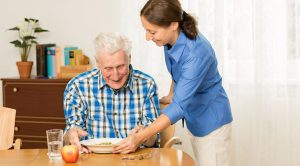
We grieve the loss of the lifestlye we shared before the stroke.
Our hearts break a thousand different ways, and it can be a long, long journey of care.
Nevertheless, self-care and respite care is important for family members, neighbors, or friends caring for and managing a stroke patient.
Through respite care and paying attention to your own mental, emotional and spiritual needs you will be in a better position to help your loved one.
Caregiving can be a tough job.
Let us help you with caregiving.
Call us today to arrange care.