

The main types of dementia are Alzheimer’s disease, vascular dementia, Lewy body dementia, frontotemporal dementia, and mixed dementia. Each affects the brain differently, so each changes care at home in different ways, from fall risk to medication safety to how much supervision someone needs. When a doctor says “dementia,” most families think of Alzheimer’s disease. But dementia is not one disease, and the difference matters once you’re caring for someone at home.
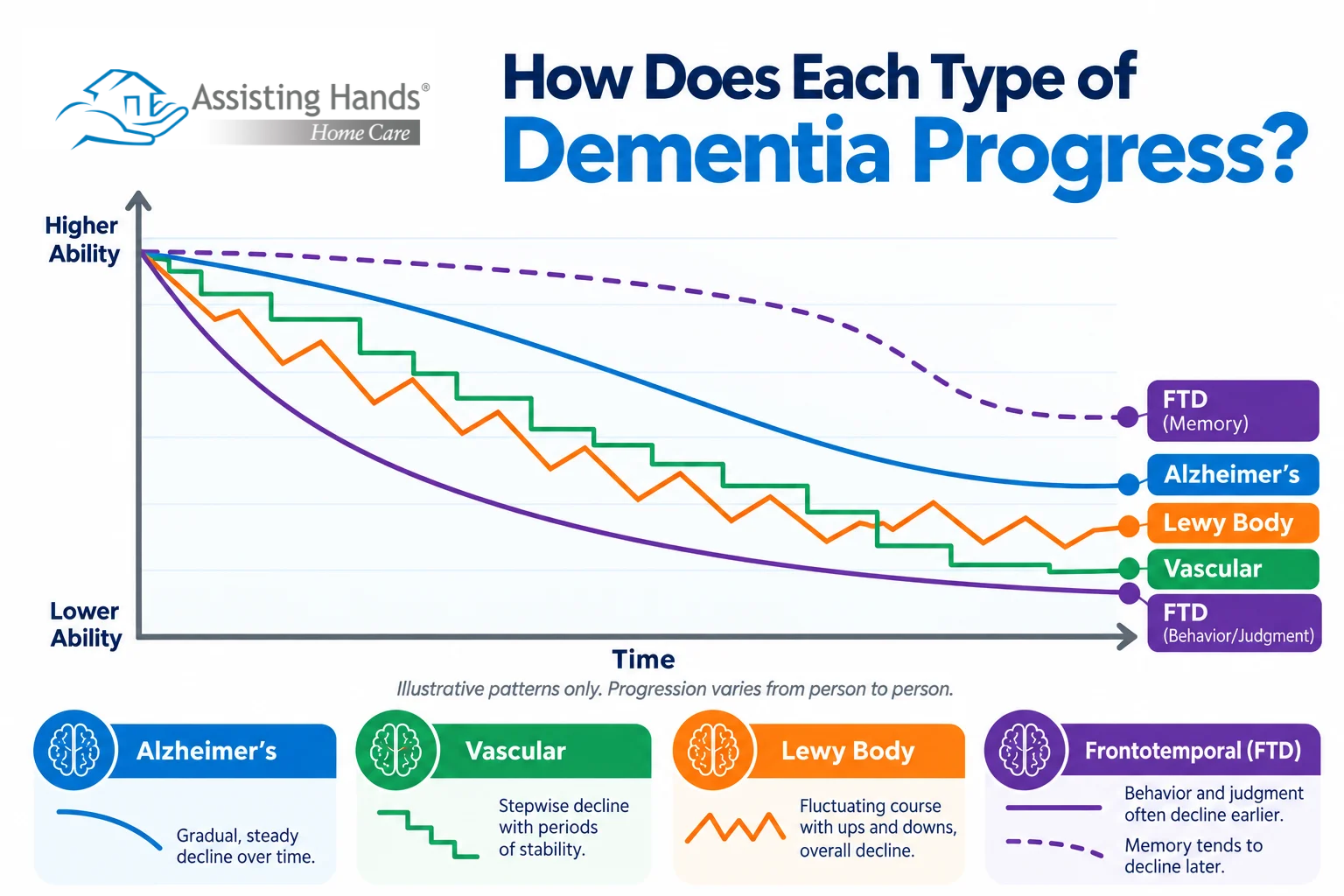
Alzheimer’s often calls for routines, memory cues, and help with familiar tasks. Vascular dementia requires closer attention to blood pressure and stroke risk. Lewy body dementia makes falls, hallucinations, sleep problems, and medication safety bigger concerns. Frontotemporal dementia may affect judgment and behavior long before memory. Mixed dementia combines features of more than one type.
Those differences shape everything from how you structure the day to whether someone should still be driving, managing medications, cooking alone, or handling finances. Here’s what each type can mean for care at home, based on what our caregivers see working with families every day.
What Does “Type of Dementia” Mean?
Dementia is a general term for a group of symptoms, including problems with memory, thinking, language, or judgment, that are serious enough to interfere with everyday life. The type of dementia names the underlying disease causing those symptoms.
For families caring for someone at home, knowing the type has three practical benefits:
- It tells you which symptoms are likely to appear first.
- It helps you recognize sudden changes that need urgent medical attention.
- It points you toward care strategies that fit the person’s needs.
If the diagnosis on paper simply says “dementia,” ask the doctor what type it is and what that means for care at home.
How Doctors Determine the Type of Dementia
There’s no single test for the type of dementia. A neurologist, geriatrician, or memory clinic usually combines several pieces of information:
- A detailed medical history, including when symptoms started and how fast they changed
- Cognitive testing of memory, attention, language, and problem-solving
- Bloodwork to rule out treatable causes, such as vitamin B12 deficiency or thyroid problems
- Brain imaging, such as an MRI, CT, or PET scan, to look for strokes, shrinkage, or other changes
Sometimes the type only becomes clear as symptoms develop over months or years. Family observations help a lot here. A simple log of what you notice, when it happens, and whether it came on suddenly or gradually gives the doctor information a short office visit can’t.
Types of Dementia at a Glance
| Type | Share of cases | First signs | How it progresses | Top home care priority |
|---|---|---|---|---|
| Alzheimer’s disease | 60 to 80% | Forgetting recent events, repeating questions | Steady slope over years | Routine, memory cues, consistent caregivers |
| Vascular dementia | About 10% on its own | Slow thinking, poor planning, often after a stroke | Staircase: a drop, a plateau, another drop | Blood pressure, diabetes, and stroke watch |
| Lewy body dementia | About 5 to 10%, often missed | Hallucinations, alertness that comes and goes, stiffness | Good days and bad days | Fall prevention and medication alerts |
| Frontotemporal dementia | Less common; often starts between 45 and 64 | Personality change, poor judgment, word trouble | Behavior changes before memory | Supervising money, driving, and public behavior |
| Mixed dementia | More common than once thought, especially after 80 | A blend of the above | Depends on the mix | Combined plan, reviewed more often |
Source: Alzheimer’s Association
These categories are not always mutually exclusive. A person may have Alzheimer’s disease and vascular changes, for example, or Alzheimer’s disease alongside Lewy body disease. Mixed dementia describes multiple underlying causes contributing to cognitive impairment.
Each type follows its own pattern. Knowing the pattern helps families tell a normal change from one that needs a doctor.
Alzheimer’s Disease and Care at Home
Alzheimer’s disease is the most common type of dementia, and its gradual progression makes it the easiest to plan around. Instead of changing everything at once, families can add care in stages as new needs appear.
- First signs families notice: Asking the same question twice in an hour, missing appointments, putting things in odd places, and getting turned around on a familiar drive.
- How it progresses: A steady slope over several years. Recent memory goes first. Old memories, favorite music, and long-held routines often last much longer.
- What changes at home: Routine does most of the work. Label cabinets and drawers, keep the same caregiver whenever possible, and set medication reminders for the same time each day. Plan for sundowning, the late-day confusion many families see: close blinds before dusk, turn lights on early, and keep evenings quiet. Use short sentences and offer two choices instead of open-ended questions.
- Caregiver tip: If evenings bring confusion, move social outings and visits to early afternoon. Keep the social life and move the clock.
- When to add in-home help: When reminders stop working, meals get skipped, or a spouse is running on empty. A few hours of companion care is often a good first step.
- Call the doctor if: Confusion changes over hours or days. Alzheimer’s moves slowly, so a fast change usually points to something else, like an infection or a medication problem.
Vascular Dementia and Care at Home
Vascular dementia happens when reduced blood flow damages the brain, often after a stroke or years of damage to small blood vessels. Because those vascular problems can keep causing damage, care at home means managing overall health, not just memory and thinking.
- First signs families notice: Slower thinking, trouble planning or following steps, and poor focus. Memory may hold up at first. Many families first notice changes right after a stroke.
- How it progresses: More like a staircase than a slope: a sudden drop, a stretch of stability, then another drop.
- What changes at home: Daily routines center on blood pressure and blood sugar. Caregivers can give medication reminders on schedule, cook meals that follow the doctor’s diet plan, and get your loved one to appointments. Post the BE FAST stroke signs on the fridge: Balance, Eyes, Face, Arms, Speech, Time to call 911.
- When to add in-home help: After any step down. Each drop can change what your loved one can safely do alone, so reassess care hours every time it happens.
- Call the doctor if: Thinking, speech, or movement gets suddenly worse. In vascular dementia, that’s a possible new stroke, not a bad day. Call 911 for any BE FAST sign.
Lewy Body Dementia and Care at Home
Lewy body dementia (LBD) is caused by abnormal deposits of a protein called alpha-synuclein, which affect thinking, movement, sleep, and alertness. It includes two related diagnoses: dementia with Lewy bodies and Parkinson’s disease dementia. LBD is the type families most need to identify clearly, because it changes how a person can safely respond to certain medications. At home, that means keeping the diagnosis and medication sensitivities documented and making sure every caregiver knows what to watch for.
- First signs families notice: Vivid visual hallucinations, alertness that swings throughout the day, muscle stiffness or a shuffling walk, and acting out dreams during sleep. These sleep behaviors can appear years before noticeable memory problems.
- How it progresses: Good days and bad days. Someone can be sharp at breakfast and lost by mid-afternoon. A good day isn’t recovery, and a bad day isn’t always a new decline.
- What changes at home: Falls come first. Blood pressure can drop on standing, so caregivers help with slow position changes, keep walkways clear, and stay close in the shower. When a hallucination isn’t frightening, don’t argue. Reassure and redirect. Track the predictable low points and schedule care hours around them.
- The safety-critical point: Many people with LBD react severely to certain antipsychotic medications, a reaction called neuroleptic sensitivity. Keep a wallet card listing the diagnosis and that warning, and say it out loud at every ER visit. Never stop or change a prescribed medication without talking to the doctor or pharmacist first. The Lewy Body Dementia Association offers a free medical alert card.
- When to add in-home help: After the first fall, or when a spouse can’t safely help with transfers anymore. Fall prevention and nighttime help often come earlier than with Alzheimer’s.
- Call the doctor if: Hallucinations become frightening, falls or fainting increase, or confusion spikes after a new medication.
Parkinson’s Disease Dementia
Parkinson’s disease dementia is a form of Lewy body dementia, and the care at home looks much the same. Doctors tell the two apart by timing: it’s Parkinson’s disease dementia when thinking problems start more than a year after movement symptoms begin. Not everyone with Parkinson’s develops dementia. Care focuses on preventing falls, keeping Parkinson’s medications on a strict schedule, and allowing extra time when movement or alertness fluctuates.
Frontotemporal Dementia and Care at Home
Frontotemporal dementia (FTD) often doesn’t look like dementia at first. Memory may stay fairly normal while judgment, behavior, personality, or language change. FTD also tends to start younger than other types, often between 45 and 64, which makes early signs easy to miss or misread.
- First signs families notice: Changes that seem out of character: rudeness, impulsive spending, loss of empathy, new compulsive habits, overeating, or trouble finding words. It’s often mistaken for depression or a midlife crisis.
- How it progresses: Behavior changes before memory. Physical abilities usually hold up longer than judgment does.
- What changes at home: Supervision matters before memory aids do. Set up alerts on bank and credit card accounts, watch online purchases and scam calls, and address driving early. Keep the same caregivers, since new faces and changed routines tend to raise agitation. Working-age onset adds its own problems: a job that’s ending, a mortgage, sometimes kids still at home. Legal and financial planning can’t wait.
- Caregiver tip: If they also drive a golf cart, address it at the same doctor visit as the car so it’s one decision, not two fights.
- When to add in-home help: When your loved one can’t be left alone without risk of a scam, a crash, or a confrontation, even if they still dress and eat on their own.
- Call the doctor if: Behavior turns aggressive, eating becomes unsafe, or swallowing changes.
For FTD-specific family resources, see The Association for Frontotemporal Degeneration.
Mixed Dementia and Care at Home
Mixed dementia means a person has more than one type of dementia at the same time. The most common combination is Alzheimer’s and vascular dementia, followed by Alzheimer’s and Lewy body dementia. It becomes more common with age, especially after 80, so care at home usually has to cover the needs of both conditions.
- First signs families notice: A blend, such as memory loss alongside slow thinking, or memory loss with movement problems.
- How it progresses: It depends on the mix. Gradual decline can be interrupted by sudden drops.
- What changes at home: The care plan borrows from each type involved: routine and cues for the Alzheimer’s side, health routines for the vascular side, and fall prevention if Lewy bodies are part of the picture. Review the plan more often than you would for a single type.
- When to add in-home help: When the family can’t keep up with everything on the list.
- Call the doctor if: Anything changes suddenly, for the same reasons as vascular dementia.
Less Common Types and Conditions That Look Like Dementia
The five main types account for most cases, but other conditions can cause dementia or mimic it. The right diagnosis can change both treatment and care at home.
Less common causes of dementia:
- LATE (limbic-predominant age-related TDP-43 encephalopathy): A recently defined cause of memory loss, mostly in people over 80. It looks like Alzheimer’s but usually progresses more slowly, and the two often occur together.
- Normal pressure hydrocephalus: Fluid buildup in the brain that causes walking trouble, bladder leaks, and confusion. Treatment helps some people, so it’s worth ruling out.
- Korsakoff syndrome: Memory loss from a severe lack of thiamine (vitamin B1), most often tied to long-term heavy drinking.
- Posterior cortical atrophy: Damage to the back of the brain that affects how it processes what the eyes see. People struggle to read, judge distances, or spot objects in plain sight, even with a normal eye exam. Alzheimer’s is usually the cause.
Look-alikes that are often treatable:
- Delirium: Sudden confusion, agitation, or hallucinations caused by an illness, infection, dehydration, or a medication change. It develops over hours or days and can happen on top of existing dementia. Infections such as UTIs are a common trigger in older adults, but don’t assume the cause. Let a doctor evaluate it. Dehydration in Central Florida heat can make it worse, so keep water in reach, even indoors.
- Vitamin B12 deficiency
- Thyroid problems
- Medication side effects, especially from sleep aids, bladder medications, and some allergy medicines
- Depression, which can slow thinking and memory
The rule of thumb: a sudden change isn’t “just the dementia” until a doctor has checked. The National Institute on Aging has more on causes and diagnosis.
How Care Needs Grow Over Time
Most families move from a few hours of help a week to daily or round-the-clock care as dementia progresses, but the pace depends on the type.
| Stage | What it often looks like | Typical support |
|---|---|---|
| Early | Mostly independent; missed appointments, help needed with bills | Companionship, reminders, rides to errands |
| Middle | Needs help bathing, dressing, and with meals; may wander or sundown | Daily personal care, supervision, respite for family |
| Late | Needs help with most tasks; high fall risk; often awake at night | 24-hour or live-in care |
Alzheimer’s tends to follow this table most closely. Lewy body and vascular dementia often need more hours earlier because of falls and sudden changes. FTD usually needs supervision well before it needs physical help.
Read: How to Care for a Senior Parent Experiencing Memory Loss
What to Tell Your Home Care Team About the Diagnosis
The more your care team knows on day one, the faster care fits the person instead of the label. Bring this list to the first assessment:
- A current medication list, with any alerts flagged, such as antipsychotic sensitivity
- Fall history: when, where, and what happened
- Best and worst times of day
- What calms them down and what sets them off
- Tasks they can still do on their own and where they need help
- Emergency contacts and the doctor’s office number

How Assisting Hands Home Care – The Villages Builds Care Around the Diagnosis
Good dementia care starts with understanding the person, the diagnosis, and what’s happening at home. During a free in-home assessment, we meet with your family, learn about your loved one’s condition and daily routine, and build a care plan around their specific needs.
That might mean familiar caregivers and consistent routines for Alzheimer’s, medication reminders and transportation for vascular dementia, extra attention to fall prevention for Lewy body dementia, or closer supervision when changes in judgment and behavior are part of FTD. Our caregivers complete extensive dementia training, so they know how to redirect, reassure, and spot changes worth reporting.
Alzheimer’s and dementia care can range from a few hours a day to around-the-clock support as needs change. Our team works alongside your loved one’s doctors and home health providers to keep everyone informed and the plan consistent. We serve families throughout The Villages, Lady Lake, Oxford, Wildwood, Leesburg, Belleview, and Ocala. Call (352) 758-4512 or schedule your free in-home assessment to talk through what support would make life at home safer and more manageable.
Types of Dementia FAQs
How many types of dementia are there?
Dozens of conditions can cause dementia, but five main types account for most cases: Alzheimer’s, vascular, Lewy body, frontotemporal, and mixed dementia.
What is the most common type of dementia?
Alzheimer’s disease, at an estimated 60 to 80% of cases. Many people also have a second type alongside it.
What is the difference between Alzheimer’s disease and dementia?
Dementia is the general term for memory and thinking changes that interfere with daily life. Alzheimer’s disease is one specific brain disease that causes dementia, and it’s the most common one.
Can someone have more than one type of dementia?
Yes. This is called mixed dementia. The most common combination is Alzheimer’s disease with vascular changes, and many people over 80 have more than one cause contributing to their symptoms.
Which type of dementia affects behavior and personality first?
Frontotemporal dementia. It often causes changes in personality, judgment, social behavior, or language before memory problems appear. Behavior changes can happen in other types too, usually later on.
Does the type of dementia change how care is provided at home?
Yes. A sudden decline in vascular dementia may be a stroke, hallucinations in Lewy body dementia call for redirection and a medication warning, and FTD needs supervision even when memory seems fine.
Which type of dementia progresses fastest?
It varies from person to person. On average, Lewy body and frontotemporal dementia tend to progress faster than Alzheimer’s, and rare types like Creutzfeldt-Jakob disease can progress in months. Ask the doctor what to expect.
Why does my parent have good days and bad days?
Swings are a hallmark of Lewy body dementia, but any type can have off days from poor sleep, pain, dehydration, infection, or a busy schedule. If a sudden change doesn’t pass, get it checked.
Does Medicare pay for in-home dementia care?
Medicare generally doesn’t cover ongoing non-medical home care like companionship, supervision, or help with bathing. It may cover short-term home health after a hospital stay. Families often pay out of pocket, use long-term care insurance, or rely on VA benefits.
When does someone with dementia need 24-hour care?
When they aren’t safe alone overnight. Common signs are wandering, nighttime falls, waking up confused, or a family caregiver who can’t get sleep. Some families start with overnight care and move to 24-hour or live-in care later.

