

Running a successful home care business takes more than a passion for helping older adults. You need the ability to lead caregivers, communicate with families, recruit dependable employees, manage finances, build referral relationships, and understand the regulations that apply to your services.
You don't necessarily need a healthcare background to own a home care business. Many of the skills needed to operate an agency come from experience in management, sales, finance, customer service, and other industries. What matters is understanding the responsibilities of ownership, recognizing where you need additional training, and building a reliable team.
For prospective owners in Wisconsin, there are additional considerations, including state requirements for certain personal care and skilled home health services. Understanding these requirements, along with the realities of day-to-day operations, can help you decide whether opening a home care agency is the right business opportunity.
Do You Need Healthcare Experience to Own a Home Care Business?
Not necessarily. Owning a home care business and providing hands-on care are two different roles. Many successful owners come from backgrounds in sales, management, finance, marketing, operations, or other professional fields rather than healthcare.
What matters most is the type of care your agency provides, the regulations that apply to that type of business, and how the services are paid for. A non-medical home care agency may have very different requirements from a skilled home health agency, so understanding those distinctions is an important first step for anyone considering the business.
What Is the Difference Between Non-Medical Home Care and Skilled Home Health Care?
Non-medical home care covers help with daily living: bathing, dressing, meals, light housekeeping, companionship, medication reminders and transportation. Skilled home health care involves licensed clinical services such as nursing and therapy, usually ordered by a physician.
In Wisconsin, skilled home health agencies must be licensed by the Department of Health Services under Wis. Admin. Code ch. DHS 133. This is a clinical business, which means the agency must meet specific licensing requirements and have appropriate clinical oversight in place.
What Are the Requirements to Start a Home Care Business in Wisconsin?
Wisconsin rules get more specific if your agency provides personal care services funded by Medicaid. Agencies certified under DHS 105.17 must employ or contract with a registered nurse supervisor who has at least a year of supervisory or administrative experience in personal care. That RN oversees the personal care workers and reviews each client's plan of care at least every 60 days.
Notice who that requirement falls on. The agency needs a qualified RN. The owner doesn't have to be one. The agency's administrator also has defined qualifications under the same rule, and a prospective owner should review those with the state before deciding who will fill that role.
Requirements for private-pay non-medical care, Medicaid programs like Family Care and IRIS, and caregiver background checks under the Wisconsin Caregiver Law can each apply differently depending on your service mix. Before you commit, confirm the current rules with the Wisconsin DHS Division of Quality Assurance for the exact services you plan to offer.
So, Can You Own a Home Care Business Without a Healthcare Background?
In many cases, yes, provided the agency has the qualified staff its services and funding sources require. Healthcare experience isn't required for every home care business model, but every owner needs to understand the state rules that apply to them and the responsibilities that come with running a care company. Assisting Hands franchise owners in Wisconsin get regulatory guidance and compliance support as part of the system, along with coaching from a local Area Representative with years of healthcare industry experience.
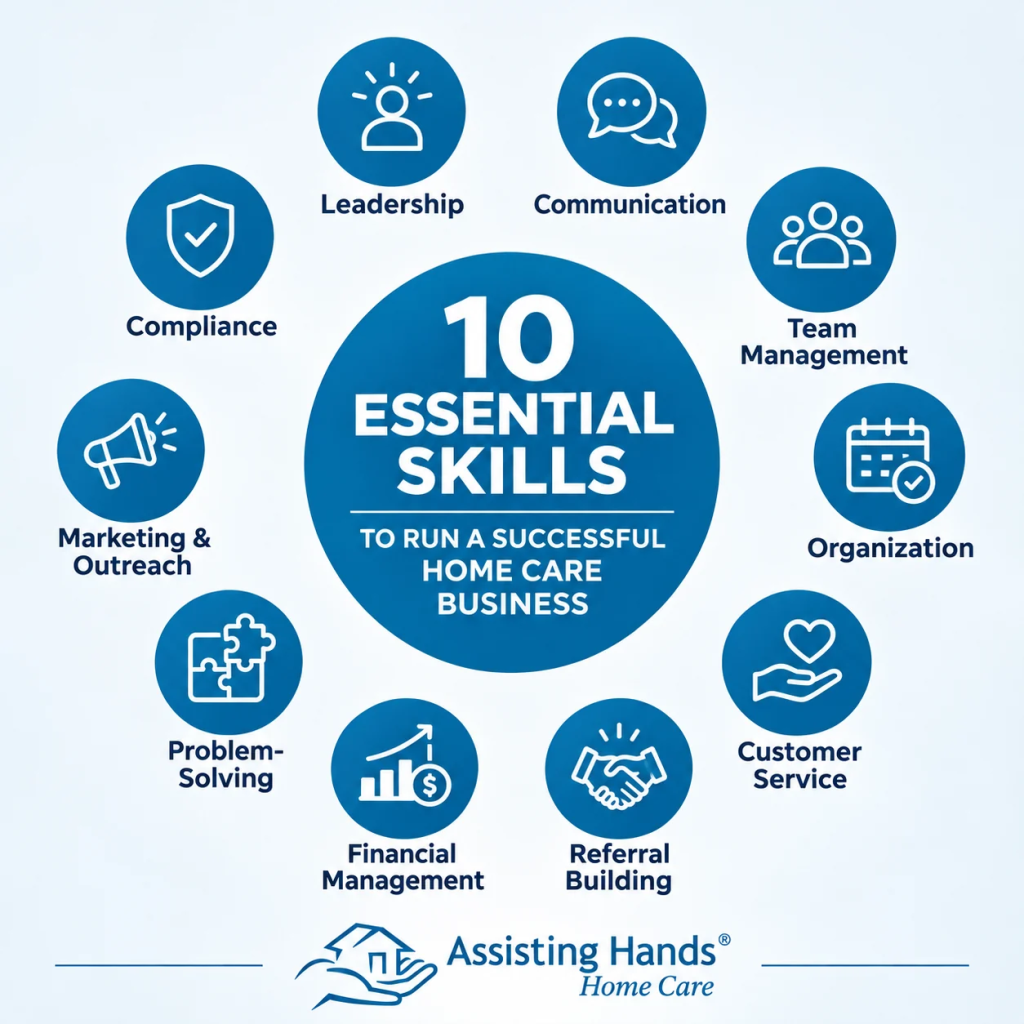
10 Essential Skills Needed to Run a Successful Home Care Business
These are the skills you'll rely on week after week to run a successful home care business. You don't need a nursing degree to develop them, and you don't need to have them all when you start. With the right training, experience, and support, each of these skills can be learned.
1. Leadership and Decision-Making
Your caregivers work alone in clients' homes, often without a supervisor in sight. The standards you set and the culture you build go with them through every front door. Leadership here means setting clear expectations, making decisions when the answer isn't obvious, handling hard conversations, and keeping the whole team focused on the quality of care.
2. Communication With Caregivers, Clients, and Families
In one afternoon, you might update a daughter on her father's new schedule, coach a caregiver through a difficult visit, and explain your services to a hospital discharge planner. Each conversation needs a different tone. Clear communication matters most when something changes: a client's needs increase, a caregiver is out sick, or a family's expectations don't match what was agreed on.
3. Caregiver Recruitment and Team Management
Home care is a people business, and caregiver recruitment is one of the biggest day-to-day challenges in the industry. Owners need to understand recruiting, interviewing, onboarding, training, scheduling, performance management and retention. Your client count can only grow as fast as your caregiver team does.
4. Organization and Time Management
On any given day, client inquiries, caregiver schedules, payroll, marketing, interviews, paperwork, and family check-ins can all demand your attention at once. In home care, small oversights can cost both money and trust. A missed callback may send a prospective client to a competitor, while a scheduling gap can leave a senior without the help they need that morning.
5. Customer Service and Relationship Management
In home care, you usually have two customers: the person receiving care and the family members who arranged it. Good service means listening closely, responding quickly, setting honest expectations at the start, and resolving concerns before they turn into cancellations. Most families stay with an agency for months or years, so relationships matter more than any single visit.
6. Sales and Referral Relationship Building
This isn't about cold-calling strangers. Many home care clients come through referrals, so owners spend time building relationships with hospitals, senior living communities, rehabilitation centers, social workers, care managers, physicians, and community organizations. It's steady, trust-based work: showing up, following through, and earning a reputation as the agency people feel confident recommending because you deliver.
7. Financial Management and Cash Flow Planning
You don't need to be an accountant, but you do need to understand what your numbers are telling you. You must keep an eye on revenue, expenses, payroll, cash flow, pricing, budgets, profit and loss statements, and working capital. Payroll is due every pay period whether or not clients have paid their invoices, so managing cash flow is especially important during the early months of the business.
8. Problem-Solving and Crisis Management
Home care rarely goes exactly according to plan as caregivers call off and clients may need a change in arrangements or additional care. Successful owners learn to stay calm, gather the facts, and find a workable solution quickly. Just as important, they look beyond the immediate fix and ask what can be changed to prevent the same problem from happening again.
9. Marketing and Community Outreach
Families usually start their search online, so owners need a working understanding of local SEO, their website, Google Business Profile, social media, referral marketing, networking, and community events. As a franchise owner, you won't build all of this from scratch. The franchisor's marketing resources and referral development tools give you a starting point.
10. Compliance and Attention to Detail
This includes state regulations, licensing or certification requirements, employment law, client documentation, privacy, insurance, caregiver screening, and, for franchisees, the brand's operating standards. The details matter. A missing background check or incomplete care record isn't simply a paperwork issue, it can put clients, caregivers, and the business at risk.
Which Skills Are Most Important for First-Time Home Care Business Owners?
You don't need to master all ten skills before opening your doors. Successful first-time owners understand which skills come naturally to them, where they have gaps, and when to seek help. New owners can build a strong home care business by building on their strengths and developing the skills they lack.
| Skill | Why It Matters |
| Leadership | Managing employees and building a team |
| Communication | Working with clients, families and caregivers |
| Recruiting | Building and keeping a caregiver team |
| Organization | Managing schedules and daily operations |
| Customer service | Building long-term client relationships |
| Sales | Building referral and client relationships |
| Financial skills | Understanding revenue, expenses and cash flow |
| Problem-solving | Handling unexpected situations |
| Marketing | Generating awareness and inquiries |
| Compliance | Following applicable requirements |
What Can First-Time Owners Learn From an Assisting Hands Franchisee in Wisconsin?
Real franchise ownership experiences can offer a more practical perspective than a general list of business skills.
Robin Elario, who became an Assisting Hands franchise owner in the Menomonee Falls area in 2017, had previously worked as a business broker. Her interest in home care was influenced by a personal family experience involving her grandmother's need for care.
Her story demonstrates how business experience and personal motivation can lead someone into the home care industry without following a traditional clinical career path.
When Assisting Hands announced her ownership, Elario emphasized the importance of finding quality caregivers. Her focus on recruitment reflected an essential reality of home care: an agency's reputation depends heavily on the people providing services.
Elario has also publicly acknowledged the value of guidance from Richard E. Ueberfluss, the Assisting Hands Wisconsin and Illinois Area Representative. In a testimonial published by Assisting Hands, she credited his healthcare background with helping her understand the home care industry's operations and requirements.
Her experience illustrates two important lessons for prospective franchise owners: previous business skills can transfer into home care, and industry-specific guidance can help owners navigate responsibilities that are unfamiliar to them.
Sources: Assisting Hands Menomonee Falls ownership announcement and Assisting Hands Wisconsin leadership and franchisee testimonials.
What Are the Daily Responsibilities of a Home Care Business Owner?
A home care owner's typical day combines employee management, client coordination, administrative work, and business development. Responsibilities vary according to agency size, staffing, and the owner's role.
- Morning: Review the caregiver schedule and fill any gaps. Respond to new inquiries from families and referral partners. Check in on current clients and families and address any staffing or care issues that came up overnight.
- Midday: Meet with referral sources such as hospital discharge planners, senior living staff, or care managers. Interview caregiver candidates, hold team check-ins, and work on marketing or community outreach.
- Afternoon: Review client care updates and overall operations. Handle billing, payroll, and administrative tasks. Follow up with prospective clients, schedule in-home assessments, and keep caregivers informed about schedule changes.
As the agency grows, many owners add an office manager, scheduler, or care coordinator. That can free the owner to spend less time on day-to-day administration and more time on business development, relationships, and leadership.
How Does Home Care Franchise Training Help First-Time Business Owners?
When starting an independent home care agency, you must create your own systems for everything from hiring and scheduling to billing, marketing, and compliance. A franchise gives you an established framework, training, and operating systems to build on from day one. This allows you to focus on learning how to run the business and lead your team instead of figuring out every process from scratch.
For a deeper look at the differences, see our guide to independent home care agency vs. franchise.
Training
Assisting Hands provides training in compliance, caregiver hiring, operations, and marketing. That covers several of the skills that career changers most often feel unsure about, especially recruiting and compliance.
Systems and Technology
Franchise owners get systems and software for scheduling, billing, and client management, along with caregiver training programs and recruitment support. That takes much of the organizational load off a new owner in the first year.
Marketing and Referral Development
Assisting Hands supplies marketing resources and local referral development tools. In Wisconsin, the Area Representative works with owners on marketing strategy and on building relationships with referral partners and local healthcare providers.
Local Support in Wisconsin
Wisconsin franchisees work with Area Representative Richard E. Ueberfluss, who coaches owners before, during, and after launch. Owners such as Robin Elario in Menomonee Falls have credited his healthcare industry background with helping them learn how the home care business works.
A Network of Owners
Assisting Hands has more than 200 territories across the United States. During the discovery process, prospective owners speak directly with current franchise owners about their experience before signing anything.
Is Owning a Home Care Business Right for You?
Home care ownership may be a good fit if you enjoy working with people, managing employees, solving problems, and building a business that provides a meaningful community service.
You may be well suited to the industry if you:
- Enjoy working with people and feel comfortable leading a team
- Communicate clearly, including when the news isn't good
- Stay organized when several priorities compete at once
- Are comfortable making business decisions with incomplete information
- Like networking and building relationships in your community
- Understand that home care is a people-focused business at every level
- Are willing to learn an industry that may be new to you
- Have researched the financial commitment, including working capital
New owners must understand that home care ownership is not passive income. It's an active, hands-on business, especially in the first few years. Owners who expect to check in once a week tend to struggle. Owners who show up, build relationships, and invest in their caregivers tend to grow.
If you're new to business ownership altogether, our guide to the best franchises for first-time owners walks through how to evaluate your options.

Questions to Ask Before Starting a Home Care Business
Before you sign anything, get clear answers to these questions:
- What type of care will my business provide: non-medical, personal care, skilled, or a mix?
- What licenses or certifications does that service mix require in my state?
- Will I need a registered nurse or other qualified staff, and how will I hire them?
- How will I recruit and keep caregivers in my market?
- What will my startup costs be, and how much working capital will I need?
- How will I find clients, and which referral sources serve my territory?
- What insurance and technology will I need?
- What will my day-to-day responsibilities be in year one?
- Should I start independently or join a franchise, and what support comes with that choice?
For Wisconsin investment details, the Assisting Hands Wisconsin franchise page lists typical startup ranges, available territories and the five-step path to ownership.
Frequently Asked Questions About Home Care Business Ownership
Do you have to be a nurse to own a home care business?
No. In Wisconsin, a personal care agency certified for Medicaid must have a registered nurse supervisor on staff or under contract, but the owner does not have to be that nurse. Skilled home health agencies have their own clinical staffing requirements. Confirm the rules for your exact service mix with the Wisconsin Department of Health Services.
Can a first-time entrepreneur start a home care business?
Yes. Many home care owners have never run a business before. A franchise can shorten the learning curve with established systems, training, and a local mentor, but first-time owners should still expect a hands-on first year and plan for enough working capital.
What skills do you need to manage caregivers?
You need to recruit and screen well, train clearly, build fair schedules, give regular feedback, and recognize good work. Caregivers stay longer with agencies that communicate openly, match them with suitable clients, and back them up when a visit gets difficult.
Is running a home care business difficult?
It's demanding, mainly because it depends on people. Caregiver staffing, changing client needs, and cash flow can all be challenging, especially early on. Owners with strong systems, a reliable office team, and outside support usually find the work manageable and rewarding.
Can a home care franchise help with business training?
Yes. Assisting Hands provides training in compliance, caregiver hiring, operations, and marketing, plus scheduling and billing software and ongoing coaching. Wisconsin owners also work directly with a local Area Representative before and after launch.
Take the Next Step Toward Home Care Franchise Ownership in Wisconsin
Ready to explore what it takes to own a home care franchise in Wisconsin? Learn more about the Assisting Hands franchise opportunity, including the investment, available territories, training, and ongoing support available to franchise owners.
When you're ready to explore the opportunity, request information to start a conversation with our Wisconsin Area Representative.