

For many older adults who do not need round-the-clock medical supervision, home care is often a better and more affordable choice than moving into a nursing home. It allows seniors to remain in the home they know, receive one-on-one assistance, and pay for the amount of support they actually need rather than moving immediately into a full residential care setting.
A nursing home can still be the right choice for someone who needs frequent skilled nursing, extensive physical assistance, or continuous supervision that cannot be provided safely at home. The problem is that families sometimes begin considering a nursing home before they have clearly identified what has actually changed. Often, Mom or Dad has not lost the ability to live at home altogether. Instead, a handful of everyday tasks have gradually become harder or less safe.
Maybe Mom is still managing her finances, talking with friends, making decisions, and sleeping safely through the night, but she is afraid of falling in the shower. Dad may still be comfortable living in his own home, but driving has become difficult, standing long enough to cook dinner hurts, and carrying laundry downstairs is no longer safe.
When the main challenges involve bathing, meals, transportation, mobility, housekeeping, companionship, or other daily activities rather than continuous medical care, home care may provide the support that is missing without requiring the senior to give up their home and established routine.
Why Is Home Care Often Better for Seniors Who Are Still Mostly Independent?
Home care works especially well when an older adult remains independent in many areas but needs help with specific parts of the day. The goal is not to take over everything the senior still knows how to do. It is to provide help where assistance has become necessary.
That might include bathing and dressing, preparing meals, getting to appointments, grocery shopping, walking safely through the home, keeping up with laundry, or simply having someone available during the parts of the day when being alone has become difficult.
For someone who manages most of the day without assistance, paying for targeted support can make considerably more sense than moving into a facility that provides residential services around the clock. Home care also gives seniors more control over the way their day unfolds. They may still be able to wake up when they want, have coffee in their favorite chair, choose their meals, visit with neighbors, spend time with a pet, or keep the evening routine they have followed for years.
Needing help with one part of the day does not mean every other part of the day needs to change.
Why Can Home Care Be More Affordable Than a Nursing Home?
Home care is often more affordable for seniors who need part-time or moderate assistance because families can build care around the hours when help is actually needed. A nursing home is a complete residential setting, so the cost generally reflects housing, meals, staffing, supervision, personal assistance, and access to care throughout the day and night.
Home care is structured differently. A family might need a caregiver for three hours in the morning to help with bathing, dressing, and breakfast. Another senior may only need assistance several afternoons each week, transportation to appointments, evening help with dinner and bedtime, or respite care so a spouse can take a break.
For a person who remains independent for much of the day, paying for those specific hours may be far more practical than paying for full residential care.
Home care is not automatically less expensive in every situation. If someone needs continuous one-on-one assistance day and night, the cost of home care can become substantial. That is why families should compare care based on the person’s actual level of need rather than simply comparing an hourly home care rate with a monthly nursing home charge.
The better question is, what will it cost to safely provide the level of care this person actually needs?
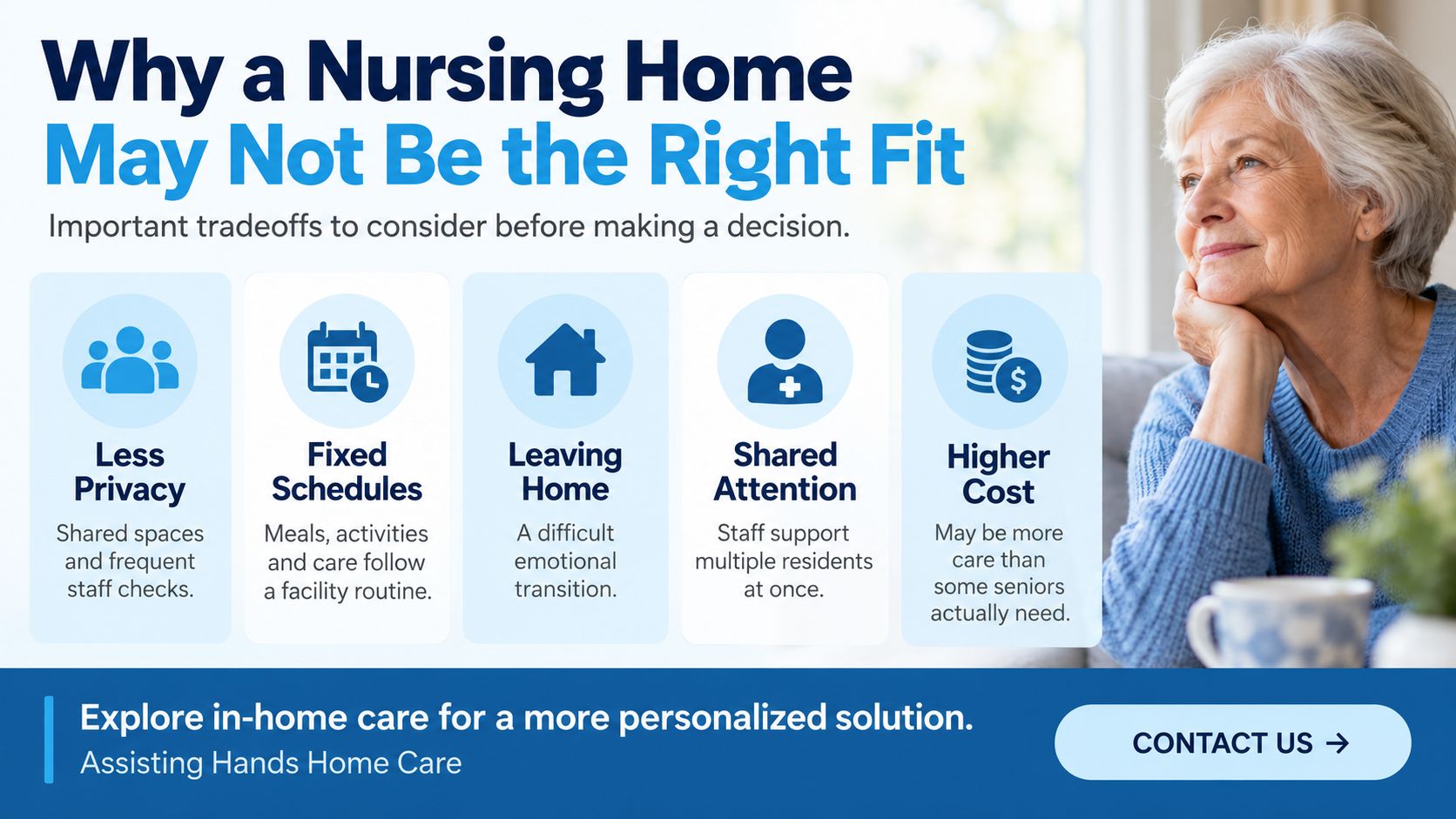
What Are the Disadvantages of a Nursing Home?
Nursing homes provide an important level of care for seniors with complex medical or personal needs, but residential care comes with tradeoffs that should be considered before a family decides that a move is necessary.
Less Privacy and Personal Space
A person who has lived independently for decades may suddenly find themselves sharing dining rooms, hallways, activity spaces, bathrooms, or even a bedroom. Staff members may also need to enter the room throughout the day for medications, meals, personal care, and routine checks.
For someone who highly values privacy, that can be a major adjustment. Home care allows assistance to take place in the senior’s own environment, where they continue to have control over their personal space.
Less Control Over Daily Routines
Nursing homes have to coordinate care for many residents at the same time. Meals, bathing, therapy, medication rounds, and activities may follow established schedules. Even when a facility offers flexibility, residents are still living within a shared system.
At home, care can often fit more naturally into the routines the senior already has. If someone prefers breakfast early, likes bathing in the evening, or has always spent afternoons reading quietly, those routines may be easier to preserve.
Leaving Home Can Be Emotionally Difficult
Moving into a nursing home involves more than changing where someone receives care. It means leaving an environment that may hold decades of memories.
The senior may be leaving behind their bedroom, furniture, pet, garden, neighbors, church community, favorite stores, and the routines that made everyday life feel familiar. Even when the move is necessary, it can still feel like a significant loss of independence.
Staff Attention Is Shared
Nursing home staff care for multiple residents. Even in a well-run facility, caregivers and nurses have to divide their attention among people with different needs.
Home care provides a different experience because the caregiver is focused on one client during the scheduled visit. That can allow more time for individualized assistance, conversation, and care that moves at the senior’s pace.
Residential Care Can Cost More Than a Senior Actually Needs
A nursing home provides housing, staffing, meals, supervision, and access to around-the-clock care. For someone who truly needs that level of support, those services may be appropriate.
For a senior who only needs help with bathing, meal preparation, transportation, mobility, or companionship, it may be more care than is currently necessary. Home care gives families the option to pay for specific periods of assistance instead of moving immediately to a higher level of care.
Family Life Can Feel Different
When a senior remains at home, family members can continue visiting in a familiar setting. They can eat together, sit in the backyard, watch television, celebrate holidays, or spend time together without every visit feeling centered around a care facility.
A nursing home does not prevent strong family relationships, but it can change how those visits feel and how easily family members remain part of the senior’s normal daily routine.
Group Living Does Not Automatically Prevent Loneliness
Many nursing homes offer activities, dining programs, and opportunities to socialize. Those can be valuable, but living around other people does not automatically mean a person feels connected.
Some seniors enjoy group activities. Others may miss the specific people, places, and routines that gave their life meaning before the move. Home care can help maintain social connection in a more individualized way by providing companionship, transportation, outings, and support for continuing familiar activities.
Start by Naming the Actual Problem
“Mom is struggling” is not specific enough to build a good care plan.
Before deciding between home care and a nursing home, families should identify exactly what is becoming difficult. Is she skipping meals because standing at the stove is tiring? Has she stopped driving because her vision has changed? Is she afraid of getting into the shower because she nearly fell? Is Dad waking up several times every night to help her and becoming exhausted himself?
Maybe laundry is piling up because carrying baskets downstairs is no longer safe. Maybe Mom is physically doing well but spends nearly every day alone because she stopped driving. These problems are very different, and they do not all require the same level of care.
A vague concern can make it feel like someone needs full-time assistance. A specific problem such as, “She cannot safely get in and out of the shower,” may point to a much smaller and more manageable solution.
How Do You Determine How Much Home Care a Senior Needs?
One of the best ways to evaluate care needs is to walk through an entire day. Look beyond the tasks your loved one tells you are difficult and pay attention to what actually happens from the time they wake up until the next morning.
Morning
Can your loved one get out of bed safely, reach the bathroom, shower, get dressed, prepare breakfast, and take medications correctly? Morning is one of the most common times for care gaps because stiffness, balance problems, and personal care needs may all occur within the same few hours.
Midday
Once the morning routine is over, look at what happens during the rest of the day. Is your loved one eating lunch and drinking enough water? Can they move safely around the home? Are they able to attend appointments, pick up groceries, or manage household tasks?
A senior may appear physically independent but still spend long stretches alone because they no longer drive or feel comfortable leaving the house.
Evening
Evening can reveal problems that are not noticeable earlier in the day. Fatigue may make balance worse, and some seniors with memory concerns may become more confused later in the day.
Ask whether your loved one can prepare dinner, manage evening medications, move safely when tired, and get ready for bed without assistance.
Overnight
Nighttime needs are easy to overlook until they create a serious problem. Does your loved one get up several times to use the bathroom? Are hallways dark? Do they become confused after waking? Can they get back into bed safely?
For some families, overnight concerns are what ultimately determine whether a few hours of daytime assistance are enough.
Find the Real Care Gaps
A care gap is any period when the senior needs assistance but nobody is available to provide it.
Consider a daughter who visits her father every evening. She brings dinner, checks his medications, and spends an hour with him. From the family’s perspective, he receives help every day. But his real problem occurs in the morning, when arthritis makes dressing difficult and he avoids showering because he is afraid of falling.
The family is providing support, but it is arriving at the wrong time. A caregiver for a few morning hours may solve the problem without requiring full-day care.
Another example might involve a spouse who is home all day but can no longer safely assist with bathing or transfers. The issue is not whether someone is present. It is whether the right kind of help is available.
Looking at care this way helps families focus resources on the times that matter most.
Look at What the Family Is Already Doing
Families often underestimate how much care they are already providing because the responsibilities build slowly.
It may begin with grocery shopping. Then someone starts driving Mom to appointments. Later, they begin filling prescriptions, managing the calendar, doing laundry, preparing meals, and calling several times each day.
Write it down. Who is driving, shopping, cooking, cleaning, managing appointments, picking up medication, helping with bathing, staying overnight, or responding whenever something goes wrong?
Then ask whether the arrangement is sustainable for the next six months or year.
A daughter may want to continue attending medical appointments but be unable to keep leaving work every morning. A spouse may still want to provide companionship but no longer have the strength to assist with transfers.
Home care can take over the responsibilities that have become difficult while allowing family members to remain involved in ways they can realistically maintain.
How Does the Home Care Process Work?
Families sometimes avoid contacting a home care agency because they assume that doing so means immediately committing to a large schedule. A thoughtful home care process should work differently. It should begin with understanding the individual before deciding how much care is appropriate.
Step 1: Have an Initial Conversation
The first conversation should focus on why the family is reaching out. Has there been a recent fall? Did the senior stop driving? Is someone returning home from the hospital? Has a spouse become overwhelmed?
The goal is to understand what changed and which concerns are most urgent.
Step 2: Assess Daily Needs
The next step is to review a normal day. That includes personal care, mobility, meals, transportation, household tasks, cognitive changes, medication reminders, social needs, nighttime concerns, and the amount of support the family is already providing.
This is where the most important care gaps often become clear.
Step 3: Review the Home Environment
The home itself should also be considered. Someone may be capable of remaining at home but still face unnecessary risks from the environment.
Families should look for loose rugs, poor lighting, cluttered walkways, difficult stairs, unsafe shower access, furniture that is difficult to rise from, and frequently used items stored in hard-to-reach places.
Small changes such as grab bars, a shower chair, better lighting, or rearranging furniture can sometimes reduce risk substantially.
Step 4: Create a Personalized Care Plan
Once the family’s needs are understood, the care plan should identify what assistance is needed and when it is needed.
For one client, that might mean morning personal care and breakfast. Another person may need transportation, companionship, meal preparation, or evening assistance.
The plan should reflect the senior’s actual routine rather than forcing them into a standard package.
Step 5: Match the Caregiver to the Senior
Caregiver matching matters because care takes place inside someone’s home and often involves very personal parts of daily life.
Experience is important, but personality fit can matter too. Some seniors enjoy a caregiver who is outgoing and conversational. Others prefer someone quieter and more reserved. Some respond well to encouragement, while others need a slower and more patient approach.
Families should ask how the agency considers communication style, personality, experience, schedule, and the client’s individual care needs.
Step 6: Begin Care and See What Actually Works
The first few visits help everyone understand whether the initial plan fits real life. The caregiver learns the senior’s routines and preferences, while the senior becomes more comfortable accepting assistance.
Families may discover that certain tasks take longer than expected or that the most useful hours are slightly different from what they originally assumed. Adjusting the schedule early is normal.
Step 7: Keep Communication Open
Home care should not operate separately from the family. There should be a clear way to communicate concerns and changes.
If a caregiver notices that Dad is eating much less than usual, Mom suddenly needs more help standing, or confusion has increased, the family should know how that information will be shared.
Good communication allows small changes to be addressed before they become larger problems.
Step 8: Reassess the Plan as Needs Change
Senior care does not remain static. A care plan that works today may need to change after a fall, hospitalization, surgery, new diagnosis, medication change, decline in mobility, memory changes, or increasing caregiver strain.
Sometimes the answer is adding more home care hours. In other cases, skilled home health services may need to be added. Eventually, some seniors may require a higher level of residential care.
The goal is not to create one plan and keep it forever. It is to keep the level of care appropriate as the person’s needs change.
Build the Schedule Around the Problem
Once the family’s care gaps are clear, the schedule should match those specific needs.
Morning Care
A senior may be independent for most of the day but need help getting out of bed, showering, dressing, and preparing breakfast. A few morning hours may be enough to make the rest of the day safer.
Evening Care
Another senior may function well during the day but become more tired and unsteady after dinner. Evening care can help with meal preparation, personal care, medication reminders, and getting ready for bed.
Respite Care
A spouse may be providing most of the care but need predictable time for medical appointments, errands, exercise, or simply rest. Respite care can provide coverage during those specific periods.
Temporary Care After a Hospital Stay
A senior returning home after surgery or hospitalization may temporarily need more help with meals, bathing, dressing, mobility, transportation, and household routines. Having the right support in place during this transition can also reduce some of the problems that send older adults back to the hospital. Families can learn more about how home care can help prevent hospital readmissions.
As strength returns, those care hours can often be reduced. That ability to increase or decrease assistance is one of home care’s biggest advantages.
Starting With Less Care Can Sometimes Be the Better Approach
Families do not always need to begin with a large care schedule. In many situations, it makes more sense to start with the most important problem.
If bathing is the greatest safety concern, begin there. If Mom is physically safe but isolated, companionship and transportation several times a week may be enough initially. If Dad is exhausted from caring for his wife every afternoon, respite care during those hours may make the biggest difference.
Starting with the highest-priority care gap can make the transition easier for the senior and more manageable financially for the family. Care can then be expanded if needs change.
Why Familiar Surroundings Matter
Home is not simply the building where someone lives. It contains years of routine.
A senior knows how many steps it takes to reach the bathroom at night. They know which chair is easiest to stand from, where the coffee cups are kept, which neighbor walks by every morning, and where they like to sit in the afternoon.
Those familiar details create predictability and comfort. For someone experiencing memory changes, that familiarity may become even more meaningful. Consistent surroundings, established routines, and one-on-one support are some of the reasons families may consider the benefits of in-home dementia care before assuming a move is immediately necessary.
This does not mean home is always the safest option for someone with dementia. As cognitive changes progress, wandering, nighttime confusion, unsafe behavior, or the need for continuous supervision may eventually require a different level of care.
The diagnosis itself should not be the only factor. The person’s actual abilities and safety needs should guide the decision.
Home Care Can Preserve Independence Instead of Replacing It
Good caregiving does not mean doing every task for the senior.
If a person can safely participate, they should be encouraged to continue doing so. A caregiver might stand nearby while someone showers instead of completing the entire task for them. They may prepare ingredients while the senior continues cooking, drive to the grocery store instead of shopping without them, or provide a steady arm while the client walks.
For many older adults, independence does not mean doing everything without help. It means continuing to make decisions about how they live their life.
The right assistance can protect that independence rather than take it away.
Home Care Can Help Protect Family Relationships
One of the less obvious benefits of professional home care is the effect it can have on family relationships.
Without outside support, an adult child may slowly become the driver, cook, cleaner, scheduler, medication manager, care coordinator, and personal care assistant. Eventually, every visit becomes another list of tasks.
Professional home care can take over some of those responsibilities. A daughter may be able to visit her mother without immediately doing laundry. A son may have lunch with his father instead of spending the entire visit running errands. A spouse can enjoy time with their partner without being responsible for every physically demanding part of care.
Home care does not have to replace family involvement. It can make that involvement more sustainable.
When Is Home Care No Longer Enough?
Home care offers many advantages, but there are situations where it may no longer provide the level of support someone needs.
A nursing home or another higher level of care may need to be considered when a senior requires continuous skilled nursing, cannot safely be left alone at any time, needs extensive assistance with transfers, experiences frequent medical emergencies, has advanced dementia with serious safety concerns, or lives in a home that cannot reasonably be made safe or accessible.
Families should also pay attention when the amount of care required at home becomes overwhelming for both professional and family caregivers.
Changing the care setting does not mean home care failed. It may simply mean the person’s needs have changed.
Home Care vs. Nursing Home: A Comparison
| Consideration | Home Care | Nursing Home |
|---|---|---|
| Living environment | Senior remains at home | Senior moves into a residential facility |
| Privacy | High level of privacy | May involve shared rooms and common spaces |
| Daily routine | Can often follow the senior’s existing routine | More influenced by facility schedules |
| Caregiver attention | One-on-one during scheduled visits | Staff attention is shared among residents |
| Cost structure | Cost is based largely on needed hours and services | Includes residential housing and around-the-clock staffing |
| Independence | Can preserve familiar routines and choices | Daily routines may become more structured |
| Family involvement | Family remains closely involved in the home | Family generally participates through visits and care planning |
| Medical needs | Best when needs can safely be managed at home | Better suited to extensive medical and continuous care needs |
| Flexibility | Hours can often increase or decrease | Residential structure is generally less flexible |
| Best fit | Seniors who can remain safe with targeted assistance | Seniors requiring a higher level of continuous support |
How Should a Family Decide Between In Home Care & Nursing Home?
The decision should not begin with, “Does Mom need a nursing home?”
Start with, “Where is Mom having difficulty?”
Identify which parts of the day are unsafe, how long she can safely remain alone, what the family is already doing, and whether that support is sustainable. Determine whether her primary needs are medical or whether they involve everyday activities such as bathing, mobility, meals, transportation, and companionship.
The family should also consider whether the home can be made safer, what Mom wants, and whether professional home care could fill the current gaps.
It is also helpful to decide in advance what changes would cause the family to reconsider the plan. Repeated falls, significant cognitive decline, increased nighttime needs, or an inability to transfer safely may all signal that the existing care arrangement needs to be reevaluated.
 Home Care in Frisco and North Texas
For families in Frisco and throughout North Texas, needing help does not automatically mean an older adult needs to leave home. Sometimes the solution is much smaller and more targeted.
A senior may need a few hours of help in the morning, assistance getting to appointments, someone to prepare meals, help with bathing, companionship several afternoons each week, or relief for a spouse who has been doing too much alone.
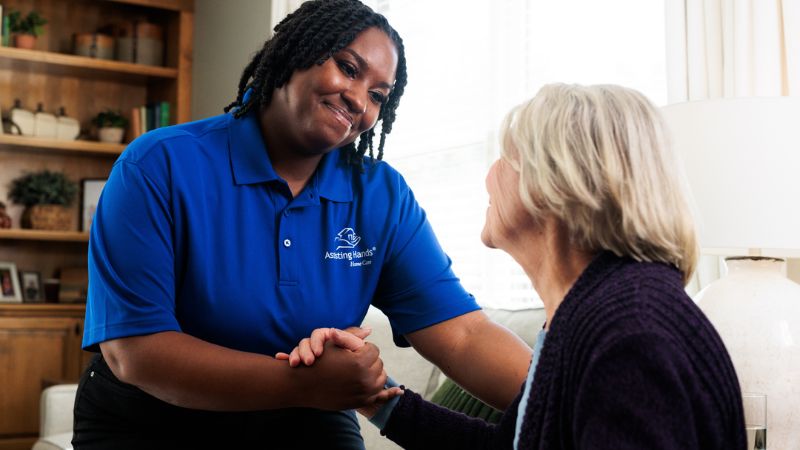
Assisting Hands Home Care can help families identify where support is needed, build a care plan around those needs, and adjust that plan as circumstances change. The goal is not simply to keep someone home regardless of the situation. It is to help them remain safely, comfortably, and meaningfully at home for as long as home continues to be the right place for them.
Contact Assisting Hands Home Care in Frisco to discuss your loved one’s needs today at (214) 609-1340.
Frequently Asked Questions About Home Care vs. Nursing Homes
Is home care cheaper than a nursing home?
Home care is often more affordable for seniors who need part-time or moderate assistance because families can pay for the hours of support actually needed. If someone requires continuous one-on-one care, the financial comparison can change.
What is the biggest advantage of home care?
For many families, the biggest advantage is flexibility. Care can be built around the senior’s actual needs without requiring them to give up their home and entire daily routine.
When does a nursing home make more sense?
A nursing home may be a better option when someone needs frequent skilled nursing, continuous supervision, extensive physical assistance, or a level of medical care that cannot safely be provided at home.
How many hours of home care does a senior need?
There is no standard number. The schedule should be based on where care gaps occur during a normal day. Some seniors may need only a few hours in the morning, while others need extended daily assistance.
What happens during a home care assessment?
A home care assessment should review daily routines, mobility, personal care, meals, transportation, cognitive changes, home safety, family involvement, and the times when assistance is most needed.
Can home care hours increase over time?
Yes. One of the advantages of home care is that schedules can often be adjusted as a senior’s needs increase or decrease.
Is home care appropriate for someone with dementia?
It can be, depending on the person’s stage of dementia and safety needs. Familiar surroundings and consistent routines may be helpful, but advanced dementia involving wandering, severe confusion, or continuous supervision may eventually require more intensive care.
Can home care help after a hospitalization?
Yes. A senior may temporarily need additional help with meals, dressing, bathing, mobility, transportation, and household routines while recovering at home.

