
A home care franchise sends trained caregivers into clients’ homes and can operate from a relatively small office, allowing it to launch with roughly $100,000 to $200,000 in startup capital without purchasing a facility. An assisted living business, by contrast, operates a licensed residential community. A purpose-built assisted living facility can require $2 million to more than $10 million in upfront investment before the first resident moves in. For many first-time senior care entrepreneurs, home care offers a lower barrier to entry, a potentially faster launch, and a more straightforward path to expanding into additional territories.
However, if you’re seriously considering investing in senior care, there’s more to the decision than startup costs. Both business models serve the same growing senior population, but they operate very differently. A home care franchise is primarily a service business, while an assisted living franchise combines residential real estate, facility operations, and healthcare-related services under one roof.
So, how does the home care franchise vs. assisted living franchise decision compare when you look at the factors that matter most to an investor? Let’s break down the key differences.
What Is the Difference Between a Home Care Franchise and an Assisted Living Franchise?
A home care franchise is a non-medical service business. Your agency recruits, trains, and schedules caregivers who help seniors in their own homes with bathing, dressing, meals, medication reminders, companionship, transportation, and dementia care. Clients pay by the hour, and your main assets are your caregiving team, your referral relationships, and your reputation.
An assisted living business is a residential facility. Seniors move in, pay a monthly fee, and receive housing, meals, supervision, and personal care under one roof. You own or lease the building, staff it around the clock, and answer to state regulators for everything from staffing ratios to fire safety.
How Much Does It Cost to Invest in a Home Care Franchise vs. Assisted Living?
This is where the two models separate most sharply.
Home Care Franchise Startup Costs
Home care franchises are among the more accessible opportunities in senior care because there's nothing to build. At Assisting Hands®, the initial franchise fee is $55,000 for a single territory, and the typical total startup investment in Wisconsin runs about $150,000 to $200,000+. That figure covers the franchise fee, office setup, and working capital. Discounts are available to qualified owners who buy additional territories.
For context, other national home care brands report total initial investments in a similar range. Senior Helpers lists $149,000 to $201,000. Amada Senior Care's 2023 disclosure document lists $115,150 to $270,200. The pattern holds across the category: a six-figure investment, most of it going into operating capital rather than property.
Ongoing fees matter too. Assisting Hands charges a sliding-scale royalty of 5% down to 4% of gross revenue, so the rate drops as your business grows. Lower royalty and ad fund contributions mean more of every dollar stays in your business.
For a detailed breakdown of franchise fees, working capital, and ongoing expenses, read our guide on how much it costs to open a home care franchise in Wisconsin.
Assisted Living Facility Investment Costs
The assisted living franchise cost story starts with the building. Recent construction benchmarks put ground-up assisted living at roughly $290 to $430 per square foot in 2026. Once you add land, design fees, permits, and furniture and equipment, industry analysts estimate total development costs of $325,000 to $450,000 per unit in most Midwest and Sun Belt markets.
In practical terms:
- A 30-bed purpose-built facility commonly requires $2 million to $5 million.
- Larger communities of 70 to 100 beds, which many operators consider the size needed for real economies of scale, can run $10 million or more.
- Converting an existing building is cheaper than building new, but it still runs well into seven figures for a facility of meaningful size.
- On top of construction, operators typically need $200,000 to $500,000 or more in working capital to cover payroll and expenses while the building fills.
It's also worth knowing that true franchised assisted living communities are relatively uncommon. Much of the industry is run by independent operators, real estate investment trusts, and management companies. Many of the "assisted living franchises" you'll see advertised are senior living placement or referral franchises. Those businesses help families find a community and earn a fee from the facility. Assisted Living Locators, for example, lists a total investment of about $74,600 to $94,500. That's a legitimate business, but it's a referral service, not an operating facility. Don't compare it apples-to-apples with owning a care business.
Home Care Franchise vs. Assisted Living: Investment Comparison
| Factor | Home Care Franchise (Assisting Hands) | Assisted Living Facility |
| Franchise fee | $55,000 | Varies; many facilities aren't franchised |
| Total initial investment | ~$150,000–$200,000+ | ~$2M–$10M+ |
| Working capital | Included in total investment | Often $200K–$500K+ on top of construction |
| Real estate needed | No, a small office | Yes, a licensed residential building |
| Typical time to open | 3–6 months | Often 18–36 months including construction |
| Main financial risk | Caregiver staffing and client growth | Occupancy against high fixed costs |
What Are the Real Estate and Facility Requirements for Each Senior Care Business?
A home care agency needs a modest office where you can interview caregivers, hold training, and meet referral partners. There's no build-out, no commercial kitchen, and no roof to replace. Your clients' homes are the care setting.
An assisted living operator is in the real estate business whether they want to be or not. The building must meet state physical plant standards including accessible bathrooms, fire suppression, emergency power, common dining, and activity space. It has to be maintained, insured, furnished, and kept compliant for as long as you own it. When the HVAC fails in January, that's your problem and your capital expense.
For many entrepreneurs, this is the deciding factor. Home care lets you build equity in a business. Assisted living requires you to finance and carry a large property before the business can start earning.
How Do Licensing Requirements and Startup Timelines Compare?
Both models are regulated, but the load is different.
Home care: Licensing rules vary by state. Some states require a specific agency license for non-medical home care, and others have lighter requirements. Assisting Hands provides regulatory guidance and compliance support as part of onboarding. Most of our franchisees launch within 3 to 6 months of their first introductory call, depending on licensing, caregiver hiring, and territory readiness.
Assisted living: Expect a much heavier process that includes state licensure, building code review, fire marshal inspections, zoning approvals, staffing plans, and resident care policies. All of this sits on top of a construction timeline that can take a year or more. In Wisconsin, assisted living settings are licensed and regulated through the Department of Health Services, and the rules differ by facility type and size. From signing to opening, two years or more is common for new construction.
Regulations change and are state-specific, so verify current requirements with your state health department before you commit to either model. Don't treat any article, including this one, as legal guidance.
What Are the Staffing and Daily Operations of a Home Care Franchise vs. Assisted Living?
Staffing is the hardest part of any senior care business, but the scope of the challenge is very different.
A home care owner focuses on recruiting, training, scheduling, and keeping good caregivers, plus building relationships with hospitals, rehab centers, physicians, and senior living communities that refer clients. Your office team can start small, often with the owner, a care coordinator or scheduler, and a growing bench of caregivers. You scale staffing as your client hours grow, so payroll tracks revenue.
An assisted living operator staffs a building 24 hours a day, 365 days a year, whether it's full or not. That means caregivers and med aides on every shift, plus nursing oversight, dietary staff, activities, housekeeping, maintenance, and an administrator who meets state qualification rules. A large share of payroll is fixed from day one.
The day-to-day life of the owner differs too. Home care owners spend much of their time on relationships, growth, and team culture. Assisted living owners spend more time on facility management, regulatory inspections, and keeping a large staff covered across three shifts.
Which Senior Care Franchise Offers Better Scalability and Growth Potential?
This is where home care has a structural advantage.
A home care agency grows by adding clients, caregivers, and service hours within your territory. When you're ready to expand further, you can add a territory with no second building to finance. Many Assisting Hands owners grow into multi-unit operators because the same systems, office team, and referral relationships can support neighboring markets. Assisting Hands has more than 200 territories across the U.S., and our exclusive territories are designed to give each owner room to grow.
An assisted living community is capped by its bed count. Once you're full, the only way to grow meaningfully is to build or buy another facility. That means another multi-million-dollar capital raise and another multi-year development cycle. Growth is possible, but it's slow and expensive.
Home Care Franchise vs. Assisted Living: Revenue and Profit Potential
The two models make money differently.
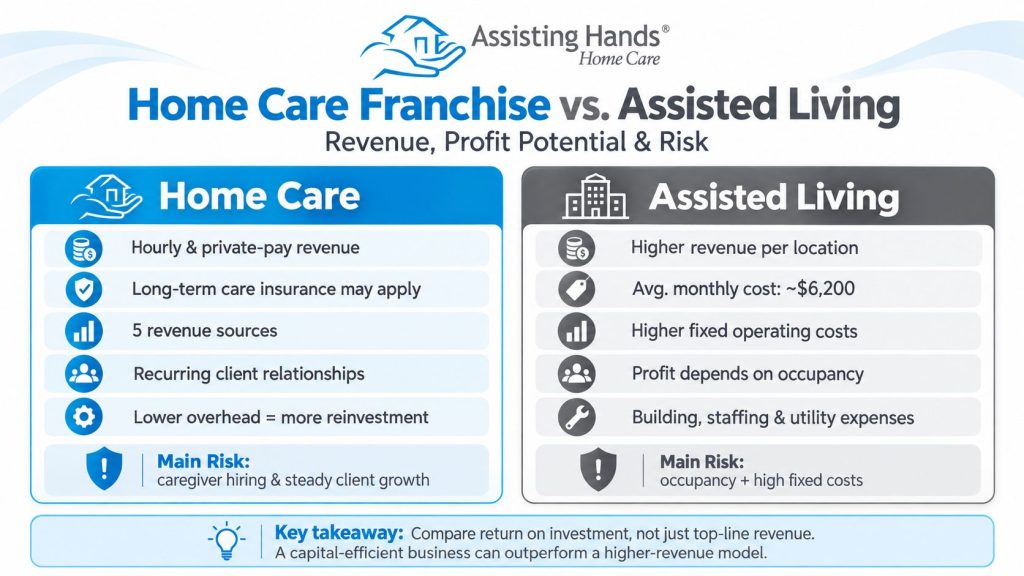
Home care revenue is mostly hourly and private-pay, with clients paying directly or through long-term care insurance. Depending on the state, veterans' benefits and Medicaid waiver programs can add to it. In Wisconsin, some agencies also work with programs like Family Care and IRIS. Assisting Hands owners can draw on five different revenue sources, and care relationships often last months or years, which creates a recurring revenue base. Because you aren't servicing a mortgage on a building, a larger share of revenue is available to reinvest in caregivers, marketing, and growth.
Assisted living generates more revenue per location. The national median monthly cost for assisted living was about $6,200 in 2025. But fixed costs are also far higher including debt service, property taxes, insurance, utilities, food, and round-the-clock payroll. Profitability depends heavily on keeping the building full.
Any franchisor's earnings claims are regulated under the FTC Franchise Rule and belong in Item 19 of the Franchise Disclosure Document (FDD). Assisting Hands provides Financial Performance Representations in our FDD for franchisees who have operated for more than one full year. Assisting Hands was named Most Profitable Franchise of 2022 by Franchise Business Review, an award based on franchise owner feedback. When you compare opportunities, look at return on the capital you invest, not just revenue per location. A business that earns well on $175,000 can be a stronger investment than one that earns more on $5 million.
What Are the Financial Risks of Investing in Home Care vs. Assisted Living?
Both models ride the same demographic wave. In Wisconsin alone, the population aged 75 and older is projected to grow from about 431,700 in 2020 to more than 607,000 by 2030. AARP surveys show that about 75% of older adults want to remain in their homes for the long term. That preference points demand toward home care.
The risks are different in kind:
- Home care risk centers on caregiver recruitment and retention and steady client growth. These are operational challenges that strong systems, training, and local support can address. Your downside is limited because your capital is limited.
- Assisted living risk centers on occupancy. Senior housing occupancy has recovered strongly and reached about 89.9% nationally in the second quarter of 2026. But the pandemic showed how fast that can change as occupancy fell to about 77.8% by mid-2021. When a building with millions in debt loses residents, the fixed costs don't shrink with it.
Put simply, assisted living concentrates risk in one large asset, while home care spreads it across a flexible, service-based operation.
Is a Home Care Franchise a Good Investment for First-Time Business Owners?
A home care franchise can be an appealing option for entrepreneurs who want to enter the senior care industry without purchasing a residential facility or building every operating system from scratch.
Franchise ownership provides access to an established brand, training, business systems, and ongoing support. The value of those resources depends on the franchise organization and the owner's ability to execute the business plan.
For someone transitioning from another industry, that support can be particularly valuable.
Franchise Owner Experience: Tyler and Shawna Field's Journey with Assisting Hands
In 2015, Tyler and Shawna Field made the decision to leave their established careers and open an Assisting Hands Home Care franchise in Brevard, Florida.
Tyler previously worked in the insurance industry, while Shawna was a registered dietitian. They saw an opportunity to build a business together while providing meaningful support to seniors and families in their community.
In their franchise owner testimonial, Tyler and Shawna share why they chose Assisting Hands, how their business has grown, and the support they have received throughout their journey.
Their experience also highlights something that matters to many prospective franchise owners: the opportunity to build a growing business while finding personal fulfillment in the work they do.
Watch Tyler and Shawna Field share their Assisting Hands franchise ownership experience.
If you're considering a home care franchise but aren't sure whether to join an established brand or build your own agency, read our comparison of independent home care agency vs. franchise ownership.
How Do You Choose Between a Home Care Franchise and an Assisted Living Investment?
The right senior care business model depends on your available capital, timeline, operating preferences, and long-term growth plans. Ask yourself these five questions before deciding between a home care franchise and an assisted living franchise:
- How much capital can you invest without financing real estate?
If you have low-to-mid six figures available, a home care franchise may offer a more accessible way to enter the senior care industry without taking on the cost of acquiring or developing a facility. - How quickly do you want to open?
Home care businesses can often begin serving clients within months, while assisted living facilities typically require a much longer timeline for site selection, financing, construction or renovation, licensing, and staffing. - How comfortable are you with facility and regulatory requirements?
Assisted living operators must manage facility inspections, building and safety codes, licensing requirements, and around-the-clock staffing. If you would rather focus on people, caregivers, and business development than facility operations, home care may align more closely with your strengths. - Do you want to expand into multiple locations?
Home care franchises can add territories without building a new residential facility for each one. Expanding an assisted living business, however, generally requires another property, significant capital, and another round of development and regulatory work. - What type of work do you find most rewarding?
If you enjoy building relationships, leading a team, developing referral networks, and growing a business within your community, home care may be a natural fit. If you have experience in real estate development, facility operations, or access to substantial investment capital, assisted living may better match your background and resources.
If your priorities are lower upfront capital requirements, a faster path to opening, and the ability to expand without constructing a new facility for every location, a home care franchise may align well with your goals. If you are prepared for a larger capital commitment and the complexities of developing and operating residential facilities, assisted living offers a different path into the senior care industry.
Assisted Living Franchise vs Home Care Franchise FAQs
Is a home care franchise or an assisted living franchise more profitable?
It depends on the operator and market, and franchisors can only make earnings claims through Item 19 of their FDD. That said, home care requires far less capital, often around $150,000 to $200,000 compared to millions for a facility. That can mean a stronger return on invested capital and a faster path to profitability. Review each franchisor's Item 19 for actual disclosed results.
How much money do I need to start a home care franchise?
For Assisting Hands in Wisconsin, the typical startup investment is about $150,000 to $200,000+, including the $55,000 franchise fee, office setup, and working capital. Other national home care brands report ranges from roughly $100,000 to $270,000. The FDD lists exact figures and any liquid capital or net worth requirements.
How much does it cost to open an assisted living facility?
A purpose-built assisted living community commonly costs $2 million to $5 million for about 30 beds, and $10 million or more for larger communities. Operators also need working capital, often $200,000 to $500,000 or more, to cover costs while the building fills. Senior living placement franchises cost far less, but they are referral businesses, not care facilities.
Which senior care franchise is easier to scale to multiple units?
Home care is generally easier to scale. You can add clients, caregivers, and territories using the same office systems and referral relationships, with no new construction. Growing an assisted living business requires building or acquiring additional facilities, each with its own capital raise and development timeline.
Do I need healthcare experience to own a senior care franchise?
Not for a non-medical home care franchise. Many successful Assisting Hands owners come from business, sales, and service backgrounds. We provide training in compliance, caregiver hiring, operations, and marketing, plus ongoing mentorship from a local Area Representative. Assisted living typically requires a state-qualified administrator, and owners without healthcare experience usually hire one.
Which is more recession-resistant, home care or assisted living?
Both serve need-driven demand from an aging population. Home care carries lower fixed costs, so it can adjust staffing to match client hours when conditions change. Assisted living depends on keeping occupancy high to cover large fixed costs, which made it more exposed during the pandemic, when national senior housing occupancy dropped sharply.
Explore Home Care Franchise Investment Opportunities in Wisconsin
The home care franchise vs. assisted living franchise decision comes down to capital, speed, and how you want to grow. Assisted living can be a strong business for developers with deep access to capital and a long time horizon. For entrepreneurs who want to own a senior care business, open within months, and grow territory by territory without betting everything on a building, home care is the more practical and capital-efficient path.
If you're exploring senior care franchise opportunities in Wisconsin, talk with Rich Ueberfluss, our Wisconsin Area Representative. He'll walk you through the investment, the FDD, and available territories. Request information here or call (262) 585-0330.