

Wisconsin’s senior population is growing faster than almost any other age group in the state, and the workforce that cares for them can’t keep up. One in four direct caregiver positions at Wisconsin nursing homes and assisted living communities now sits vacant, double the rate from just two years ago. For anyone weighing where to open a senior care business, whether that’s non-medical home care, personal care services, or a recognized senior care franchise, that gap is the opportunity.
Location decides more than almost anything else in this business. The right city gives you a deep pool of private-pay clients, a caregiver workforce you can actually hire from, and referral partners who will send you business. The wrong one means competing for the same shrinking pool of aides as three other agencies down the street.
This guide walks through why 2026 is a strong year to launch in Wisconsin, what separates a strong market from a crowded one, and the nine cities and regions worth the closest look. It closes with what licensing actually involves and answers to the questions we hear most from people exploring this path.
Why Wisconsin Is One of the Strongest States for Senior Care in 2026
Nationally, about 10,000 Americans turn 65 every day, a pace the U.S. Census Bureau expects to continue for close to another decade as the last of the baby boomer generation, roughly 70 million people, moves into retirement. Wisconsin is feeling that shift firsthand. Residents age 65 and older made up 19.1% of the state’s population in 2023, and within two decades roughly one in five residents will be in that age group. The state added about 400,000 seniors between 2010 and 2024 alone, close to a 50% increase in that population in a little over a decade. That growth isn’t slowing: the number of Wisconsinites 75 and older is projected to climb from roughly 432,000 in 2020 to more than 607,000 by 2030.
The supply side hasn’t kept pace. Wisconsin had more than 46,000 licensed nursing home beds in 2002 for about 143,000 elderly, blind, and disabled residents; today there are just over 26,000 licensed beds for nearly 270,000 people in that same category. One in four direct caregiver positions in the state’s nursing homes and assisted living communities is currently vacant, and the state is projected to need almost 10,000 additional elder care workers by the end of the decade just to hold current care levels steady.
That shortage is pushing more families toward home-based care. National research from AARP finds that roughly 75% of older adults want to remain in their own homes long-term rather than move into a facility, and the private-pay home care market is projected to grow from $75.6 billion in 2021 to $109.9 billion by 2026. Wisconsin already leads the nation in the number of licensed assisted living communities, with more than 4,150 statewide. Even that isn’t enough to absorb the demand, which is exactly why home care and non-medical senior care businesses have room to grow.
For a closer look at what’s driving that demand statewide, see Wisconsin: The Heart of Home Care Business Opportunities.
What Makes a City a Strong Fit for a New Senior Care Business
A large retiree population alone doesn’t make a city a good place to open a senior care agency.
Size and growth rate of the 65+ population: A large current base matters, but a fast-growing one matters more for a business you’re building for the next decade.
- Household income: Non-medical home care is largely private-pay in Wisconsin, so an area’s ability to afford quality care matters as much as its senior headcount.
- Existing competition: Some metro submarkets are already crowded with national home care brands; smaller cities and county seats are often underserved.
- Caregiver labor pool: You can’t serve clients you can’t staff. Areas near colleges, hospitals, or nursing programs make hiring easier.
- Referral relationships: Proximity to hospitals, senior centers, assisted living communities, and discharge planners drives a steady stream of client referrals.
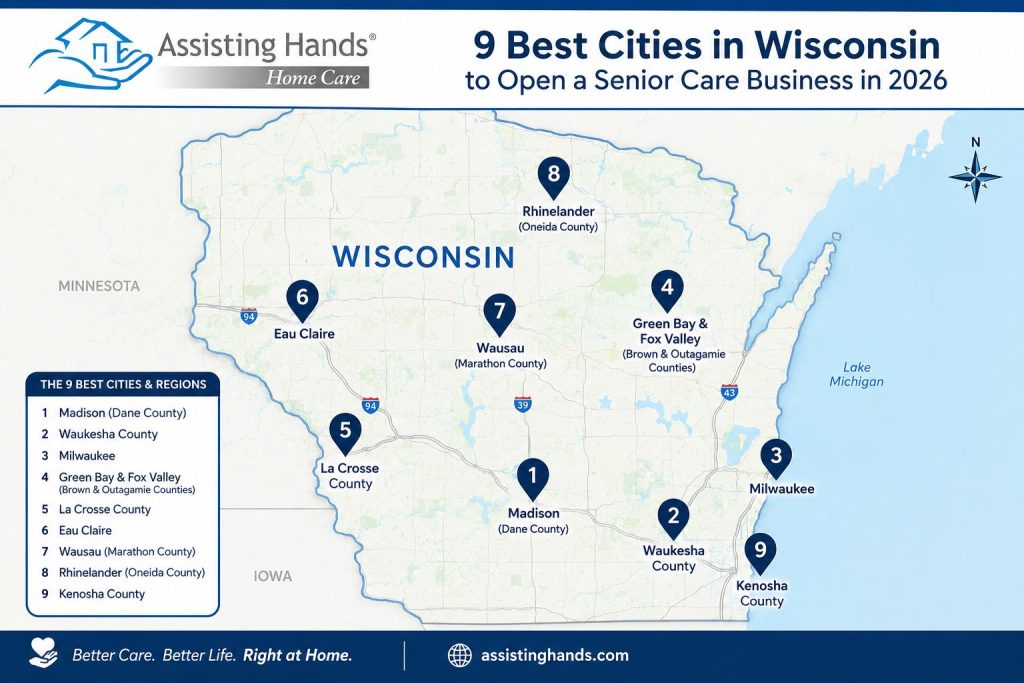
The 9 Best Cities in Wisconsin to Open a Senior Care Business in 2026
1. Madison (Dane County)
Madison combines a large senior population with real spending power. About 35,000 residents, or 12.7% of the city, are 65 or older, and Dane County’s population has grown nearly 11% since 2010, among the fastest in the state. Median household income sits around $77,000, and income among the 65+ population has climbed steadily over the past decade, supporting a healthy private-pay client base. Two major health systems and a large university create strong referral pipelines for a new agency.
2. Waukesha County
Just west of Milwaukee, Waukesha County is one of the wealthiest and fastest-aging suburban markets in the state: about 91,000 residents, or 21.8% of the county, are 65 or older. Higher-income suburbs like Brookfield, New Berlin, and Pewaukee are exactly the kind of private-pay market that supports premium home care pricing, without the saturation you’ll find in the city of Milwaukee itself.
3. Milwaukee
Wisconsin’s largest city offers the biggest single pool of potential clients in the state and the deepest network of hospitals, clinics, and discharge planners to build referral relationships with. Competition from national home care brands is heavier here than elsewhere, so success depends on carving out a neighborhood or niche, whether that’s a specific community, a language capability, or a specialty like dementia care, rather than competing head-on for the entire metro.
4. Green Bay & the Fox Valley (Brown & Outagamie Counties)
Green Bay and Appleton anchor a fast-growing regional economy with a steadily aging population: roughly 17% of Outagamie County is already 65 or older. The Fox Valley has a strong base of regional hospital systems and a lower cost of doing business than the Milwaukee or Madison metros, making it easier to reach profitability with a smaller client roster.
5. Door County
Door County has the highest concentration of seniors anywhere in Wisconsin: 31.5% of residents are 65 or older, and the median age is 54. It’s a smaller, seasonal market, but that’s exactly why it’s underserved: national home care chains rarely build a presence in a county this size, leaving a real opening for a locally focused operator who can handle both year-round residents and the seasonal retiree population that swells every summer.
6. Sheboygan County
Sheboygan sits along Lake Michigan with a stable, manufacturing-anchored economy and 18.8% of its population already 65 or older. It’s close enough to Milwaukee’s supply chains and training pipelines to make staffing manageable, while avoiding the intense agency competition of the metro itself.
7. Wausau (Marathon County)
As the commercial hub of central Wisconsin, Wausau serves a wide rural catchment area where senior care options are thin. Marathon County’s 65+ population sits around 18.5%, and its role as a regional healthcare center for the surrounding counties means an agency based here can realistically serve clients well beyond the city limits.
8. Eau Claire & La Crosse (Chippewa Valley & Coulee Region)
Western Wisconsin’s two largest cities are healthcare hubs in their own right, anchored by major regional health systems, and the surrounding region already skews older than the state average, a gap researchers expect to widen further by 2040. Rural counties surrounding both cities have some of the thinnest caregiver coverage in the state, making Eau Claire and La Crosse strong bases for an agency willing to serve a wider radius.
9. The Kenosha-Racine Corridor
Sitting in the growth corridor between Milwaukee and Chicago, Kenosha and Racine benefit from steady population growth and proximity to two major metro referral networks without the saturation level of either downtown market. It’s a strong fit for an operator who wants big-metro demand with a smaller-market cost structure.
Licensing & Getting Started in Wisconsin
Every agency providing home care services in Wisconsin needs a license from the Department of Health Services’ Division of Quality Assurance (DQA), even if you only serve private-pay clients and never bill Medicaid. Operating without one is a violation of state law. Which specific category you fall under depends on your service model:
- Home Health Agencies provide skilled, medical services and are governed by Wis. Admin. Code ch. DHS 133, with federal requirements under 42 CFR Part 484 if the agency also pursues Medicare certification.
- Personal Care Agencies (PCAs) provide non-medical assistance with daily living, such as bathing, dressing, meal preparation, and companionship, and are regulated under Wis. Admin. Code §§ DHS 105.17 and 107.112.
Non-medical, private-pay franchise models, including Assisting Hands Home Care in Wisconsin, operate under the Personal Care Agency path rather than the Home Health Agency path, since they don’t provide skilled nursing services.
For the PCA route, plan for roughly 90 days for initial application review. That initial approval is what allows most private-pay agencies to open and start seeing clients. If you also want to accept Medicaid or IRIS clients, you can then request an on-site survey within nine months of approval, and DQA has up to another 90 days after that survey to recommend Medicaid certification. Wisconsin’s Caregiver Law also requires background checks for every caregiver you employ and mandatory reporting of abuse, neglect, or misappropriation allegations to DQA. Build both into your hiring process from day one, since they’re non-negotiable, not optional paperwork.
Given the statewide caregiver shortage, your staffing plan deserves as much attention as your license application. Markets near colleges, technical schools, or CNA training programs will make hiring meaningfully easier than markets without one.
Ready to Open a Senior Care Business in Wisconsin?
Wisconsin’s aging population isn’t slowing down, and the caregiver shortage means the demand for quality senior care is only going to grow. Whether you’re drawn to Madison’s affluent, fast-growing market, an underserved county like Door or Marathon, or the Milwaukee-Chicago growth corridor, the opportunity is real. Getting the location, licensing, and staffing plan right from the start makes the difference between a business that struggles and one that thrives. And before you settle on a business model, it’s worth weighing the tradeoffs covered in Independent Home Care Agency vs. Franchise, since that choice shapes everything from your startup costs to how fast you can reach profitability.
Founded in 2006 in Boise, Idaho by Dr. Gail Silverstein and Cline Waddell, Assisting Hands Home Care has grown into a national franchise network built around a four-phase training program, a complete back-office software system, and Electronic Visit Verification (EVV) technology that keeps every caregiver visit documented and compliant. That operating model also gives owners room to build multiple revenue streams within a single senior care franchise, rather than depending on one service line to carry the business. Assisting Hands Home Care in Wisconsin works with entrepreneurs who want to open a senior care business backed by that established brand, proven operating systems, and local support instead of building everything from scratch.
In Wisconsin, that local support comes from Rich Ueberfluss, the Wisconsin Area Representative. He works directly with prospective and current franchise owners before, during, and after launch, and he’s available to answer your questions and mentor you through every step of getting started. If you’re serious about launching a home care business in Wisconsin in 2026, contact Assisting Hands Home Care in Wisconsin today for a consultation on the right market and next steps for you
Learn more: assistinghands.com/franchise-opportunity/wisconsin
Frequently Asked Questions
Is Wisconsin a good state to start a senior care business in 2026?
Yes. Wisconsin’s 65+ population grew nearly 50% between 2010 and 2024, the state already leads the nation in licensed assisted living communities, and one in four caregiver positions at existing facilities is vacant, a combination that points to unmet demand rather than an oversaturated market.
How long does it take to get a home care license in Wisconsin?
Initial DQA application review typically takes about 90 days. That approval lets a non-medical, private-pay agency open its doors. An on-site survey within nine months of approval and up to another 90 days for a Medicaid recommendation only apply if you plan to accept Medicaid or IRIS clients.
Do I need a nursing background to open a non-medical senior care business?
No. Non-medical home care and personal care agencies focus on companionship, personal hygiene, meal prep, and daily living support rather than skilled medical care, so a clinical license isn’t required to own the business, though you will need trained, background-checked caregivers on staff.
What’s the most underserved area for senior care in Wisconsin?
Rural counties and smaller regional hubs, including Door County, the area around Wausau, and the counties surrounding Eau Claire and La Crosse, tend to have the thinnest coverage, since national home care brands concentrate their presence in Milwaukee, Madison, and their immediate suburbs.
Can I open a senior care business in Wisconsin through a franchise?
Yes. Franchising with an established senior care brand gives you a tested operating model, training, and brand recognition from day one, which can shorten the runway to profitability compared to building an independent agency from scratch.
What kind of support does a senior care franchise like Assisting Hands provide?
Assisting Hands Home Care, founded in 2006 in Boise, Idaho, provides franchise owners with a four-phase training program, an all-in-one back-office software system for scheduling, billing, and client management, and Electronic Visit Verification (EVV) technology that documents caregiver visits for compliance. That structure is built to shorten the learning curve for owners who don’t come from a healthcare background.